
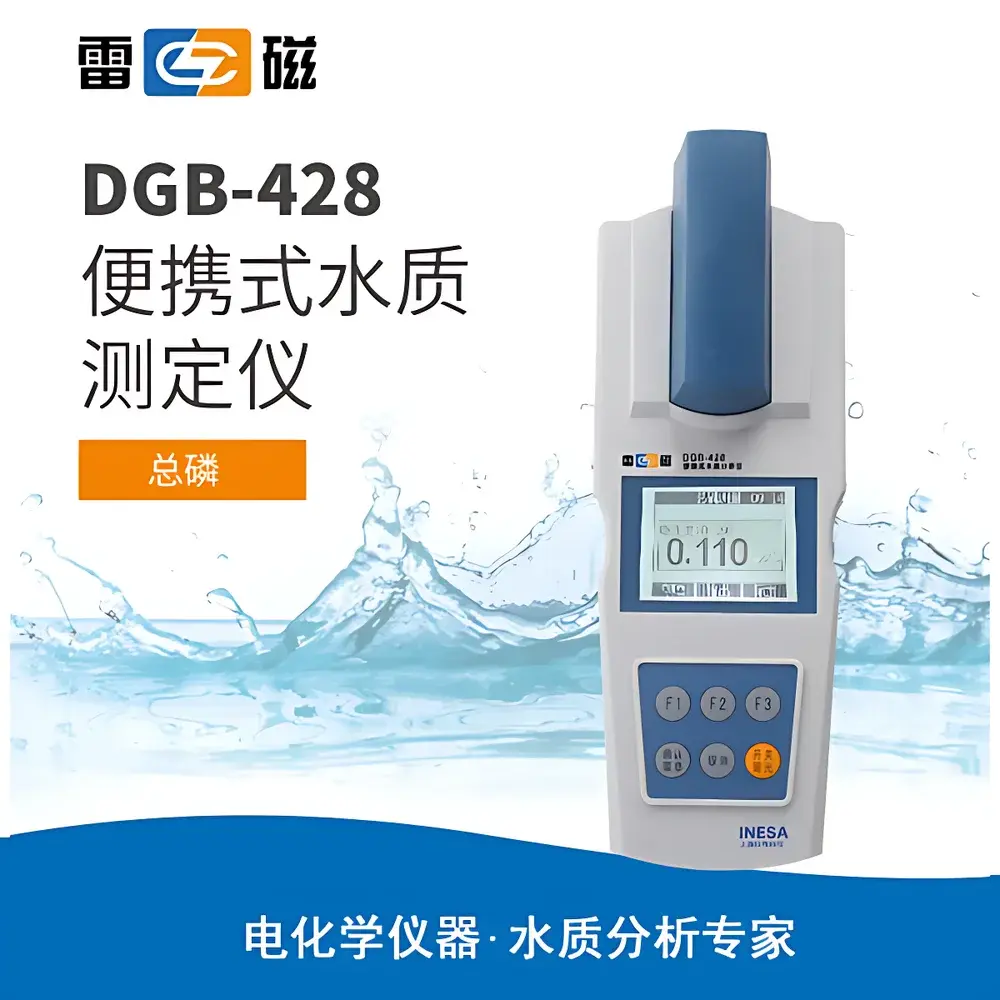
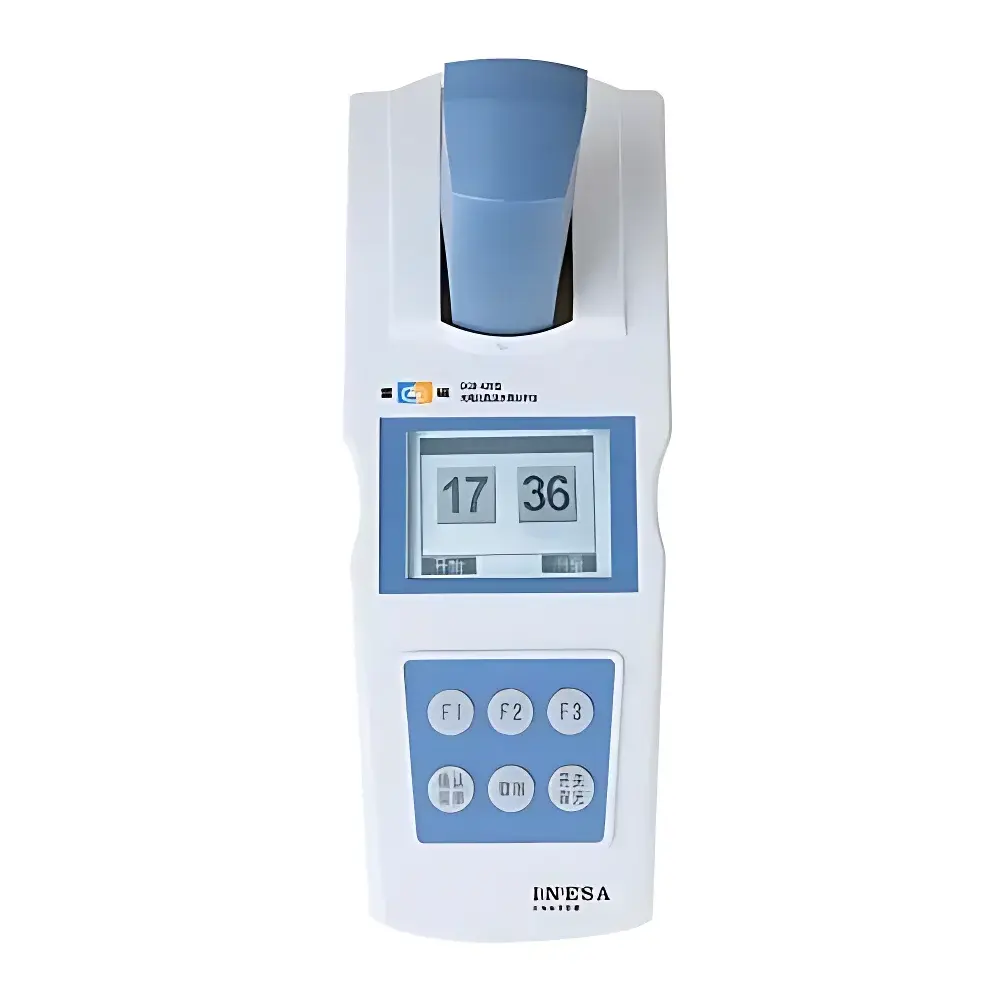
Leici DGB-428 Portable Total Phosphorus Analyzer
| Brand | Leici |
|---|---|
| Origin | Shanghai, China |
| Model | DGB-428 |
| Measurement Parameter | Total Phosphorus |
| Instrument Type | Portable |
| Measurement Principle | Molybdate Spectrophotometry (650 nm LED) |
| Measurement Range | 0.000–1.000 mg/L |
| Accuracy | ≤ ±10% |
| Detection Limit | 0.05 mg/L |
| Resolution | 0.001 mg/L |
| Calibration | Up to 5-point user-defined calibration |
| Display | Backlit LCD with adjustable contrast and backlight duration |
| Protection Rating | IP65 |
| Power Supply | 4 × AA alkaline batteries or USB 5 V DC |
| Interface | USB for data transfer, printer connection, and firmware update |
| Operating Environment | 5–35 °C, 0–85% RH |
| Dimensions | 220 × 85 × 50 mm |
| Weight | ~0.4 kg |
| Cuvette | 16 mm OD × 100 mm, 10 mL capacity |
| Data Management | GLP-compliant storage, review, deletion, and print export |
Overview
The Leici DGB-428 Portable Total Phosphorus Analyzer is an engineered field-deployable instrument designed for rapid, on-site quantification of total phosphorus (TP) in aqueous environmental matrices using standardized molybdate spectrophotometry. It operates at a fixed 650 nm LED light source—optimized for the characteristic absorption peak of the phosphomolybdate complex formed under acidic, oxidizing conditions—ensuring high specificity and minimal interferences from common water constituents. Unlike generic “colorimetric” or “other method” instruments, the DGB-428 implements a rigorously validated adaptation of ISO 6878:2004 and GB/T 11893–1989 methodologies, incorporating mandatory pre-digestion steps (e.g., potassium persulfate oxidation) prior to analysis—a prerequisite for accurate total phosphorus determination in natural and treated waters. Its compact architecture (220 × 85 × 50 mm, 0.4 kg), combined with dual power options (AA batteries or USB 5 V DC), enables uninterrupted operation during extended field campaigns, including remote sampling in rivers, reservoirs, wastewater treatment plants, and recreational water facilities.
Key Features
- Integrated 650 nm high-stability LED optical system with temperature-compensated photodetector for consistent absorbance measurement across ambient operating ranges (5–35 °C).
- Pre-programmed calibration curves compliant with national standard GB/T 11893–1989; supports up to five-point user-defined calibration for trace-level accuracy verification.
- IP65-rated enclosure ensures dust-tightness and resistance to low-pressure water jets—critical for outdoor deployment near wetlands, storm drains, or effluent discharge points.
- Backlit monochrome LCD display with adjustable contrast and programmable backlight timeout (1–60 s), optimized for readability under variable lighting (e.g., shaded stream banks or indoor lab benches).
- Direct cuvette-based measurement using standardized 16 mm OD × 100 mm glass tubes (10 mL volume); eliminates need for sample transfer or flow cells—reducing contamination risk and operator error.
- GLP-compliant data handling: timestamps, operator ID (optional input), calibration history, and measurement records stored internally (≥500 entries); exportable via USB to CSV-compatible software.
- Auto-hold function freezes stable readings after signal convergence (±0.002 AU over 2 s), eliminating subjective endpoint judgment.
- Firmware-upgradable architecture allows future integration of additional parameters (e.g., ammonia nitrogen, COD via permanganate method) without hardware modification—subject to regulatory validation.
Sample Compatibility & Compliance
The DGB-428 is validated for use with filtered or digested samples from diverse water types: surface water (rivers, lakes), municipal and industrial wastewater (pre- and post-treatment), reclaimed water for landscape irrigation, potable water (post-chlorination), and swimming pool water. All measurements require adherence to prescribed sample preparation protocols—including acid digestion with potassium persulfate at 120 °C for 30 min—to convert organic and condensed phosphates into orthophosphate prior to color development. The instrument meets functional requirements of ISO/IEC 17025:2017 for field instrumentation used in accredited environmental testing laboratories. While not certified to IEC 61000-6-2/6-3 for EMC, its design incorporates EMI-suppressed circuitry suitable for typical field electromagnetic environments (e.g., near pumps or telemetry transmitters). No CE, UKCA, or FDA 510(k) certification is claimed; users are responsible for local regulatory alignment (e.g., US EPA Method 365.4 equivalency assessment).
Software & Data Management
Data generated by the DGB-428 is stored with full audit trail metadata: date/time stamp, measurement mode (blank/reference/sample), calibration status flag, and operator identifier (manually entered). Internal memory retains ≥500 result sets with automatic overwrite protection for critical calibration logs. USB connectivity supports direct transfer to Windows-based PCs running Leici’s optional DGB-Series Data Manager v2.1 (freely downloadable), which generates PDF reports compliant with GLP documentation standards—including electronic signatures, revision-controlled templates, and export to LIMS via ODBC. Firmware updates are delivered as signed .bin files with SHA-256 checksums to ensure integrity; no cloud dependency or internet connection is required during installation. The device does not implement FDA 21 CFR Part 11 electronic signature functionality but provides sufficient traceability for non-GxP environmental monitoring programs.
Applications
- Regulatory compliance monitoring of TP discharges per national effluent limits (e.g., China’s GB 18918–2002 Class I-A standards).
- Trend analysis in eutrophication-prone watersheds—supporting early warning of algal bloom potential through routine grab sampling.
- Performance verification of tertiary phosphorus removal units (e.g., FeCl₃ coagulation, lanthanum-modified bentonite dosing).
- Drinking water safety checks post-filtration and pre-distribution, particularly in decentralized systems lacking central lab access.
- Educational field labs for environmental science curricula requiring quantitative, hands-on water chemistry training.
- Emergency response screening during agricultural runoff events or accidental fertilizer spills into receiving waters.
FAQ
What sample pretreatment is required for total phosphorus measurement?
All samples must undergo high-temperature alkaline persulfate digestion (120 °C, 30 min) to hydrolyze organic phosphorus and polyphosphates into orthophosphate prior to colorimetric analysis.
Can the DGB-428 measure orthophosphate directly without digestion?
No—the instrument is configured exclusively for total phosphorus; orthophosphate measurement requires a separate analytical protocol and calibration curve not provided with this model.
Is the 0.05 mg/L detection limit achievable in turbid or colored samples?
Turbidity > 5 NTU or intense yellow/brown coloration (e.g., humic-rich groundwater) may elevate baseline absorbance and compromise detection sensitivity; filtration (0.45 µm) and blank correction are mandatory.
How is calibration traceability maintained?
Calibration standards are prepared gravimetrically from certified reference materials (CRM) traceable to NIM (China National Institute of Metrology); certificates of analysis must accompany each batch used.
Does the device support battery-level monitoring during field use?
Yes—the LCD displays real-time battery voltage and provides low-battery warning (≤4.2 V) with 30-second grace period before auto-shutdown.







