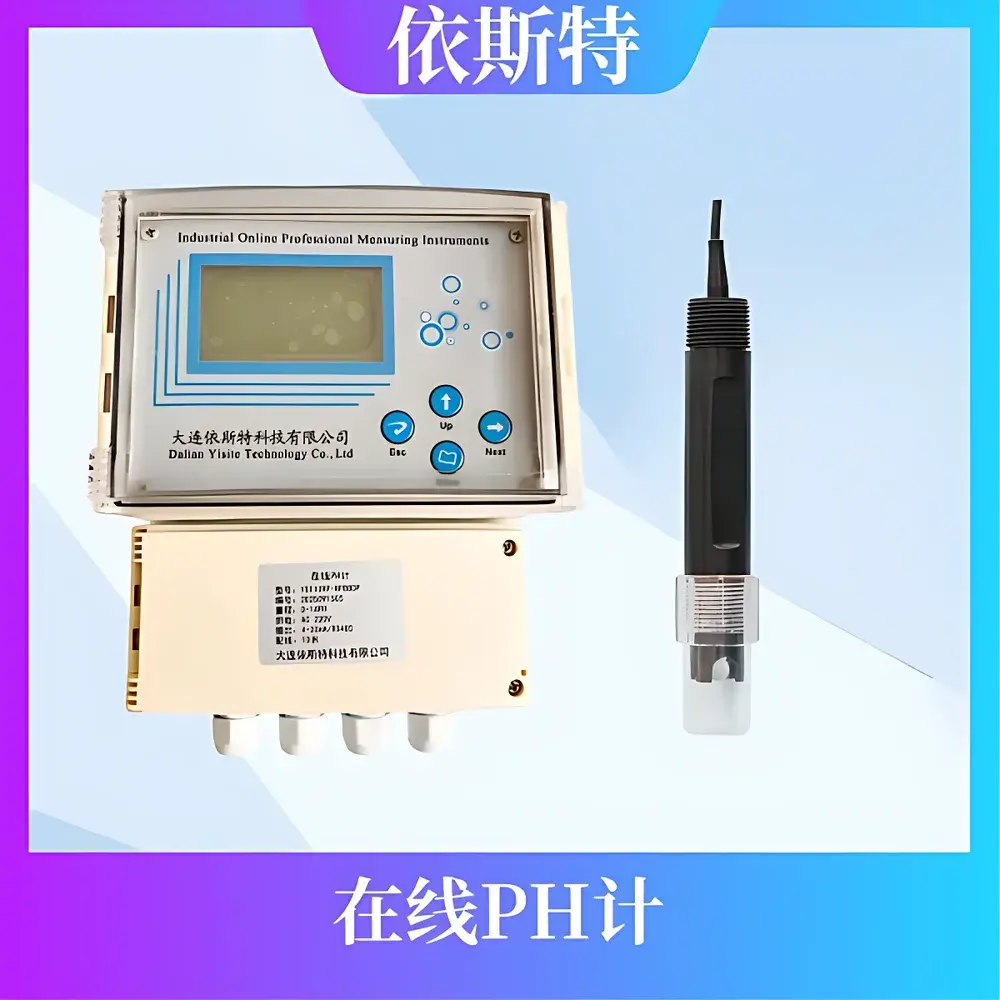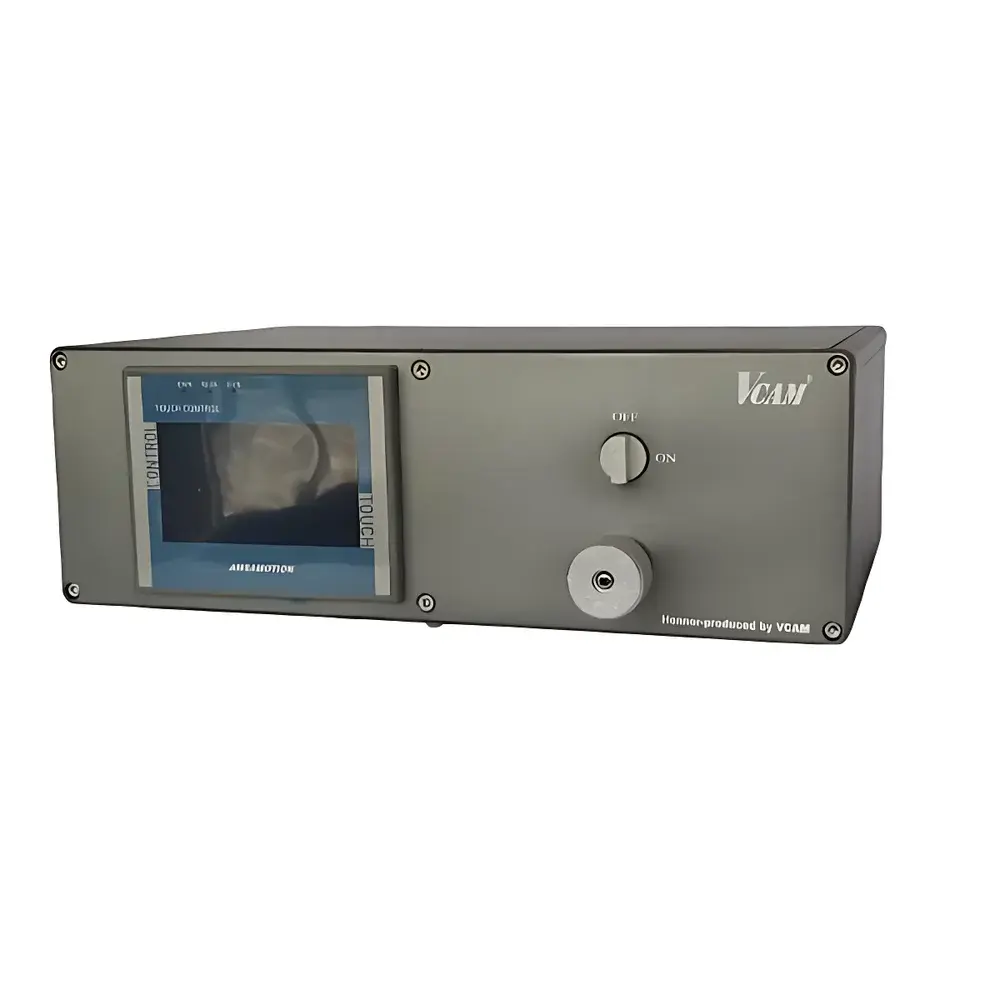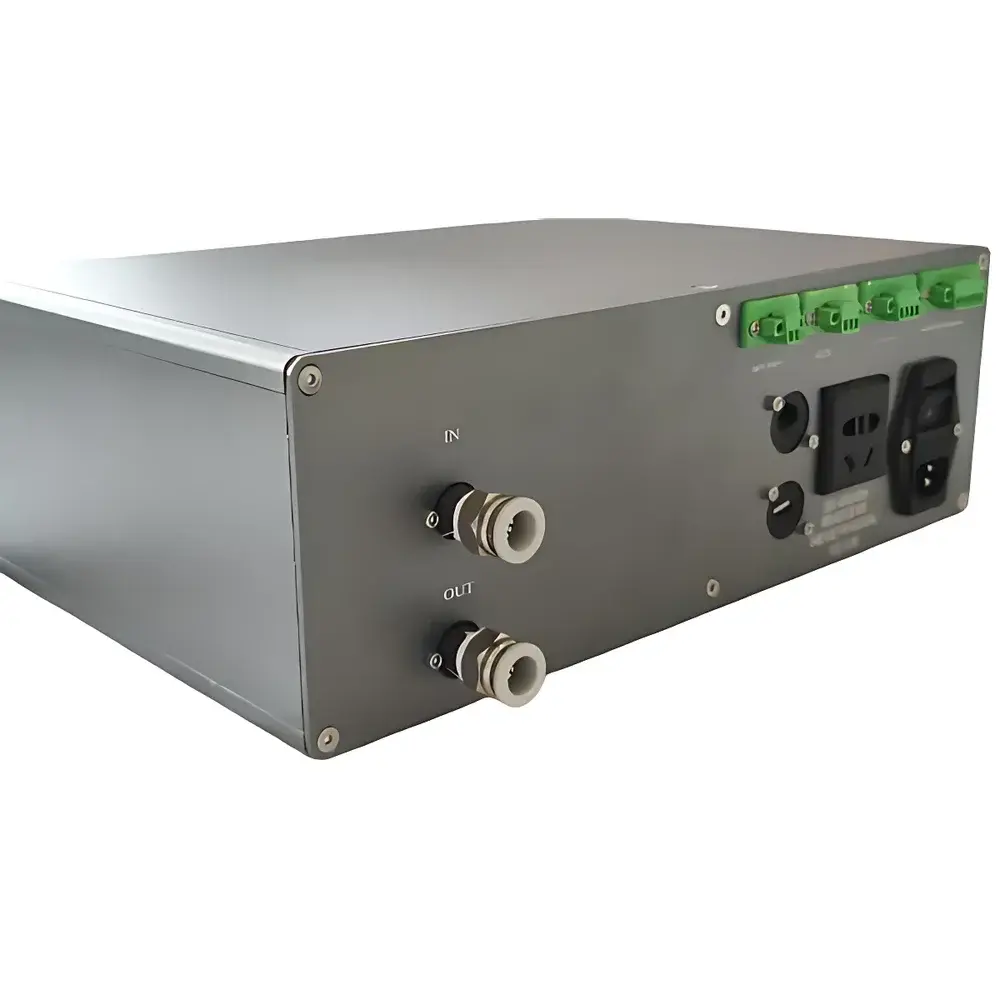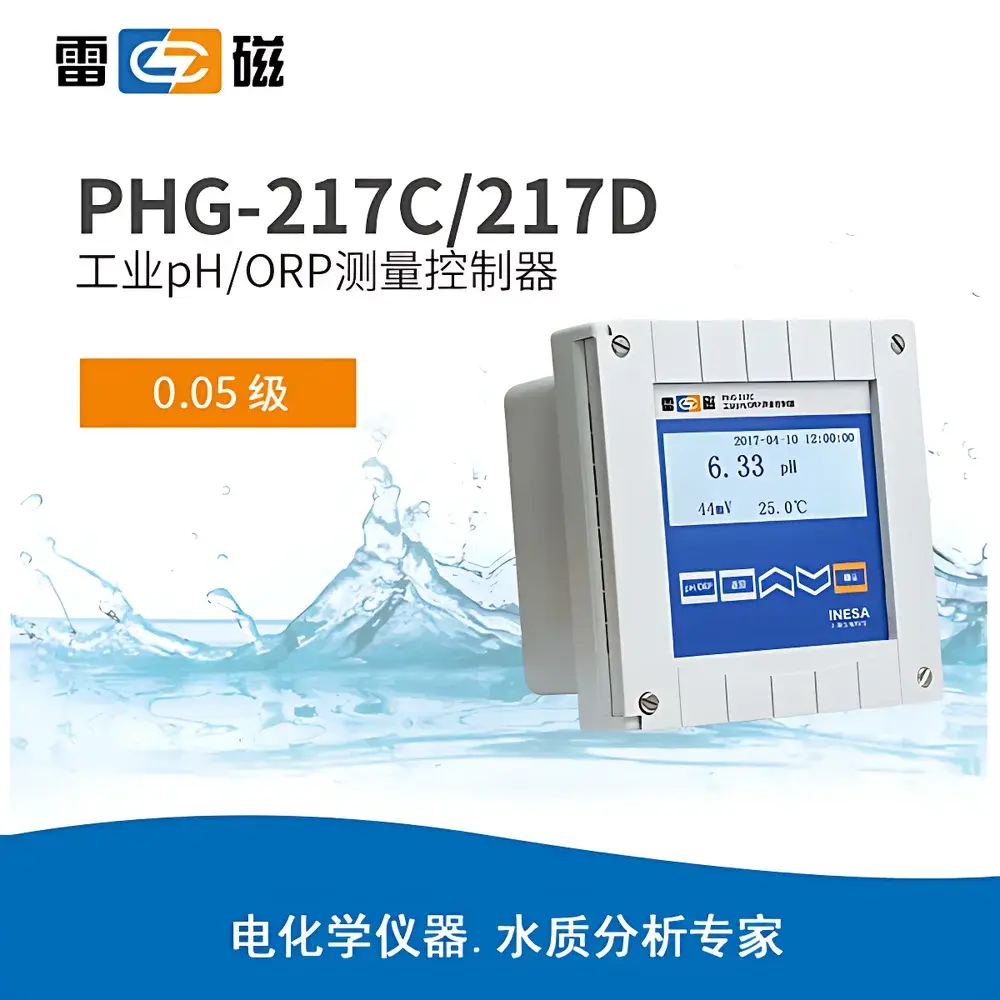
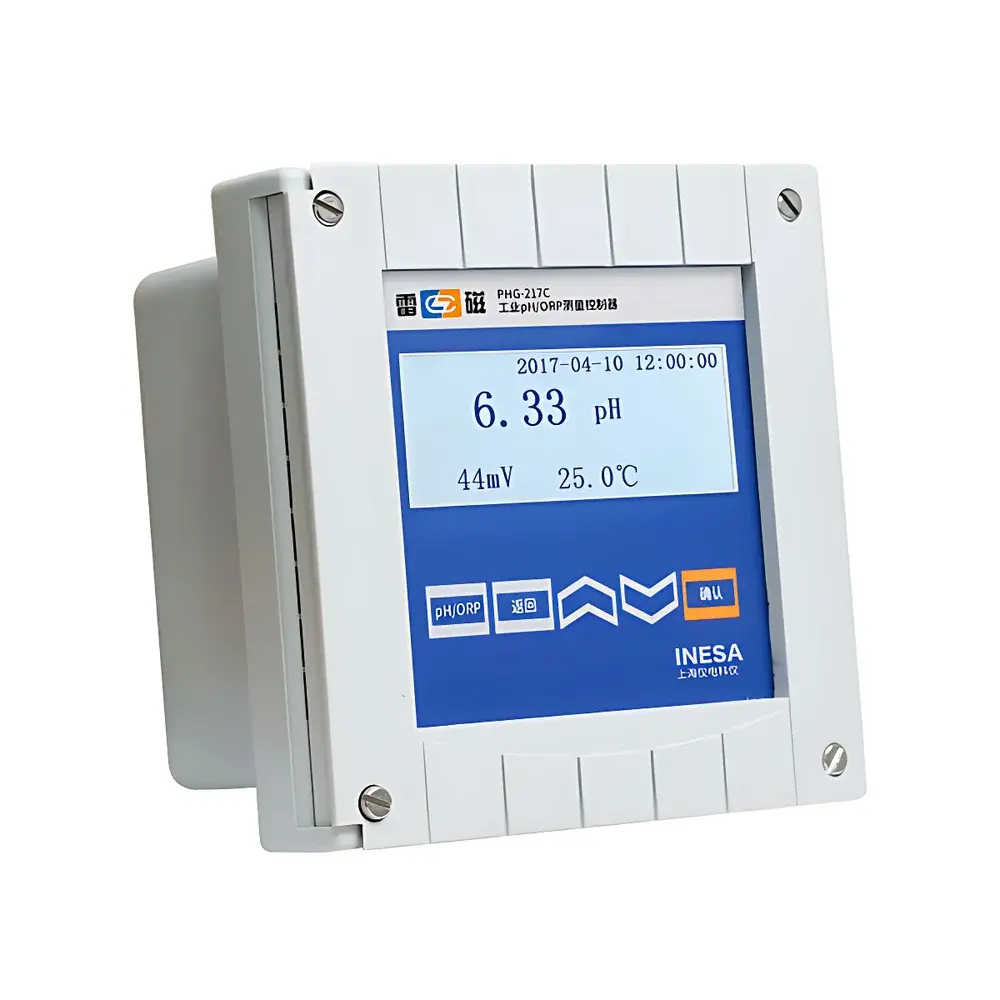
Leici PHG-217C / PHG-217D Industrial pH/ORP Transmitter and Controller
| Brand | Leici |
|---|---|
| Origin | Shanghai, China |
| Model | PHG-217C, PHG-217D |
| Measurement Range | pH (0.00–14.00), ORP (−1800–+1800 mV), Temperature (−10.0–120.0 °C) |
| Resolution | 0.01 pH, 1 mV, 0.1 °C |
| Accuracy | pH ±0.05 pH ±1 digit, ORP ±10 mV, Temp ±1.0 °C |
| Input Impedance | ≥1 × 10¹² Ω |
| Input Current | ≤2 × 10⁻¹² A |
| Stability | ≤±0.02 pH/24 h |
| Output | Isolated 4–20 mA DC (configurable span), RS-232 or RS-485 (user-selectable), 4 control relays |
| Data Storage | 400 records with programmable interval |
| Auto Calibration | Supports recognition of pH 4.00, 6.86, and 9.18 buffers |
| Temperature Compensation | Automatic (NTC or Pt100 sensor input) |
| Enclosure Rating | IP65 |
| Power Supply | AC 220 V ±10%, 50 Hz ±1% |
| Dimensions | 144 × 144 × 163 mm |
| Weight | 2.5 kg |
Overview
The Leici PHG-217C and PHG-217D are industrial-grade pH and ORP (Oxidation-Reduction Potential) transmitters engineered for continuous, high-reliability process monitoring in demanding environments. Designed around a robust analog front-end architecture and precision low-noise signal conditioning circuitry, these instruments employ high-input-impedance operational amplifiers (≥1 × 10¹² Ω) to minimize electrode loading effects—critical for stable measurement of high-impedance glass pH electrodes. The dual-model configuration addresses distinct installation topologies: the PHG-217C integrates an internal measurement board and is optimized for direct electrode connection in compact installations (e.g., inline flow cells with short cable runs), while the PHG-217D operates as a remote display and control unit requiring a compatible transmitter (e.g., PHGF-27B, PHGF-28B, or PHGF-43) with built-in preamplification—ideal for extended cable distances (>10 m) where signal integrity must be preserved prior to transmission. Both models comply with fundamental electrochemical measurement principles defined in ISO 7027 (for turbidity-correlated pH stability) and support traceable calibration practices aligned with ASTM D1293 and USP .
Key Features
- True dual-parameter capability: Simultaneous acquisition and switching display of pH, ORP, and temperature—each with independent scaling and alarm thresholds.
- Intelligent auto-buffer recognition: Identifies standard calibration solutions (pH 4.00, 6.86, 9.18) without manual selection; supports both single-point and two-point slope calibration with real-time slope and offset diagnostics.
- Programmable 4–20 mA isolated analog output: Fully configurable upper/lower range values per parameter (e.g., 0–14 pH mapped to 4–20 mA); includes fault signaling (e.g., 3.6 mA under sensor failure).
- Four SPDT control relays: Configurable as high/low alarms, pump triggers, or auto-clean cycle initiators—enabling closed-loop response to process excursions without external PLC intervention.
- Onboard data logging: Stores up to 400 timestamped measurement records (pH, ORP, temp, date/time) with user-defined sampling intervals (1 min to 24 h); data retained during power loss via non-volatile memory.
- Comprehensive environmental resilience: IP65-rated polycarbonate enclosure ensures protection against dust ingress and water jets—validated per IEC 60529—and rated for operation from −10 °C to 50 °C ambient.
Sample Compatibility & Compliance
The PHG-217 series interfaces with standardized industrial pH and ORP sensors (e.g., double-junction gel-filled, refillable liquid-junction, or solid-state electrodes) using universal BNC or DIN connectors. It accommodates common temperature sensing elements—including NTC thermistors (2.252 kΩ @ 25 °C) and Pt100 RTDs—enabling accurate automatic temperature compensation (ATC) across the full measurement range. Regulatory alignment includes support for audit-ready operations: all calibrations, alarms, relay activations, and parameter changes are time-stamped and stored locally. While not natively Part 11-compliant, the device’s deterministic behavior, non-erasable log structure, and hardware-based write protection facilitate integration into GLP/GMP workflows when paired with validated SCADA or DCS systems. It meets EMC requirements per IEC 61326-1 (industrial environment) and electrical safety per IEC 61010-1.
Software & Data Management
No proprietary PC software is required for basic operation; all configuration—including relay logic, analog output mapping, calibration parameters, and data logging settings—is performed via the intuitive backlit LCD interface with tactile membrane keys. For advanced integration, the RS-232 or RS-485 serial interface (Modbus RTU protocol, slave ID configurable) enables bidirectional communication with PLCs, HMIs, or centralized historian systems (e.g., Ignition, WinCC, or PI System). Logged data can be exported in CSV format via serial dump; no cloud connectivity or firmware OTA updates are implemented—ensuring deterministic firmware behavior and long-term validation stability. All configuration changes generate immutable event logs accessible on-screen or via serial query.
Applications
These transmitters serve critical monitoring roles across regulated and heavy-industry processes: continuous pH control in chemical reactor effluents and neutralization tanks; ORP monitoring for chlorine dioxide or ozone dosing in municipal wastewater treatment; boiler feedwater alkalinity tracking in thermal power plants; fermentation pH supervision in biopharmaceutical upstream processing; and rinse bath monitoring in semiconductor wet benches. Their relay outputs directly drive solenoid valves for reagent dosing or air-scour cycles in self-cleaning probe housings—reducing maintenance frequency in slurry or fouling-prone streams. The PHG-217D’s distributed architecture is routinely deployed in refinery desalting units where sensor locations are >30 m from control rooms, mitigating noise-induced drift.
FAQ
What is the difference between the PHG-217C and PHG-217D models?
The PHG-217C contains an integrated signal conditioning board and connects directly to pH/ORP electrodes—suitable for installations with electrode-to-instrument cable lengths ≤5 m. The PHG-217D lacks this board and must be used with a remote transmitter (e.g., PHGF-27B) that performs signal amplification at the sensor; it is intended for longer cable runs where signal degradation is a concern.
Does the instrument support NIST-traceable calibration?
Yes—calibration is performed using certified reference buffers (pH 4.00, 6.86, 9.18), and all calibration metadata (date, buffer IDs, slope, offset, temperature) is stored in non-volatile memory with time stamping.
Can the 4–20 mA output be assigned to ORP instead of pH?
Yes—each analog output channel is independently assignable to pH, ORP, or temperature, with fully customizable zero/span values.
Is temperature measurement mandatory for pH compensation?
Automatic temperature compensation (ATC) is enabled by default but can be disabled for manual compensation or fixed-temperature applications; the unit accepts either NTC or Pt100 inputs.
How is data integrity ensured during power interruption?
All logged measurements and system configurations reside in EEPROM with hardware write-protection; power-loss recovery preserves clock accuracy and resumes logging from the last valid interval without data corruption.