
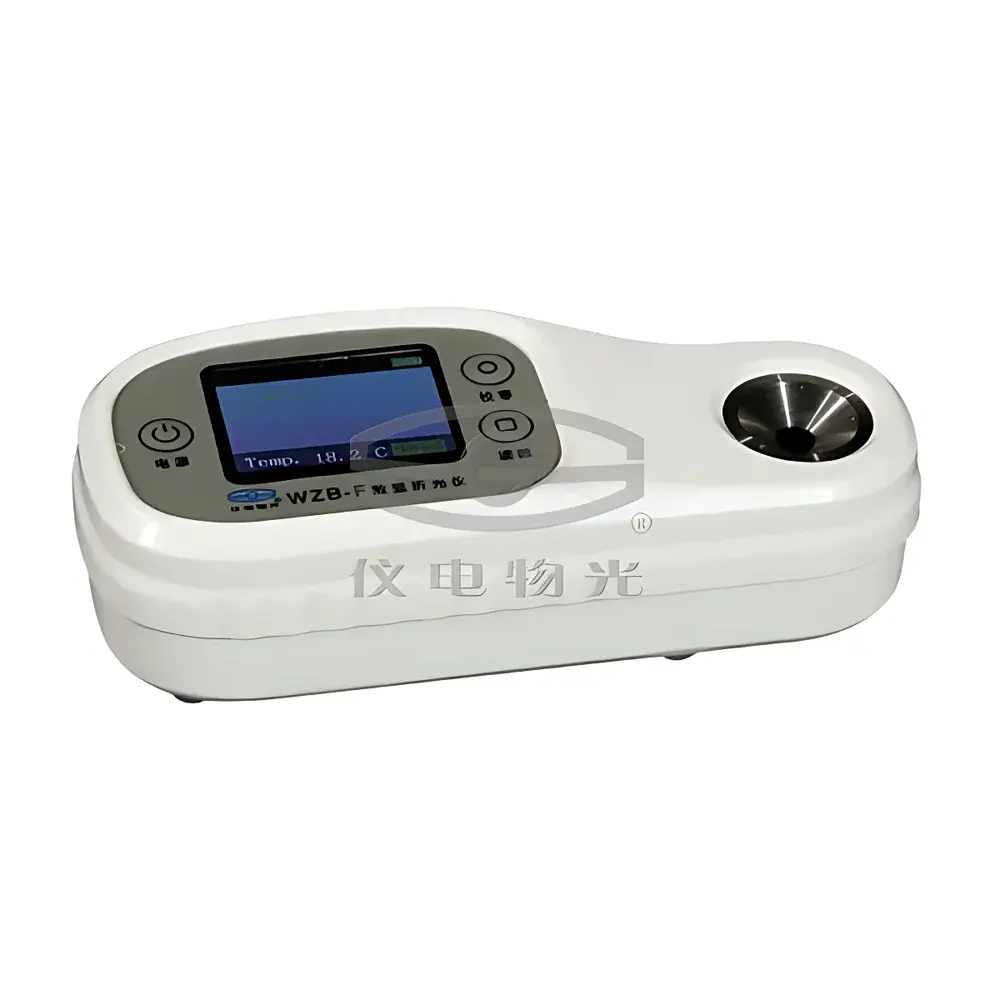
YDWG WZB-F Series IP65-Rated Portable Digital Refractometer
| Brand | YDWG |
|---|---|
| Origin | Shanghai, China |
| Product Type | Handheld Refractometer |
| Display | TFT Color Backlit LCD |
| Temperature Compensation | Automatic (ATC) |
| Measurement Ranges | Brix (0–92%), Honey (Brix 58–92%, Be° 38–43, IHC/GB water content), Salinity (0–28%), Sugar-Salinity Dual Scale, Wine (Brix, Potential Alcohol % v/v, Oe, KMW), Urine Specific Gravity (1.000–1.060), Serum Protein (0–14 g/dL), Ethanol (0–60% v/v or w/w), Soy Milk (0–35%), Antifreeze (Ethylene/Propylene Glycol, Battery Fluid SG, Windshield Fluid) |
| Accuracy | ±0.1–0.5% for Brix |
| IP Rating | IP65 |
Overview
The YDWG WZB-F Series IP65-Rated Portable Digital Refractometer is an optical instrument engineered for rapid, field-deployable measurement of refractive index (RI) and derived concentration parameters across diverse industrial, agricultural, clinical, and quality control applications. Based on the principle of total internal reflection at the prism-sample interface, the device determines RI with high reproducibility by detecting the critical angle shift induced by sample composition. This fundamental optical property correlates directly with solute concentration in homogeneous liquid solutions—enabling quantitative analysis of sugar (Brix), salt, alcohol, protein, glycol, and other analytes without chemical reagents or consumables. Designed for rugged daily use, the WZB-F series integrates automatic temperature compensation (ATC) using a built-in thermistor, ensuring stable readings across ambient conditions from 5 °C to 40 °C. Its compact, ergonomic housing—constructed from impact-resistant, environmentally compliant polymers—meets IP65 certification for dust-tightness and protection against low-pressure water jets, making it suitable for outdoor fieldwork, food processing lines, veterinary clinics, and mobile laboratory environments.
Key Features
- IP65-certified enclosure for reliable operation in humid, dusty, or splash-prone settings including wineries, apiaries, marine facilities, and agricultural fields
- TFT color backlit LCD display with high-contrast readability under variable lighting—including direct sunlight and low-illumination indoor conditions
- Multi-scale measurement capability: pre-programmed modes for Brix, honey (IHC2002/GB), salinity, sugar-salinity dual readout, wine parameters (Oe, KMW, potential alcohol), urine specific gravity, serum protein, ethanol (v/v and w/w), soy milk, and antifreeze (ethylene/propylene glycol, battery electrolyte, windshield fluid)
- Automatic temperature compensation (ATC) algorithm calibrated to standard reference curves per ISO 2173 and AOAC 932.12, minimizing manual correction errors
- User-definable zero-point calibration mode for traceability and adaptation to non-standard reference fluids or process-specific baselines
- Prism surface optimized for minimal light scatter and enhanced signal-to-noise ratio, supporting consistent resolution down to 0.0001 RI units
- Battery-powered operation (4×AAA, ~10,000 measurements per set) with auto-power-off and low-battery indicator
Sample Compatibility & Compliance
The WZB-F series accommodates aqueous and semi-viscous liquid samples including fruit juices, honey, brines, fermentation musts, urine, serum, antifreeze solutions, and windshield washer fluids. Sample volume requirement is ≤0.5 mL; no dilution or filtration is needed for clear or mildly turbid liquids. For viscous or particulate-laden samples (e.g., raw honey), brief warming to <40 °C and gentle homogenization are recommended prior to measurement. The instrument complies with general requirements for portable optical measuring devices under IEC 61010-1 (safety) and ISO 17025:2017 (when used within validated laboratory workflows). While not intrinsically certified for hazardous locations, its sealed construction supports use in non-explosive Class I, Division 2 environments per NEC guidelines. Data output adheres to GLP documentation principles, with user-defined ID tags and timestamped readings supporting audit readiness.
Software & Data Management
The WZB-F operates as a standalone instrument with no embedded Bluetooth or USB connectivity. All calibration, mode selection, and zeroing functions are executed via intuitive tactile buttons and on-screen prompts. Calibration is performed using distilled water (RI = 1.3330 at 20 °C) or NIST-traceable sucrose standards. Each unit ships with a calibration certificate indicating factory verification against primary refractive index standards. For regulated environments requiring electronic records, users may manually log results into LIMS or Excel-based QA templates. The device supports 21 CFR Part 11 compliance when integrated into documented procedures that include operator authentication, change control logs, and retention of calibration records—though native electronic signature functionality is not provided.
Applications
- Fruit juice and soft drink production: inline Brix verification during blending and pasteurization
- Beekeeping and honey grading: rapid assessment of moisture content per Codex Alimentarius Standard CXS 12-1981
- Seafood and aquaculture: salinity monitoring in hatcheries and transport tanks
- Veterinary diagnostics: urine specific gravity screening for renal function and serum protein estimation in canine/feline practice
- Automotive maintenance: ethylene/propylene glycol concentration and freeze point prediction for coolant systems
- Wine and cider making: Brix-to-alcohol conversion tracking and must ripeness evaluation per OIV methods
- Food service QA: soy milk solids content verification and battery acid density checks in commercial kitchens
FAQ
Does the WZB-F require periodic recalibration?
Yes—calibration with distilled water or certified reference standards is recommended before each measurement session or after significant ambient temperature shifts.
Can the WZB-F measure opaque or suspended samples?
It is optimized for transparent to slightly turbid liquids; heavy particulates or emulsions may require centrifugation or filtration to avoid prism contamination and optical interference.
Is ATC active across all measurement modes?
Yes—automatic temperature compensation is applied uniformly to all preloaded scales, using the same thermistor and algorithm per ISO 2173 Annex B.
What is the prism material and how should it be cleaned?
The prism is optical-grade BK7 glass with anti-scratch coating; clean gently with lens tissue and reagent-grade isopropanol—never abrasive cloths or acetone.
Are replacement calibration tools available?
YDWG supplies NIST-traceable Brix and RI reference solutions (5%, 10%, 30%, 60% sucrose) and certified distilled water vials for routine verification.




