
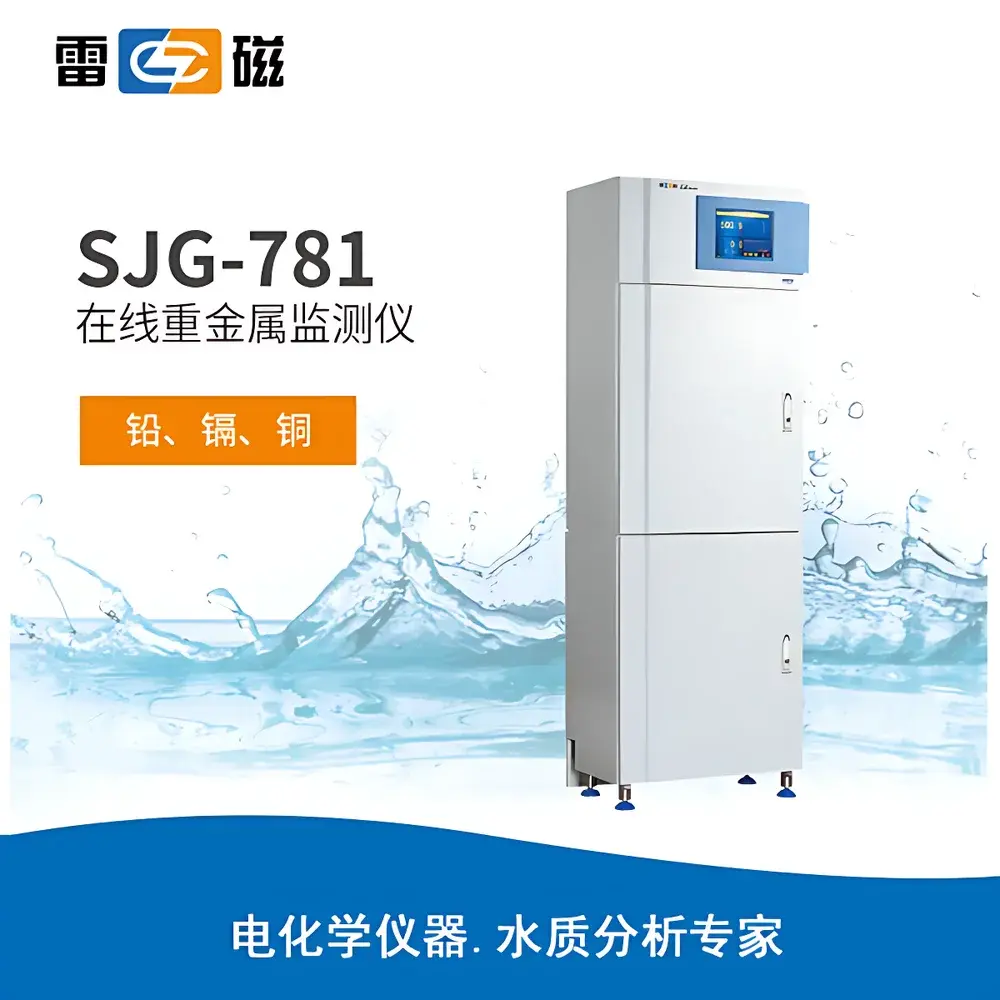
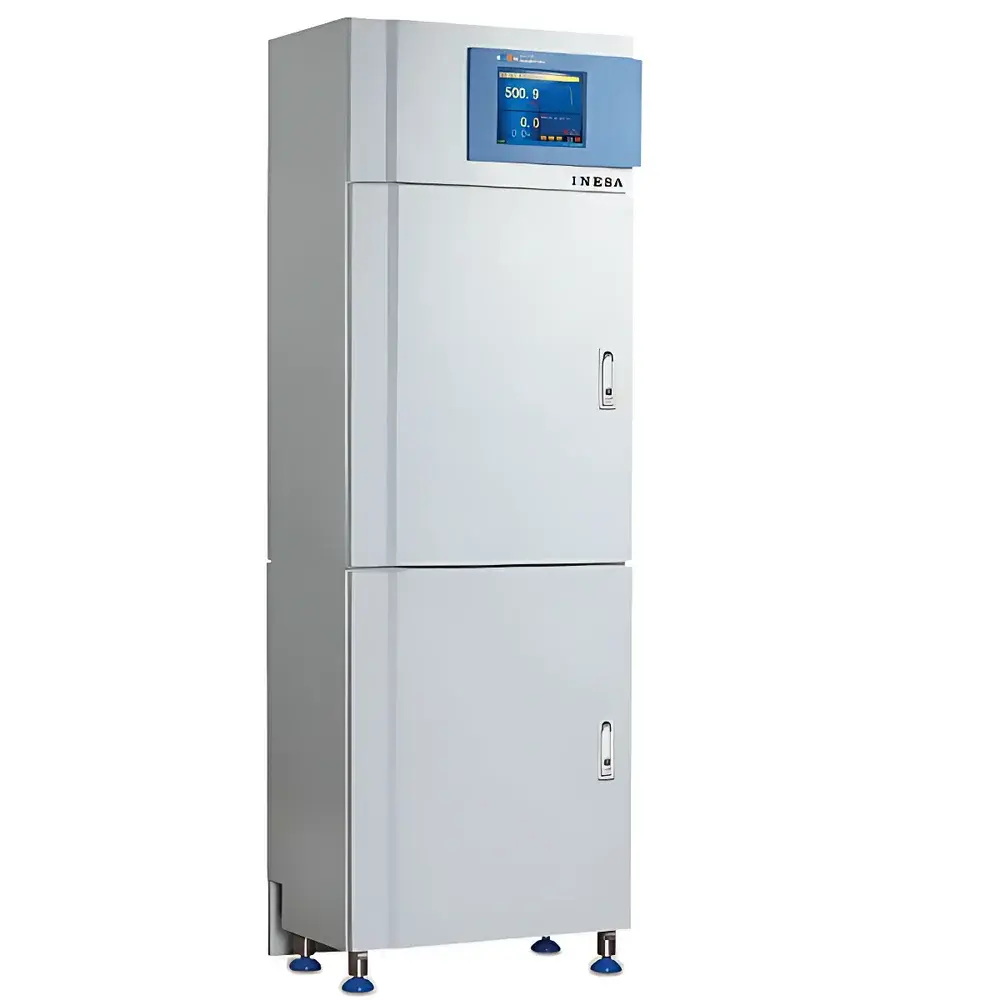
Leici SJG-781 Online Heavy Metals Analyzer
| Brand | Leici |
|---|---|
| Model | SJG-781 |
| Origin | Shanghai, China |
| Instrument Type | Online Analyzer |
| Detection Principle | Anodic Stripping Voltammetry (ASV) |
| Target Metals | Pb, Cd, Cu (dual/multi-parameter) |
| Accuracy | ±10% or ±5 µg/L (at ≤50 µg/L) |
| Resolution | 0.01 µg/L |
| Detection Limit | 1 µg/L |
| Measurement Range | 0–100 µg/L and 100–1000 µg/L per metal (expandable to 10 mg/L) |
| Repeatability | 5% |
| Zero Drift | ±5 µg/L/24 h |
| Span Drift | ±5%/24 h |
| Power Supply | AC 220 V ±10%, 50 Hz |
| Dimensions | 400 × 550 × 168 mm |
| Weight | 50 kg |
Overview
The Leici SJG-781 Online Heavy Metals Analyzer is an industrial-grade, fully automated water quality monitoring system engineered for continuous, real-time quantification of trace heavy metals—including lead (Pb), cadmium (Cd), and copper (Cu)—in aqueous matrices. It employs anodic stripping voltammetry (ASV), a well-established electrochemical technique recognized for its high sensitivity, selectivity, and suitability for low-concentration metal analysis in complex environmental samples. Unlike optical or atomic absorption-based systems, ASV enables direct measurement of dissolved metal ions at sub-ppb levels without requiring digestion or pre-concentration steps—making it ideal for unattended operation in municipal drinking water intakes, surface water monitoring stations, wastewater treatment plants, and industrial effluent discharge points. The instrument complies with GB/T 3914–2008, the Chinese national standard specifying performance criteria, validation protocols, and operational requirements for ASV-based heavy metal analyzers.
Key Features
- Triple-metal simultaneous or sequential detection capability for Pb, Cd, and Cu using mercury-film or bismuth-film modified working electrodes—optimized for interference minimization and long-term electrode stability.
- Integrated photometric liquid-level sensing system ensures precise reagent metering and dosing accuracy across extended operational cycles.
- 7-inch color TFT-LCD touchscreen interface with intuitive Chinese-language navigation—designed for field technicians with minimal electrochemical training.
- Automated operational sequence: auto-calibration (manual, time-scheduled, or interval-triggered), auto-sampling, auto-measurement, and auto-cleaning—reducing manual intervention and operator dependency.
- Configurable measurement modes including single-step hardware debugging, parameter customization (e.g., deposition time, scan rate, pulse amplitude), and user-defined alarm thresholds (upper/lower concentration limits).
- Robust mechanical architecture with IP54-rated enclosure; designed for installation in non-climate-controlled environments such as pump stations, inline process lines, or outdoor kiosks.
Sample Compatibility & Compliance
The SJG-781 is validated for use with raw and treated freshwater, surface water, municipal wastewater, and industrial effluents—with demonstrated performance across pH 4.0–9.0 and turbidity ≤100 NTU. Sample filtration (≤5 µm) is recommended prior to inlet to prevent sensor fouling. While not certified to ISO 17025 or EPA Method 7063, its analytical methodology aligns with the electrochemical principles referenced in ASTM D3559 (for Pb), ASTM D3597 (for Cd), and ISO 8692 (for Cu in aquatic toxicity testing). Data integrity meets basic GLP documentation requirements: all calibration events, measurement timestamps, raw voltammograms, and system diagnostics are permanently timestamped and stored onboard.
Software & Data Management
Onboard firmware supports local data retention of ≥100,000 measurement records with automatic overwrite protection. All datasets include metadata: sample ID, calibration status, electrode health flag, temperature-compensated current response, and peak identification confidence score. Communication interfaces include one configurable port—either RS-232 (for local PC connection and firmware updates) or RS-485 (for Modbus RTU integration into SCADA or DCS platforms). Export formats include CSV and plain-text log files compatible with LIMS and regulatory reporting tools. Audit trail functionality logs user actions (e.g., calibration initiation, parameter modification, alarm acknowledgment) with operator ID and timestamp—supporting internal QA review and basic 21 CFR Part 11 readiness when paired with external identity management.
Applications
- Drinking water source surveillance: early-warning detection of Pb/Cd contamination from aging infrastructure or upstream industrial releases.
- Municipal wastewater treatment: monitoring influent metal loading and evaluating removal efficiency across coagulation/filtration stages.
- Industrial compliance monitoring: continuous verification of discharge limits for battery manufacturing, electroplating, and metal finishing facilities.
- Environmental remediation sites: tracking metal leaching dynamics in groundwater plumes or sediment pore water.
- Recycled water reuse programs: ensuring Cu/Pb concentrations remain below WHO and local regulatory thresholds for irrigation or industrial cooling applications.
FAQ
What electrochemical method does the SJG-781 use, and why is it suitable for online deployment?
It uses anodic stripping voltammetry (ASV), which offers high sensitivity (sub-µg/L LOD), low reagent consumption, and minimal maintenance—critical for unattended operation in remote or semi-automated water networks.
Can the instrument measure additional metals beyond Pb, Cd, and Cu?
The core configuration supports only Pb, Cd, and Cu. Expansion to other metals (e.g., Zn, As, Hg) would require electrode redesign, recalibration, and method validation—not supported under standard firmware.
Is the system compliant with international regulatory standards such as EPA or ISO methods?
It conforms to GB/T 3914–2008 and implements ASV principles consistent with ASTM and ISO reference methods—but lacks formal third-party certification for EPA or EU WFD compliance.
How frequently does the system require maintenance or electrode replacement?
Electrode lifetime exceeds 6 months under typical surface water conditions; cleaning cycles occur automatically every 2–4 hours depending on sample matrix, and full maintenance is recommended quarterly.
Does the analyzer support remote diagnostics or over-the-air firmware updates?
No—firmware updates require physical USB or RS-232 connection; remote diagnostics are limited to status polling via Modbus register reads.
Related Products







