
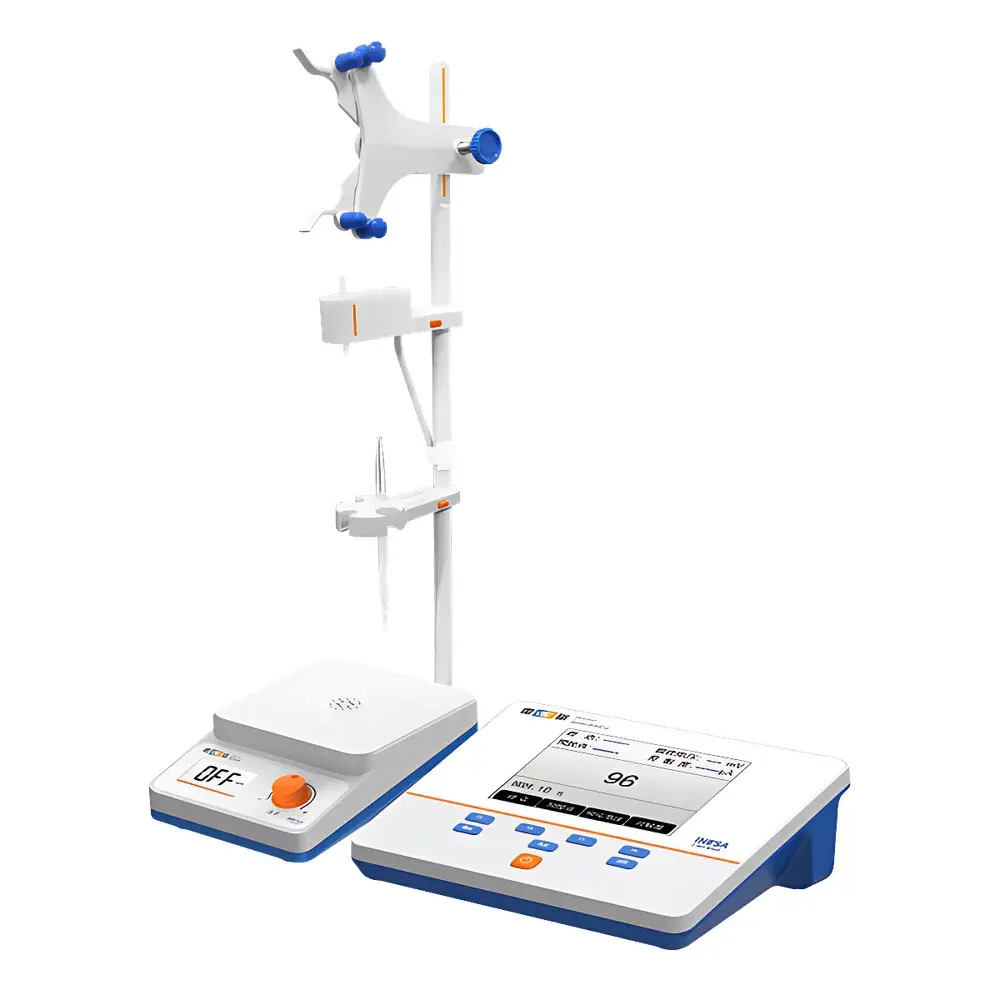
Leici ZDY-500 Automatic Dead-Stop Titration System
| Brand | Leici |
|---|---|
| Origin | Shanghai, China |
| Model | ZDY-500 |
| Instrument Type | General-Purpose Dead-Stop Titrator |
| Measuring Range | 0–10 mL and 0–25 mL burette capacity |
| Electrode Current Detection Sensitivity | 10⁻⁹ A to 10⁻⁶ A (4-step selection) |
| Polarization Voltage Settings | 30 mV, 50 mV, 100 mV |
| Endpoint Current Threshold Settings | 0.001 µA, 0.01 µA, 0.1 µA, 1 µA |
| Endpoint & Pre-Control Point Range | 0–100 (arbitrary units) |
| Delay Time Setting | 0–200 s |
| Measurement Repeatability Error | ±0.2% FS |
| Polarization Current Detection Error | ±2% FS |
| Operating Temperature | 5–30 °C |
| Power Supply | AC 100–240 V input / DC 24 V output |
| Dimensions (W×D×H) | 218 × 180 × 66 mm |
| Weight | 0.7 kg |
Overview
The Leici ZDY-500 Automatic Dead-Stop Titration System is a dedicated electrochemical titrator engineered for high-reproducibility endpoint detection in redox, argentometric, and other current-based titration methods. Unlike potentiometric titrators that monitor potential shift, the ZDY-500 operates on the dead-stop (biamperometric) principle: two identical platinum electrodes are polarized at a fixed voltage, and the system continuously monitors the diffusion-controlled current across the cell. At the stoichiometric endpoint, a sharp discontinuity in current—caused by the abrupt change in oxidant/reductant concentration—triggers automatic termination of titrant delivery. This method delivers intrinsic robustness against junction potentials, liquid junction errors, and electrode drift, making it particularly suitable for non-aqueous titrations, low-conductivity media, and applications where reference electrode stability is compromised.
Key Features
- High-contrast monochrome LCD display with intuitive menu navigation and real-time current monitoring
- Four-step polarization current sensitivity selection (10⁻⁹ A to 10⁻⁶ A), enabling precise adaptation to analyte concentration and electrode geometry
- Three programmable polarization voltage settings (30 mV, 50 mV, 100 mV) to optimize signal-to-noise ratio across diverse redox couples
- Adjustable endpoint threshold (0–100 arbitrary units), pre-control point (0–100), and post-endpoint delay (0–200 s) for fine-tuned kinetic compensation
- Hybrid operation mode: seamless switching between manual titration (for method development or troubleshooting) and fully automated endpoint-driven titration
- Integrated slow-drip algorithm activated upon rapid current gradient detection, minimizing overshoot and improving volumetric precision
- Standard configuration includes JB-11 magnetic stirrer, capillary delivery tube, dual-platinum microelectrode assembly, and compatibility with externally mounted 10 mL or 25 mL Class A glass burettes
Sample Compatibility & Compliance
The ZDY-500 supports a broad range of dead-stop titration protocols defined in pharmacopoeial and industrial standards, including USP , EP 2.2.20, and Chinese Pharmacopoeia ChP IV. It is routinely deployed for assay of sodium thiosulfate, potassium bromate, vitamin B₁₂, and chloride in pharmaceutical excipients; quantification of residual peroxide in polymer stabilizers; and determination of iodine value in fats and oils (AOCS Cd 1c-85). The instrument’s design conforms to IEC 61010-1 safety requirements for laboratory electrical equipment. While not natively compliant with FDA 21 CFR Part 11, its operational parameters—including endpoint logs, titrant volume records, and user-initiated timestamps—can be exported in CSV format for integration into validated LIMS or ELN environments supporting audit-trail requirements under GLP/GMP frameworks.
Software & Data Management
The ZDY-500 operates via embedded firmware without external PC dependency. All method parameters—including polarization voltage, sensitivity level, endpoint threshold, pre-control point, and delay time—are stored in non-volatile memory with up to 10 user-defined method slots. Each titration cycle automatically records final volume, endpoint current value, elapsed time, and operator ID (manually entered per session). Data export is supported via USB port to standard flash drives in plain-text CSV format, preserving column headers such as “Method_ID”, “Burette_Volume_mL”, “Endpoint_Current_nA”, “Date_YYYYMMDD”, and “Time_HHMMSS”. No proprietary software installation is required for data retrieval or archival, ensuring long-term accessibility and interoperability with third-party statistical analysis tools (e.g., JMP, Minitab, Python pandas).
Applications
- Pharmaceutical QC: Quantitative assay of oxidizable APIs (e.g., epinephrine, hydroquinone) and titrants (e.g., ceric sulfate, potassium iodate)
- Food & Beverage: Determination of sulfite content in wine and dried fruits per AOAC 995.12
- Chemical Manufacturing: Monitoring residual chlorine in caustic soda production and peroxide decomposition kinetics
- Academic Research: Teaching biamperometric principles in analytical chemistry laboratories; validating redox mechanisms via current transient analysis
- Environmental Testing: Trace iodide quantification in seawater samples using catalytic amplification protocols
FAQ
What distinguishes dead-stop titration from potentiometric titration?
Dead-stop titration relies on current measurement under constant polarization voltage, whereas potentiometric titration measures potential difference at zero current. Dead-stop is inherently insensitive to liquid junction potentials and reference electrode instability, offering superior reproducibility in non-aqueous or low-ionic-strength systems.
Can the ZDY-500 be used with non-aqueous solvents?
Yes—provided the solvent supports sufficient ion mobility for measurable diffusion current and does not degrade the platinum electrodes or capillary tubing. Common compatible media include glacial acetic acid, acetone, and methanol–water mixtures.
Is calibration traceable to national standards?
The instrument does not require routine electrical calibration. Its volumetric accuracy depends on the certified Class A burette used externally; users must verify burette calibration per ISO 648 or ASTM E287. Current sensitivity is factory verified against NIST-traceable picoammeter references.
Does the system support GLP-compliant electronic signatures?
No—the ZDY-500 lacks user authentication, role-based access control, or electronic signature functionality. For regulated environments, data must be manually transcribed or integrated into a compliant LIMS with supplementary validation documentation.






