
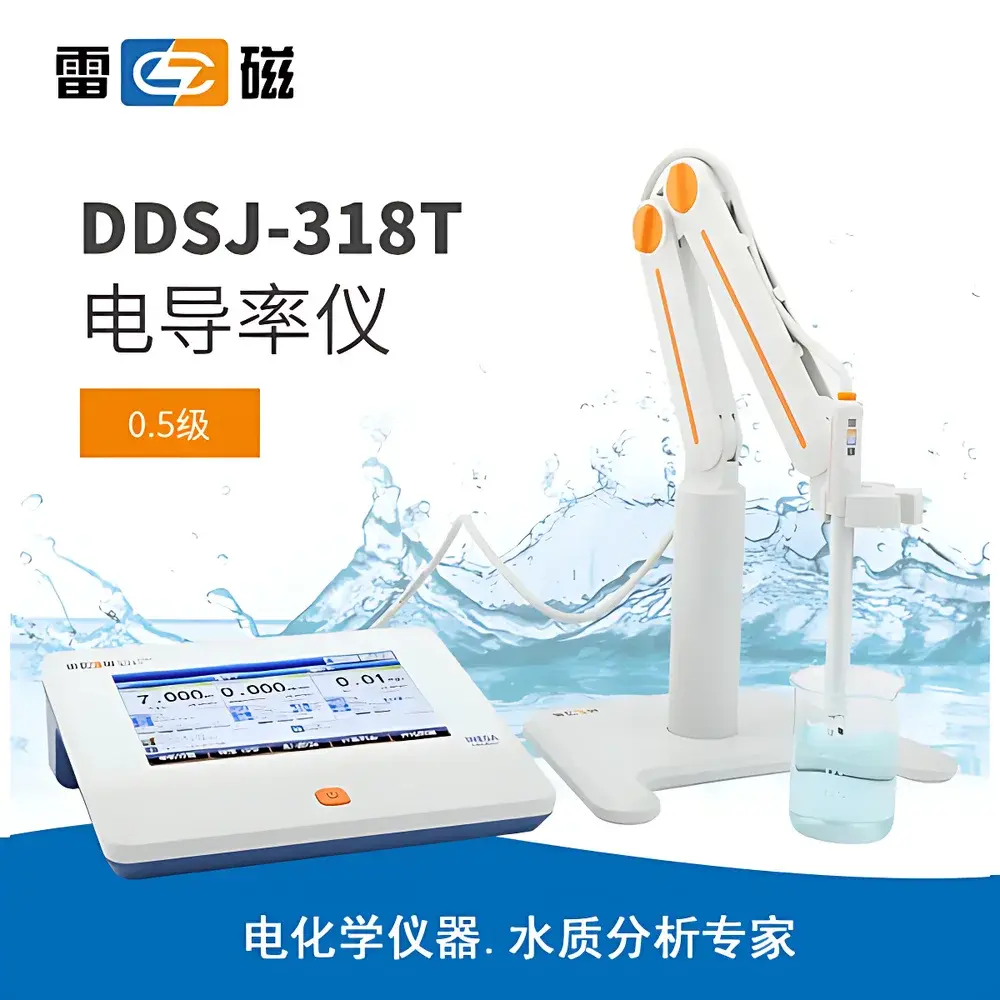
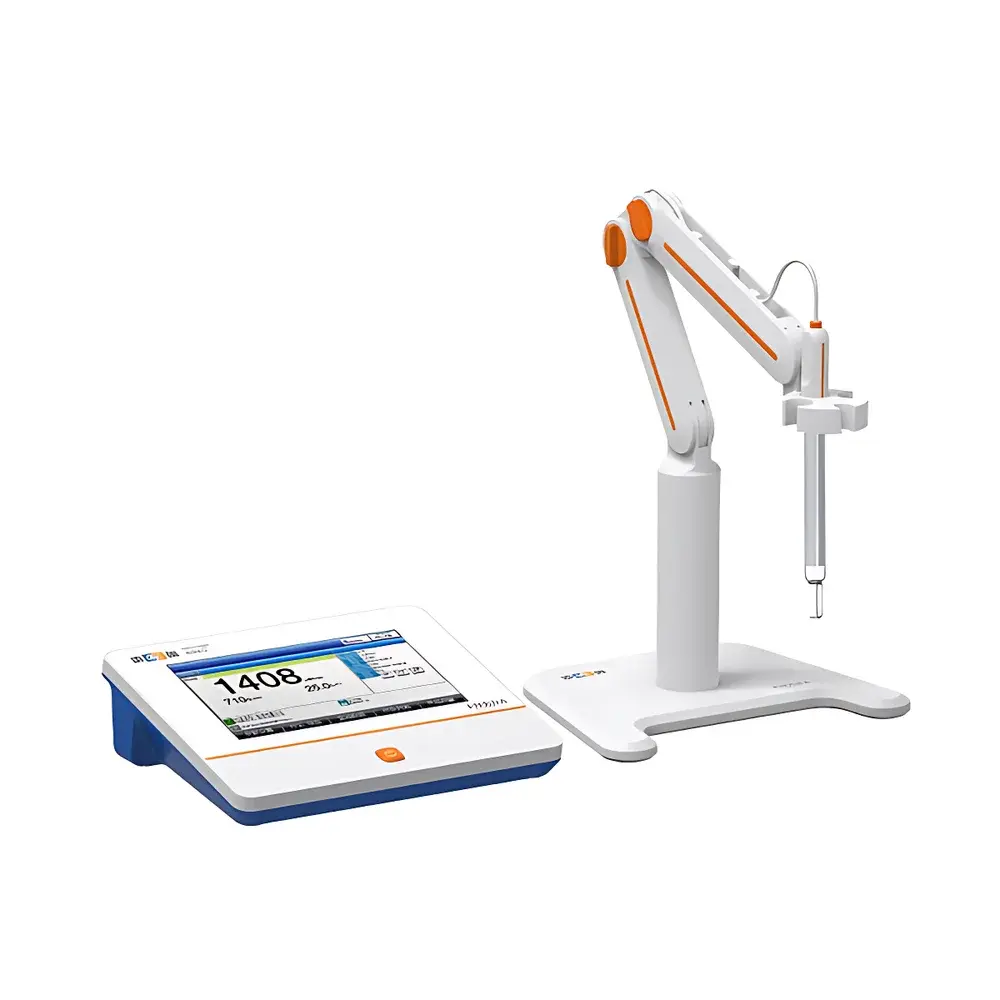
Leici DDSJ-318T Benchtop Conductivity Meter
| Key | Brand: Leici |
|---|---|
| Origin | Shanghai, China |
| Model | DDSJ-318T |
| Form Factor | Benchtop |
| Application | Laboratory |
| Conductivity Range | 0.000 µS/cm to 2000 mS/cm |
| TDS Range | 0.000 mg/L to 1000 g/L |
| Resistivity Range | 5.00 Ω·cm to 100.0 MΩ·cm |
| Salinity Range | 0.00–8.00 % |
| Temperature Range | −10.0 to 135.0 °C |
| Accuracy | ±0.5% FS (Conductivity/TDS/Resistivity), ±0.1% FS (Salinity), ±0.1 °C (Temperature) |
| Minimum Resolution | 0.001 µS/cm (Conductivity), 0.01 Ω·cm (Resistivity), 0.001 mg/L (TDS), 0.01% (Salinity), 0.1 °C (Temperature) |
| Compliance | GLP, GMP-ready, ASTM D1125, ISO 7888, USP <645>, EN 27888 |
| Connectivity | RS-232, USB, Optional Auto-sampler Interface |
| Data Storage | 1000 measurement records with audit trail |
| IP Rating | IP54 |
| Electrode Support | Automatic recognition of 0.01, 0.1, and 1.0 cm⁻¹ conductivity cells |
Overview
The Leici DDSJ-318T Benchtop Conductivity Meter is a high-precision, multi-parameter electrochemical analyzer engineered for rigorous laboratory environments requiring trace-level conductivity, resistivity, TDS, salinity, and temperature quantification. Based on the fundamental principle of two-electrode or four-electrode conductometric measurement—where electrical current is induced across a sample via an AC excitation signal to eliminate polarization effects—the instrument delivers stable, reproducible results across six decades of conductivity (0.000 µS/cm to 2000 mS/cm). Its architecture integrates automatic frequency switching (1 kHz to 10 kHz) and dynamic cell constant compensation, enabling accurate measurement of ultrapure water (≥18.2 MΩ·cm), industrial brines, and aggressive electrolytes without manual range selection. Designed to meet international metrological standards, the DDSJ-318T conforms to ISO 7888 (water quality—determination of electrical conductivity), ASTM D1125 (standard test methods for electrical conductivity of water), and USP (water for pharmaceutical use), making it suitable for QC/QA labs in pharmaceuticals, power generation, environmental monitoring, and food & beverage production.
Key Features
- 7-inch full-color capacitive touchscreen with intuitive icon-driven UI supporting English and Chinese language modes
- Multi-compensation algorithms: linear, non-linear (e.g., Vogel–Tamman–Fulcher), pure-water (ISO 7888 Annex B), and seawater-specific salinity compensation
- Programmable reference temperatures: 5.0, 10.0, 15.0, 18.0, 20.0, and 25.0 °C (default)
- Automatic electrode recognition and intelligent calibration management for 1–5 point conductance standardization using certified KCl solutions (0.01 mol/kg to 1 mol/kg)
- Real-time endpoint detection with configurable read modes: auto-hold, timed interval (1–999 s), fixed-duration, or manual capture
- IP54-rated enclosure with dust-resistant design, integrated electrode stand, protective dust cover, and pre-packaged calibration standards
- Comprehensive security framework: user-level access control (admin/operator/visitor), password protection, and immutable audit logs per GLP/GMP requirements
Sample Compatibility & Compliance
The DDSJ-318T accommodates diverse sample matrices—from deionized water and boiler feedwater to fruit juice concentrates and seawater analogs—via interchangeable conductivity cells (cell constants: 0.01, 0.1, and 1.0 cm⁻¹). Its dual-frequency excitation and adaptive gain control minimize electrode fouling artifacts and ensure stability in viscous or particulate-laden samples. Regulatory alignment includes full support for 21 CFR Part 11-compliant data integrity when paired with Leici’s certified PC software (LISLink v3.2), including electronic signatures, time-stamped audit trails, and exportable CSV/PDF reports. Instrument self-diagnostics verify sensor integrity, temperature probe accuracy, and system linearity prior to each measurement cycle, satisfying internal validation protocols required under ISO/IEC 17025 and EU GMP Annex 11.
Software & Data Management
- Onboard storage for ≥1000 complete measurement records, each containing timestamp, operator ID, electrode serial number, calibration history, temperature, and raw/conversion parameters
- Export capability via USB mass storage (direct U-disk read/write), RS-232 (to dot-matrix or thermal printers with customizable templates), or USB-to-PC link using LISLink software
- Batch analysis tools: statistical summaries (mean, SD, RSD, min/max), trend charts, and pass/fail flagging against user-defined specification limits
- GMP operation log retains all critical events—including method changes, calibration overrides, and user logins—with tamper-evident hashing
- Firmware upgradability ensures long-term compatibility with evolving regulatory expectations and analytical workflows
Applications
This meter serves as a core platform in multiple regulated domains: verification of purified water resistivity in pharmaceutical cleanrooms (USP Stage 1–3 testing); routine monitoring of cooling tower conductivity for corrosion control; TDS quantification in wastewater effluent per EPA Method 120.1; salinity profiling in aquaculture and marine research; and ash content determination in sucrose and HFCS per AOAC Official Methods 985.29 and 994.12. Its extended low-range resolution (0.001 µS/cm) enables detection of ionic leachables from packaging materials, while high-end capacity supports concentrated acid/base titration endpoint confirmation in chemical manufacturing.
FAQ
Does the DDSJ-318T comply with FDA 21 CFR Part 11 requirements?
Yes—when used with LISLink v3.2 software and configured with role-based authentication, electronic signatures, and audit-trail-enabled data export, it satisfies electronic record and signature criteria.
Can it measure ultra-pure water resistivity accurately?
Yes—using a 0.01 cm⁻¹ cell and non-linear temperature compensation per ISO 7888, it achieves reliable readings up to 100.0 MΩ·cm with ±0.5% FS uncertainty.
Is automatic temperature compensation (ATC) mandatory for all measurements?
No—users may select “no compensation”, linear, non-linear, or application-specific modes (e.g., seawater, pure water) depending on matrix and regulatory context.
What calibration standards are supported out-of-the-box?
The instrument auto-identifies and applies correction factors for GB/T 6682, ISO 3696, ASTM D1193, and NIST-traceable KCl solutions across five concentration levels.
How is data integrity maintained during power loss?
Built-in EEPROM preserves calibration coefficients, user settings, and unsaved measurements; the system performs automatic recovery upon reboot without data corruption.





