
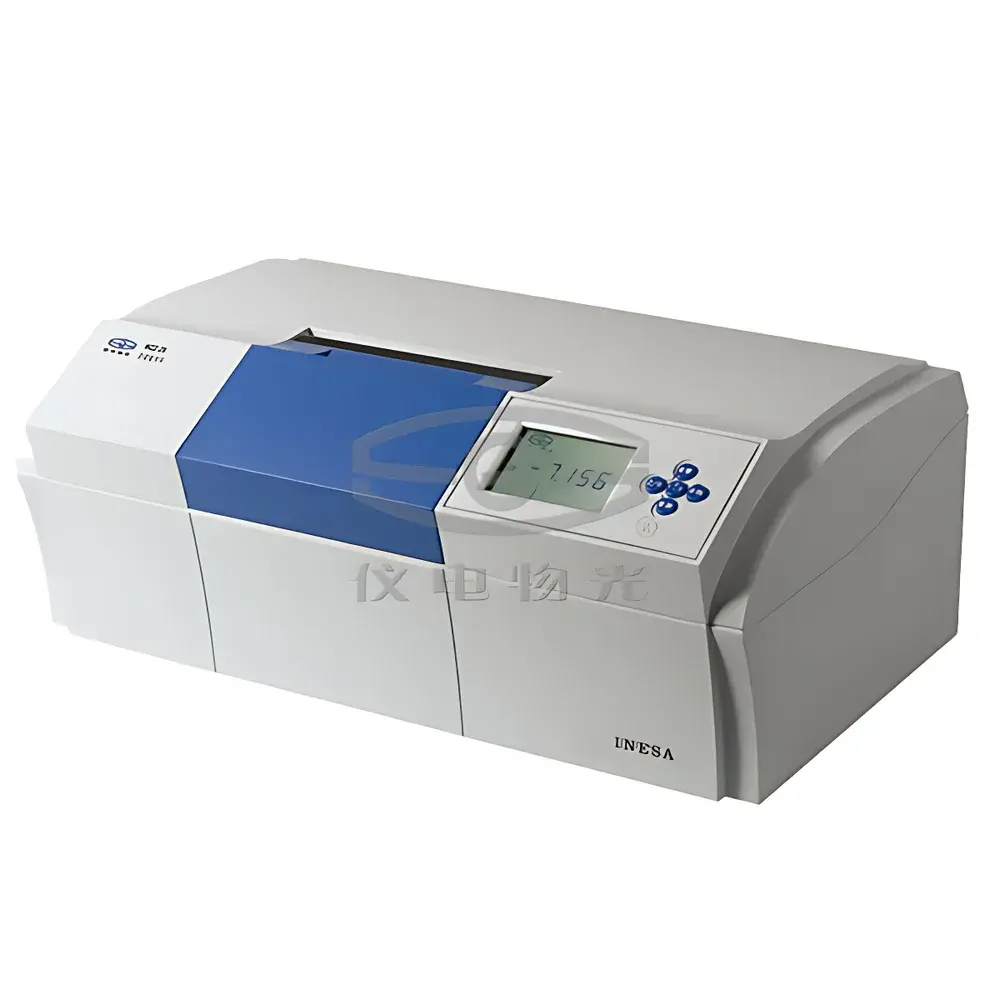
YDWG WZZ-2S Automatic Digital Polarimeter
| Brand | YDWG |
|---|---|
| Origin | Shanghai, China |
| Model | WZZ-2S |
| Product Type | Automatic Polarimeter |
| Temperature Control | None |
| Display | Backlit LCD (5-inch) |
| Light Source | LED with Interference Filter (589 nm) |
| Measurement Range | ±45° (optical rotation), ±120°Z (saccharimetric scale) |
| Minimum Resolution | 0.001° (optical rotation), 0.01°Z (sugar scale) |
| Accuracy | ±(0.01 + 0.05% of reading)° (optical rotation), ±(0.03 + 0.05% of reading)°Z (sugar scale) |
| Repeatability (Std. Dev. δ) | ≤0.002° |
| Data Storage | Up to 3 measurements with auto-averaging |
| Interface | Optional dedicated thermal printer (RD-TH32 SC) |
| Power Supply | 220 V ± 22 V, 50 Hz ± 1 Hz, 150 W |
| Dimensions | 605 × 370 × 260 mm |
| Net Weight | 21 kg |
| Accuracy Class | 0.05 |
Overview
The YDWG WZZ-2S Automatic Digital Polarimeter is a precision optical instrument engineered for quantitative determination of optical rotation in optically active substances—primarily used in pharmaceutical quality control, food and beverage analysis (especially sucrose concentration), fine chemical synthesis, and academic research laboratories. It operates on the fundamental principle of polarimetry: linearly polarized light passes through a chiral sample, and the plane of polarization rotates proportionally to the concentration, path length, and specific rotation of the analyte. The instrument employs a stable, narrow-band LED light source centered at 589 nm—the sodium D-line wavelength—filtered via an interference filter to ensure spectral purity essential for metrological consistency. Unlike temperature-compensated or thermostatted polarimeters, the WZZ-2S is designed for ambient-temperature operation, making it suitable for routine QC environments where strict thermal regulation is not required but high repeatability and ease of use are critical.
Key Features
- High-resolution digital measurement system with 0.001° angular resolution and automatic averaging of up to three consecutive readings
- Backlit 5-inch LCD display providing clear, real-time visualization of optical rotation (°) and saccharimetric scale (°Z) values
- Dedicated dual-scale functionality: direct readout in both optical rotation (±45°) and sugar concentration (±120°Z), compliant with international sugar industry conventions
- Robust mechanical architecture built with ABS housing via unified mold tooling—ensuring dimensional consistency, impact resistance, and long-term stability
- Integrated microprocessor-based control with optimized digital signal processing to minimize drift and enhance baseline stability
- Optional thermal printer interface (RD-TH32 SC) supporting GLP-compliant hard-copy record generation for audit trails
Sample Compatibility & Compliance
The WZZ-2S accommodates standard 100 mm and 200 mm path-length sample tubes (included), compatible with aqueous solutions, organic solvents, syrups, and clarified liquid extracts. Its minimum transmittance requirement of 1% enables reliable measurement of moderately turbid or colored samples common in natural product extracts and fermentation broths. While the instrument does not feature active temperature control, its optical design and thermal mass mitigate short-term ambient fluctuations—meeting the performance criteria outlined in ISO 11351:2021 (Optics and photonics — Polarimetry — Vocabulary and basic concepts) and aligning with general requirements of USP and Ph. Eur. 2.2.7 for polarimetric assays. Its 0.05 accuracy class certifies conformance with national metrological verification standards for Class II polarimeters per JJG 536–2015 (China).
Software & Data Management
The WZZ-2S operates as a standalone embedded system with no external PC dependency. All data handling—including storage of three sequential measurements, automatic arithmetic mean calculation, and unit switching—is executed onboard. Measurement records are retained in volatile memory until power-off; for permanent documentation, users may connect the optional RD-TH32 SC thermal printer. Though lacking USB or Ethernet connectivity, the device supports manual transcription into LIMS or ELN platforms. Its deterministic firmware architecture ensures reproducible behavior across operational cycles—critical for environments adhering to GLP or internal QA protocols requiring documented instrument performance history. Audit-ready printouts include date/time stamp, sample ID field (manually entered), and raw/averaged values—facilitating traceability under FDA 21 CFR Part 11 if paired with procedural controls.
Applications
- Pharmaceutical QC: Verification of enantiomeric purity for chiral APIs (e.g., levodopa, ibuprofen, chloramphenicol)
- Sugar industry: Direct saccharimetric analysis of cane juice, beet extract, invert sugar syrups, and finished beverages per ICUMSA methods
- Essential oil & flavor chemistry: Quantification of optical activity in limonene, menthol, camphor, and citral-rich distillates
- Academic teaching labs: Demonstration of chirality, specific rotation calculations, and Beer–Lambert law correlations
- Biotechnology: Monitoring optical rotation shifts during enzymatic hydrolysis or racemization studies
FAQ
Does the WZZ-2S support temperature-controlled measurements?
No. It is designed for ambient-temperature operation only and does not include Peltier cooling/heating or temperature sensor feedback.
Can the instrument measure both optical rotation and sugar concentration simultaneously?
Yes—measurements are displayed concurrently in degrees (°) and degrees Z (°Z) on the same screen, with independent calibration and error specifications.
Is the 589 nm LED source equivalent to a sodium lamp in spectral performance?
The LED + interference filter combination delivers a bandwidth <1 nm centered at 589.3 nm, closely matching the dominant D-line emission of sodium vapor lamps and satisfying ISO 11351 spectral fidelity requirements.
What is the maximum sample turbidity the WZZ-2S can tolerate?
It requires ≥1% optical transmittance at 589 nm; highly scattering colloids or particulates must be centrifuged or filtered prior to analysis.
How is calibration verified for regulatory compliance?
Users perform periodic verification using certified quartz control plates (e.g., NIST-traceable standards) or sucrose reference solutions; full calibration certificates are issued by authorized metrology labs per JJG 536 verification procedures.






