
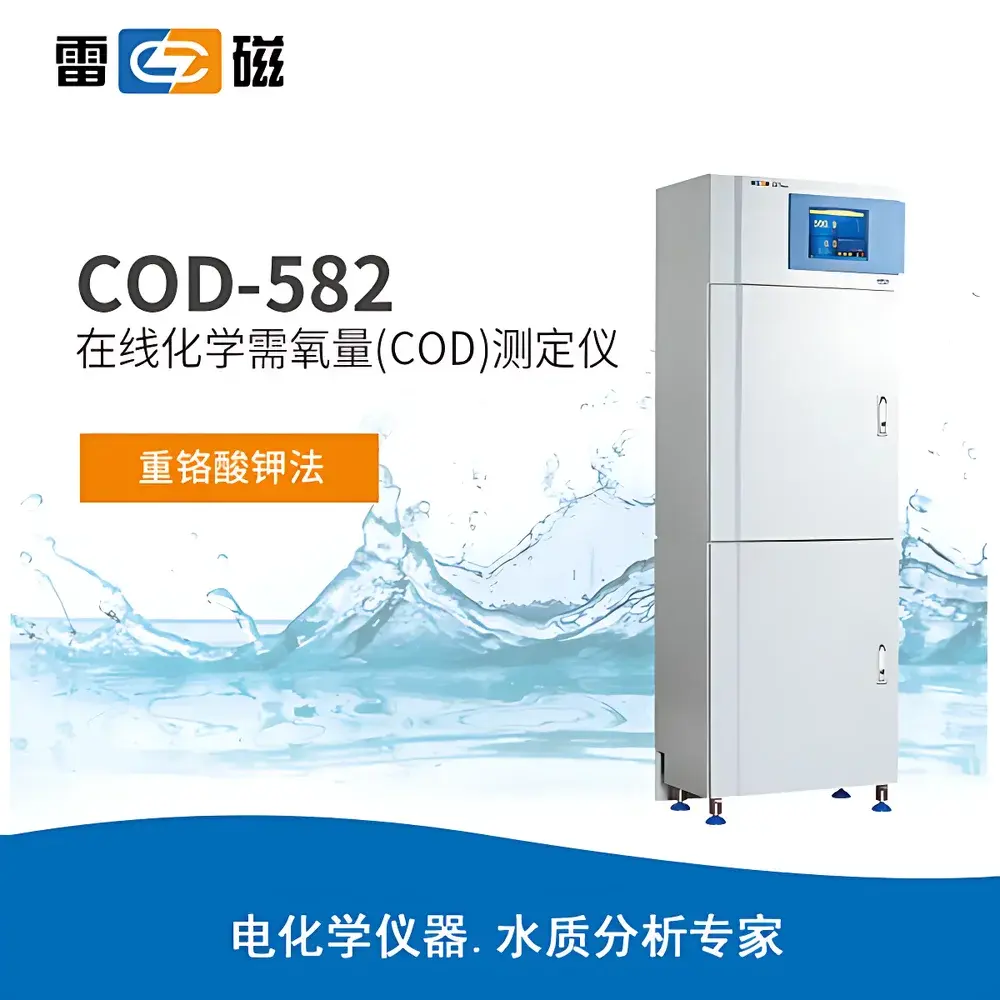
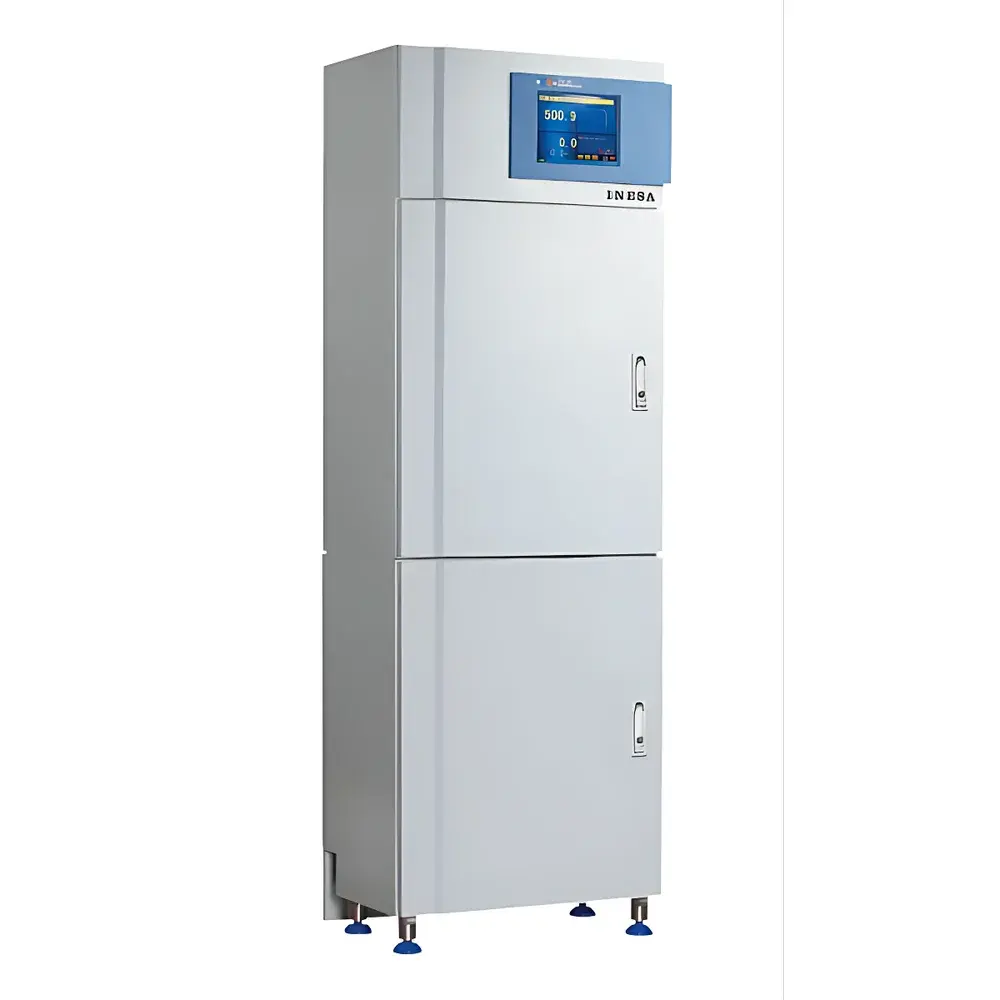
Leici COD-582 Online Chemical Oxygen Demand (COD) Analyzer
| Brand | Leici |
|---|---|
| Origin | Shanghai, China |
| Model | COD-582 |
| Instrument Type | Online Analyzer |
| Measurement Principle | Potassium Dichromate Digestion and Colorimetric Detection |
| Measurement Range | 10.0–5000 mg/L |
| Accuracy | ±10% or ±5 mg/L (for values ≤50 mg/L) |
| Repeatability | 5% or 5 mg/L (for values ≤100 mg/L) |
| Resolution | 0.1 mg/L (≤100 mg/L), 1 mg/L (>100 mg/L) |
| Zero Drift | ±5 mg/L/24 h |
| Span Drift | ±10%/24 h |
| Power Supply | AC 220 V ±10%, 50 Hz |
| Dimensions | 550 × 400 × 1680 mm |
| Weight | 50 kg |
| MTBF | ≥360 hours |
| Output | Isolated 4–20 mA DC (configurable upper/lower limits) |
| Communication | RS-232 or RS-485 (selectable) |
| Maintenance Interval | Up to 30 days without servicing |
Overview
The Leici COD-582 Online Chemical Oxygen Demand (COD) Analyzer is an industrial-grade, fully automated water quality monitoring system engineered for continuous, real-time quantification of organic pollution load in aqueous matrices. It operates on the standardized potassium dichromate digestion method—fully compliant with GB 11914–1989, the Chinese national standard equivalent to ISO 6060 and aligned with the foundational principles of APHA Standard Methods 5220C. In this process, a precisely metered sample undergoes high-temperature acidic digestion with potassium dichromate under controlled reflux conditions, converting oxidizable organic matter into CO2. The residual dichromate is then quantified colorimetrically at 600 nm using a stable photometric detection module. The resulting absorbance is linearly correlated to COD concentration via pre-calibrated calibration curves stored in non-volatile memory. Designed for unattended operation in harsh environmental and industrial settings, the COD-582 integrates digestion, reaction, optical measurement, fluidic control, and data logging within a single robust chassis—eliminating manual sampling, reagent handling, and lab-based analysis bottlenecks.
Key Features
- 7-inch full-color capacitive touchscreen interface with intuitive HMI navigation, displaying real-time status, measurement mode, current COD value, alarm flags, and system diagnostics
- Optical liquid-level sensing technology for high-precision reagent dispensing—ensuring consistent digestion stoichiometry and minimizing inter-batch variability
- Triple operational modes: manual (for hardware validation and service), timed (user-defined intervals), and equidistant (fixed time-step acquisition) measurement scheduling
- Automated sequence execution including auto-calibration (with user-loaded standards), auto-digestion, auto-colorimetry, and auto-rinse cycles—reducing operator dependency and human error
- Configurable alarm architecture: leak detection, thermal over-limit (digestion heater >165 °C), reagent depletion, and communication timeout alerts—all logged with timestamps
- Comprehensive security framework: multi-level password protection (operator, engineer, admin), firmware write-protection, and audit-trail enabled configuration change logging
- Dual digital communication options: RS-232 (for local PC connection and firmware updates) and RS-485 (Modbus RTU protocol) for integration into SCADA, DCS, or PLC-based plant control systems
- Isolated 4–20 mA analog output with programmable span mapping (e.g., 4 mA = 0 mg/L, 20 mA = 5000 mg/L), supporting direct connection to central monitoring panels or PID controllers
- Onboard storage for ≥100,000 measurement records and ≥500 calibration events; all data timestamped, tagged with measurement mode and error codes
- Embedded system log retains critical events—including power failures, sensor faults, temperature excursions, and emergency stop triggers—for GLP-compliant root-cause analysis
Sample Compatibility & Compliance
The COD-582 is validated for use with raw influent and treated wastewater, surface water (rivers, lakes, reservoirs), and process streams from municipal WWTPs, petrochemical refineries, pharmaceutical manufacturing units, food processing plants, and semiconductor fabs. It accommodates suspended solids up to 150 mg/L without clogging, thanks to its self-cleaning peristaltic pump and integrated filtration bypass. All wetted components—including digestion chamber, flow cell, and tubing—are constructed from PTFE, quartz, and 316L stainless steel to resist corrosion from acidic digestates and chloride-rich matrices. Regulatory alignment includes adherence to GB 11914–1989, compatibility with ISO/IEC 17025 laboratory accreditation requirements for field-deployed analyzers, and functional readiness for FDA 21 CFR Part 11 compliance when paired with validated LIMS or data management software (audit trail, electronic signatures, and data integrity controls).
Software & Data Management
The embedded firmware supports zero-config USB data export: plug-and-play retrieval of CSV-formatted measurement logs, calibration reports, and system event histories via standard FAT32-formatted USB drives. Optional Leici DataLink software (Windows-based) enables remote configuration, firmware upgrades, trend visualization (7-/30-/90-day overlays), alarm threshold adjustment, and report generation (PDF/Excel) meeting ISO 14001 and EU WFD reporting templates. All stored data are cryptographically hashed to prevent tampering; modification attempts trigger automatic log entries. For enterprise deployment, the analyzer’s Modbus register map allows seamless ingestion into cloud platforms (e.g., AWS IoT Core, Azure IoT Hub) using MQTT or OPC UA gateways—enabling predictive maintenance analytics and cross-site benchmarking.
Applications
- Continuous compliance monitoring at municipal wastewater discharge points per local environmental permits (e.g., China MEP Order No. 39, EU Urban Wastewater Treatment Directive)
- Real-time feedback control of biological treatment units (e.g., adjusting aeration rates in activated sludge basins based on influent COD load)
- Early-warning detection of industrial spill events in receiving waters—triggering automated valve closure or diversion protocols
- Process optimization in anaerobic digestion systems by correlating influent COD with biogas yield metrics
- Quality assurance in potable water reclamation facilities where COD serves as a surrogate for trace micropollutants and disinfection by-product precursors
- Regulatory submission support: automated generation of daily/monthly summary reports with digital signature capability and metadata (location ID, analyst ID, instrument serial number)
FAQ
Does the COD-582 require daily manual intervention?
No—it is designed for 30-day maintenance-free operation. Reagent reservoirs, waste collection, and optical path cleaning are fully automated. Scheduled preventive maintenance (e.g., digestion coil inspection, lamp replacement) is recommended every 6 months.
Can it measure samples with high chloride content?
Yes. The onboard chloride compensation algorithm—based on mercury sulfate masking—corrects for interference up to 2000 mg/L Cl⁻, in accordance with GB 11914–1989 Annex B.
Is remote firmware update supported?
Firmware updates must be performed locally via USB drive with SHA-256 verified binaries. Remote update over network is disabled by default for cybersecurity compliance (IEC 62443-3-3 SL2).
What is the minimum sample flow rate required for stable operation?
A continuous supply of ≥1.5 L/h at 0.1–3 bar pressure is required. An optional integrated booster pump module is available for low-pressure installations.
How is measurement traceability ensured?
Each calibration uses NIST-traceable potassium hydrogen phthalate (KHP) standards. Calibration certificates include uncertainty budgets (k=2) and reference to CNAS-accredited secondary standards used during factory verification.
Related Products







