
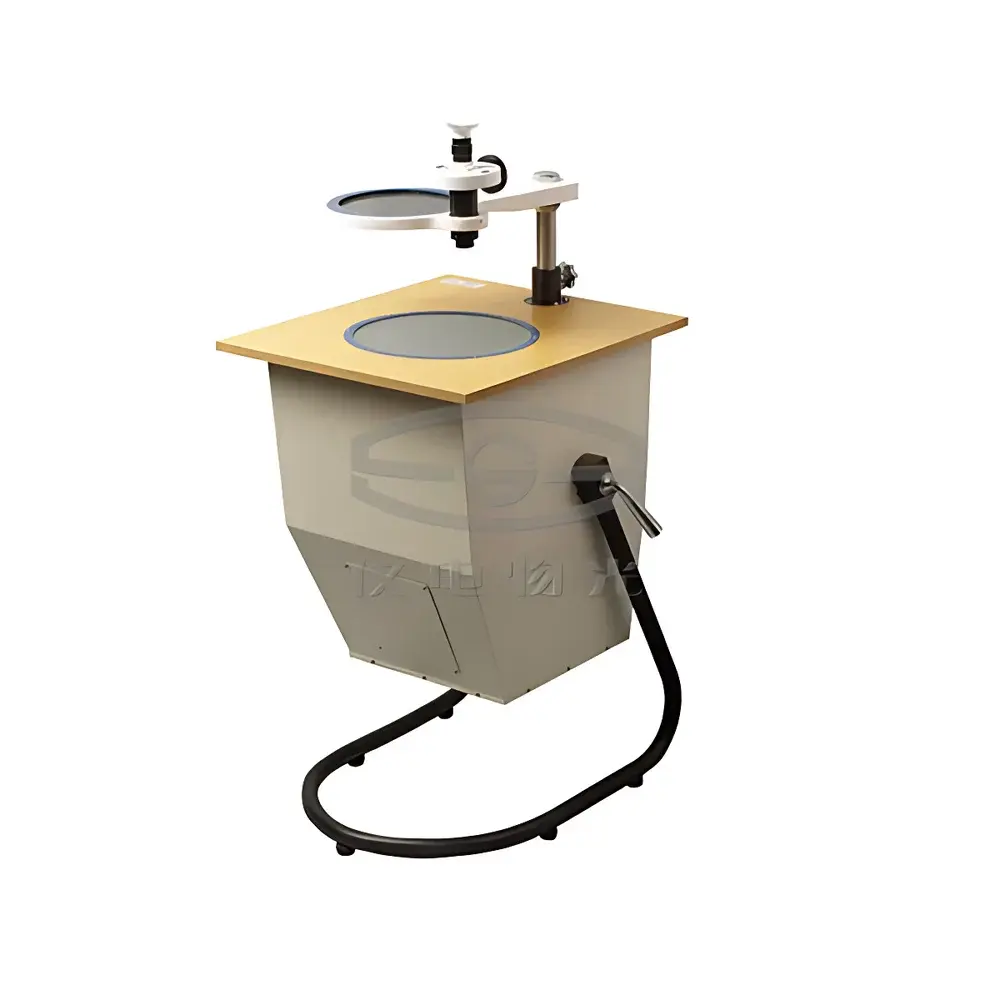
YDWG WYL-3 Photoelastic Stress Analyzer
| Brand | YDWG |
|---|---|
| Origin | Shanghai, China |
| Model | WYL-3 |
| Light Source | 12 V / 50 W Tungsten-Halogen Lamp |
| Qualitative Measurement Range | ≤560 nm (First-Order Interference Color) |
| Quantitative Measurement Range | ≤280 nm (First-Order Interference Color) |
| Resolution | 0.2 nm |
| Sample Height Capacity | 250 mm |
| Full-Wave Retardation Plate | 560 nm |
| Analyzer Aperture Diameter | φ150 mm |
| Stage Glass Aperture Diameter | φ220 mm |
| Power Supply | 220 V ± 22 V, 50 Hz ± 1 Hz, 30 W |
| Dimensions (L×W×H) | 570 mm × 510 mm × 950 mm |
| Net Weight | 21 kg |
Overview
The YDWG WYL-3 Photoelastic Stress Analyzer is a precision optical instrument engineered for the qualitative and quantitative evaluation of residual stress-induced birefringence in transparent materials. Based on the principle of photoelasticity—where mechanical stress alters the refractive index tensor of isotropic dielectrics—the WYL-3 enables visualization and measurement of stress distribution through interference fringe patterns generated under polarized illumination. The system employs a collimated tungsten-halogen light source (12 V / 50 W) coupled with a calibrated full-wave retardation plate (560 nm) and a high-aperture analyzer (φ150 mm), ensuring consistent illumination geometry and minimal polarization distortion across the field of view. Designed for industrial quality control and R&D laboratories, the WYL-3 supports non-destructive assessment of internal stress states in annealed and tempered optical glass, molded acrylic and polycarbonate components, laminated safety glass, and injection-molded plastic lenses—critical for applications where optical homogeneity, mechanical reliability, or thermal stability must be verified prior to final assembly.
Key Features
- Dual-mode operation: Simultaneous qualitative observation (via first-order interference color matching) and quantitative retardation measurement (with 0.2 nm resolution)
- Optimized optical path: Large-diameter stage glass aperture (φ220 mm) accommodates oversized samples without vignetting; analyzer aperture (φ150 mm) ensures uniform extinction conditions
- Stable illumination architecture: Regulated 12 V DC power supply for halogen lamp minimizes intensity drift during extended measurements
- Robust mechanical design: Steel-reinforced base and adjustable leveling feet provide vibration damping and long-term alignment stability
- Modular polarizer-analyzer configuration: Enables rapid switching between crossed and parallel arrangements for both dark-field and bright-field stress visualization
- Compliance-ready construction: Fixed optical alignment eliminates need for daily recalibration; all optical components are mounted in kinematic mounts with locking screws for GLP traceability
Sample Compatibility & Compliance
The WYL-3 accommodates flat or gently curved transparent specimens up to 250 mm in height and 220 mm in diameter, including annealed borosilicate glass substrates, fused silica windows, PMMA display panels, PET film rolls, and multilayer polymer laminates. Its measurement range (≤280 nm for quantitative mode; ≤560 nm for qualitative mode) aligns with ASTM C1357–22 (Standard Practice for Measuring Residual Stress in Optical Glass Using Photoelasticity) and ISO 11475:2021 (Plastics — Determination of Birefringence in Transparent Thermoplastics). While the instrument itself does not embed electronic data logging, its analog optical output is fully compatible with third-party digital imaging systems compliant with FDA 21 CFR Part 11 when integrated into validated workflows under GMP/GLP environments.
Software & Data Management
The WYL-3 operates as a standalone optical platform with no embedded firmware or proprietary software. All measurements are performed manually via visual interpretation of interference fringes or by coupling the eyepiece output to a calibrated CCD camera system (user-supplied). For traceable documentation, users may integrate the instrument with image acquisition platforms supporting TIFF/RAW export, region-of-interest (ROI) retardation profiling, and histogram-based fringe order counting. Metadata—including lamp voltage, ambient temperature, sample ID, and operator initials—can be appended using laboratory information management systems (LIMS) that support manual entry or barcode-scanned workflow triggers. Audit trails and version-controlled calibration records are maintained externally per ISO/IEC 17025 requirements.
Applications
- Residual stress mapping in precision optical components (e.g., telescope mirrors, laser cavity windows, AR-coated lenses)
- Quality screening of automotive glazing and architectural laminated glass for edge compression anomalies
- Process validation of annealing cycles in optical glass manufacturing (e.g., SCHOTT, Ohara, Hoya)
- Failure analysis of brittle fracture origins in transparent polymers subjected to thermal cycling or UV exposure
- Evaluation of stress gradients induced by adhesive bonding, ultrasonic welding, or solvent casting in medical device housings
- Teaching photoelastic theory and stress-optic coefficient determination in university physics and materials science laboratories
FAQ
What standards does the WYL-3 comply with for stress measurement?
The WYL-3 conforms to the optical configuration and measurement methodology specified in ASTM C1357–22 and ISO 11475:2021.
Can the WYL-3 measure curved or non-planar samples?
It supports gently curved surfaces within the 250 mm height limit; however, steep curvature introduces optical path differences requiring empirical correction factors.
Is the halogen lamp replaceable with an LED source?
No—LEDs lack the broadband spectral continuity required for reliable first-order interference color identification; the 560 nm full-wave plate is calibrated specifically for tungsten-halogen emission.
Does the instrument include calibration certificates or NIST-traceable references?
Calibration is performed using certified quartz wedge standards; users receive a factory verification report with measured retardation values at three wavelengths (486 nm, 546 nm, 589 nm).
How is measurement reproducibility ensured across operators?
Standardized viewing protocols—including fixed observation distance (300 mm), controlled ambient lighting (<50 lux), and mandatory use of the supplied polarizing eyepiece—are documented in the user manual to minimize inter-operator variance.






