
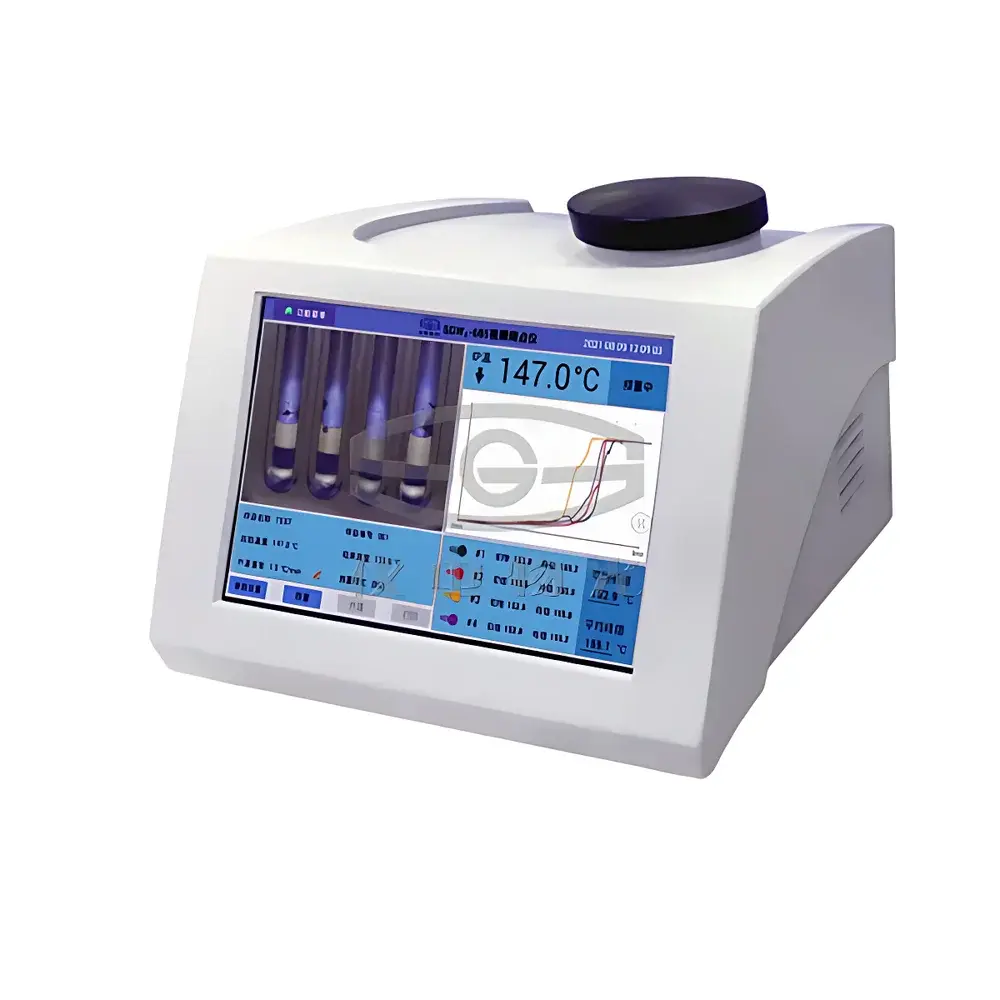
YDWG SGW®-685 Automated Video Melting Point Apparatus
| Brand | YDWG |
|---|---|
| Origin | Shanghai, China |
| Model | SGW®-685 |
| Temperature Range | Ambient to 400 °C |
| Heating Rate | 0.1–20 °C/min (continuously adjustable) |
| Temperature Repeatability | ±0.3 °C at 1.0 °C/min |
| Temperature Accuracy | ≤200 °C: ±0.4 °C |
| >200 °C | ±0.7 °C |
| Capillary Dimensions | OD 1.4 mm, ID 1.0 mm, Length 90 mm |
| Sample Capacity | 4 capillaries |
| Temperature Resolution | 0.1 °C |
| Operating System | Android |
| Display | 10.1″ IPS capacitive touchscreen |
| Camera | 720p @ 30 fps |
| Data Storage | 128 GB internal |
| Connectivity | RS232, 3×USB, RJ-45, Wi-Fi |
| Power | 100–240 VAC, 50/60 Hz, 150 W |
| Dimensions | 320 × 295 × 190 mm |
| Net Weight | 3.7 kg |
Overview
The YDWG SGW®-685 Automated Video Melting Point Apparatus is a precision thermal analysis instrument engineered for accurate, reproducible, and visually documented determination of melting point transitions in pharmaceuticals, fine chemicals, polymers, and organic compounds. It operates on the principle of controlled linear heating of solid samples encapsulated in standard pharmacopoeial capillaries, combined with real-time high-definition video imaging and photometric detection of phase change events. Unlike traditional analog or semi-automated units, the SGW®-685 integrates a closed-loop PID/PWM temperature control system with a calibrated platinum resistance thermometer (Pt100), enabling stable thermal ramping across its full operating range (ambient to 400 °C) with minimal overshoot and high thermal uniformity. The apparatus complies with pharmacopeial requirements—including USP <741>, EP 2.2.17, and ChP 0612—for capillary-based melting point determination, and supports both automated endpoint detection and manual visual verification via synchronized video playback.
Key Features
- 10.1″ high-brightness IPS capacitive touchscreen running a dedicated Android OS—optimized for laboratory use with intuitive workflow navigation and multi-user interface support.
- 720p HD camera operating at 30 frames per second, delivering smooth, artifact-free video capture of sample melting dynamics—including onset (initial softening), clear point (complete liquefaction), and intermediate stages.
- Adjustable LED illumination and photodetector sensitivity to accommodate diverse sample optical properties—enabling reliable detection of dark, colored, translucent, or low-contrast materials without manual threshold tuning.
- Integrated four-position heating block with monolithic furnace design, ensuring rapid thermal response (<60 s to reach 300 °C from ambient) and exceptional temperature homogeneity (±0.2 °C across sample zone).
- Configurable heating profiles: continuous ramp rates from 0.1 to 20 °C/min, with programmable hold steps and multi-segment protocols stored in up to 200 user-defined methods.
- Comprehensive data traceability architecture: optional FDA 21 CFR Part 11-compliant audit trail module with electronic signatures, role-based access control (four-tier permissions), and immutable event logging.
Sample Compatibility & Compliance
The SGW®-685 accepts standard pharmacopoeial capillaries (1.4 mm OD × 1.0 mm ID × 90 mm length), accommodating up to four independent samples per run. Sample loading height is standardized at 3 mm to ensure consistent heat transfer and optical path geometry. The system is validated for use with crystalline solids, hydrates, solvates, and thermally sensitive APIs where precise thermal transition characterization is required for identity confirmation, purity assessment (via mixed-melting point), or stability monitoring. All hardware and firmware meet IEC 61010-1 safety standards. When equipped with the optional audit trail software, the instrument satisfies GLP and GMP documentation requirements—including full data integrity per ALCOA+ principles—and supports integration into regulated quality systems such as LIMS or MES platforms via RS232 or TCP/IP protocols.
Software & Data Management
Data acquisition and reporting are fully integrated within the onboard Android environment. Each measurement generates a time-stamped record containing raw temperature vs. time curves, annotated video (AVI/MPEG-4), digital image snapshots at critical transition points, and tabular metadata (operator ID, method name, calibration status, environmental conditions). Reports can be exported directly as PDF files—including embedded video thumbnails and hyperlinked full-resolution clips—with customizable templates compliant with internal SOPs or regulatory submission formats. Internal 128 GB storage retains up to 40,000 complete measurement records. External data transfer is supported via USB mass storage mode or network file sharing over Wi-Fi/Ethernet. The system provides an open API (HTTP/RESTful) for bidirectional communication with enterprise laboratory informatics systems, enabling automated result ingestion, remote method deployment, and centralized audit log aggregation.
Applications
- Pharmaceutical QC/QA: Identity testing and purity verification of active pharmaceutical ingredients (APIs) and excipients per USP/EP/ChP monographs.
- Chemical R&D: Screening of polymorphs, eutectic behavior, and thermal degradation onset in synthetic intermediates and novel compounds.
- Academic research: Teaching and demonstration of solid-state phase transitions, crystal lattice energy estimation, and kinetic modeling of melt nucleation.
- Regulatory submissions: Generation of auditable, timestamped melting data packages for ANDA, NDA, or CMC dossiers requiring full data lineage and operator accountability.
- Contract laboratories: High-throughput batch testing with method locking, user-level access restrictions, and seamless LIMS synchronization.
FAQ
Does the SGW®-685 comply with FDA 21 CFR Part 11 requirements?
Yes—when configured with the optional audit trail software package, the instrument implements electronic signatures, secure user authentication, immutable activity logs, and system validation documentation required for regulated environments.
Can the SGW®-685 measure decomposition points or only melting points?
While optimized for sharp melting transitions, the system can detect and document thermal events associated with decomposition (e.g., discoloration, bubbling, charring) through synchronized video analysis—though quantitative decomposition temperature assignment requires complementary techniques such as TGA.
Is external calibration required, and how often?
The unit supports multi-point calibration using certified reference standards (e.g., indium, tin, zinc). Calibration frequency follows internal SOPs but is typically performed before each analytical session or daily in GLP/GMP settings.
What file formats are supported for video export?
Recorded videos are saved in MP4 (H.264) format; still images are captured as PNG; measurement data exports as CSV and PDF with embedded media links.
Can the SGW®-685 be operated remotely over a corporate network?
Yes—via built-in Wi-Fi or Ethernet, users can initiate runs, monitor live video streams, retrieve results, and manage methods using standard web browsers or custom client applications interfacing with the instrument’s REST API.



