
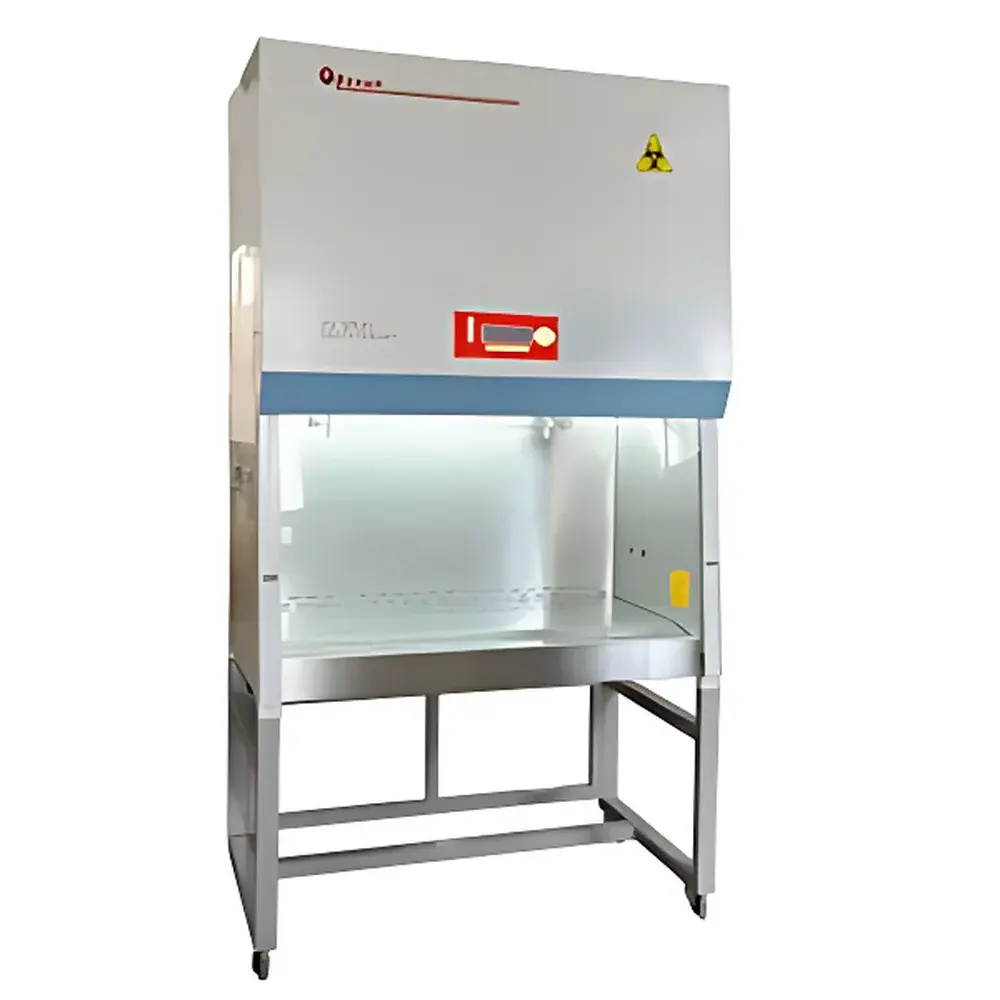
BOXUN BSC-1000B2 Class II Biological Safety Cabinet
| Brand | BOXUN |
|---|---|
| Origin | Shanghai, China |
| Manufacturer Type | Authorized Distributor |
| Country of Origin | China |
| Model | BSC-1000B2 |
| Instrument Type | Class II Biological Safety Cabinet |
| External Dimensions (L×W×H) | 1120 × 895 × 2340 mm |
| Internal Work Area Dimensions (L×W×H) | 1000 × 500 × 640 mm |
| HEPA Filter Efficiency | ≥99.99% @ 0.3 µm |
| Inflow Velocity | 0.55 m/s |
| Downflow Velocity | 0.35 m/s |
| Downflow Control Accuracy | ±0.015 m/s |
| Pressure Differential Range | 0–500 Pa |
| Noise Level | ≤67 dB(A) |
| Vibration Peak-to-Peak | ≤5 µm |
| Average Illuminance | ≥650 lx |
| Operating Ambient Temperature | 10–30 °C |
| Relative Humidity | ≤70% (at 25 °C) |
| Atmospheric Pressure Range | 80–105 kPa |
| Lighting | 2 × 30 W fluorescent lamps + 1 × 18 W UV lamp |
| Power Consumption | 2.1 kW |
| Electrical Supply | AC 220 V ±10%, 50/60 Hz |
Overview
The BOXUN BSC-1000B2 is a certified Class II, Type A2 biological safety cabinet engineered for primary containment in biosafety level 1–2 (BSL-1/BSL-2) laboratories. It operates on the principle of laminar airflow management—drawing ambient air through a front intake grille, passing it over the work surface via a vertically downward HEPA-filtered downflow, and recirculating ~70% of the air back into the work area after filtration while exhausting ~30% externally via a dedicated ducted system or optional canopy connection. This dual-path airflow architecture ensures simultaneous protection of personnel, product (sample integrity), and environment—meeting the fundamental tripartite safety mandate defined by NSF/ANSI 49-2022 and EN 12469:2000 standards. Designed for routine use in molecular biology, cell culture, clinical microbiology, vaccine production, and biopharmaceutical QA/QC workflows, the BSC-1000B2 integrates robust mechanical design with real-time environmental monitoring to support GLP-compliant and ISO 13485-aligned laboratory operations.
Key Features
- Structural modularity: Split-frame chassis with heavy-duty casters and adjustable leveling screws enables precise floor alignment and safe relocation without disassembly.
- Human-centered ergonomics: 5° inclined sash window fabricated from tempered, UV-resistant, shatterproof glass minimizes visual fatigue and glare during extended operation.
- Precision airflow control: Dual-sensor feedback loop using imported U.S.-made thermal anemometers maintains constant inflow (0.55 m/s) and downflow (0.35 m/s) velocities within ±0.015 m/s tolerance—critical for consistent particle entrapment and cross-contamination prevention.
- Intelligent filter management: Real-time differential pressure monitoring triggers audible/visual/Chinese-text alerts when pre-filter resistance exceeds threshold or HEPA integrity is compromised—supporting proactive maintenance scheduling per ISO 14644-3 requirements.
- Integrated safety interlocks: UV lamp and main lighting are electrically interlocked with sash position; alarm activates if sash exceeds safe operating height; fan automatically shuts off upon full sash closure.
- Durable interior construction: Work chamber lined with seamless, electropolished SUS304 stainless steel featuring radius-curved corners and fully welded seams—eliminating microbial harborage points and enabling validated cleaning protocols.
- Service-ready infrastructure: Built-in liquid collection trough with drain valve, dual AC outlets (one splash-proof), and standardized ports for water/gas supply facilitate integration into regulated cleanroom utilities.
Sample Compatibility & Compliance
The BSC-1000B2 accommodates standard tissue culture flasks (T25–T225), Petri dishes, centrifuge tubes, pipette racks, and small-scale bioreactors up to 640 mm working height. Its 1000 × 500 mm work surface supports simultaneous handling of multiple sterile procedures without compromising laminar flow uniformity. The unit complies with NSF/ANSI 49-2022 (Class II, Type A2), EN 12469:2000, and GB 50346-2011 (China’s Biosafety Laboratory Construction Standard). All airflow velocity profiles, filter penetration tests, and containment verification data are traceable to third-party certification reports issued by CNAS-accredited testing laboratories. Optional documentation packages include IQ/OQ protocols aligned with FDA 21 CFR Part 11 for electronic record integrity and audit trail generation.
Software & Data Management
While the BSC-1000B2 employs a microprocessor-based embedded controller (no external PC dependency), its LCD interface logs and displays time-stamped operational parameters—including real-time inflow/downflow velocity, static pressure differential across filters, cumulative runtime, and alarm event history. Data export is supported via RS232 serial interface for integration with centralized lab monitoring systems (e.g., LabVantage, STARLIMS). All critical alarms generate timestamped entries with severity classification (warning vs. critical stop), satisfying GLP requirement §58.130(a)(2) for instrument performance documentation. Firmware updates are performed via secure USB port under password-protected administrative mode, ensuring configuration integrity and version control.
Applications
- Aseptic manipulation of primary mammalian and insect cell lines under BSL-2 conditions
- Preparation of diagnostic reagents and ELISA assay components
- Handling of low-risk genetically modified organisms (GMOs) per OECD Consensus Document guidelines
- Quality control testing of sterile pharmaceutical intermediates (e.g., lyophilized APIs)
- Microbiological analysis of environmental swabs and clinical specimens
- Supporting ISO 11137-1 sterilization validation studies requiring controlled non-sterile staging zones
FAQ
Is the BSC-1000B2 certified to NSF/ANSI 49?
Yes—the unit carries full NSF/ANSI 49-2022 Class II, Type A2 certification, verified by independent testing and documented in the Certificate of Conformance supplied with each unit.
Can it be installed without external ducting?
It may operate in recirculating (non-ducted) mode only when equipped with an approved canopy and hard-ducted exhaust—per NSF 49 Section 6.3.2. Unducted use is prohibited for volatile chemicals or radionuclides.
What maintenance intervals are recommended for HEPA filters?
HEPA filters should be integrity-tested semiannually per ISO 14644-3, with replacement triggered by pressure drop >250 Pa across the filter bank or confirmed leakage during DOP/PAO scanning.
Does the unit support remote monitoring via Ethernet or Wi-Fi?
No native Ethernet/Wi-Fi module is included; however, RS232 output allows connection to industrial gateways for protocol translation (e.g., Modbus TCP) into enterprise SCADA or LIMS platforms.
Is UV irradiance intensity measured and validated at installation?
Yes—UV lamp output is verified using a NIST-traceable radiometer during commissioning; minimum irradiance of 40 µW/cm² at 1 meter is confirmed across the entire work surface per CLSI M29-A3 recommendations.





