
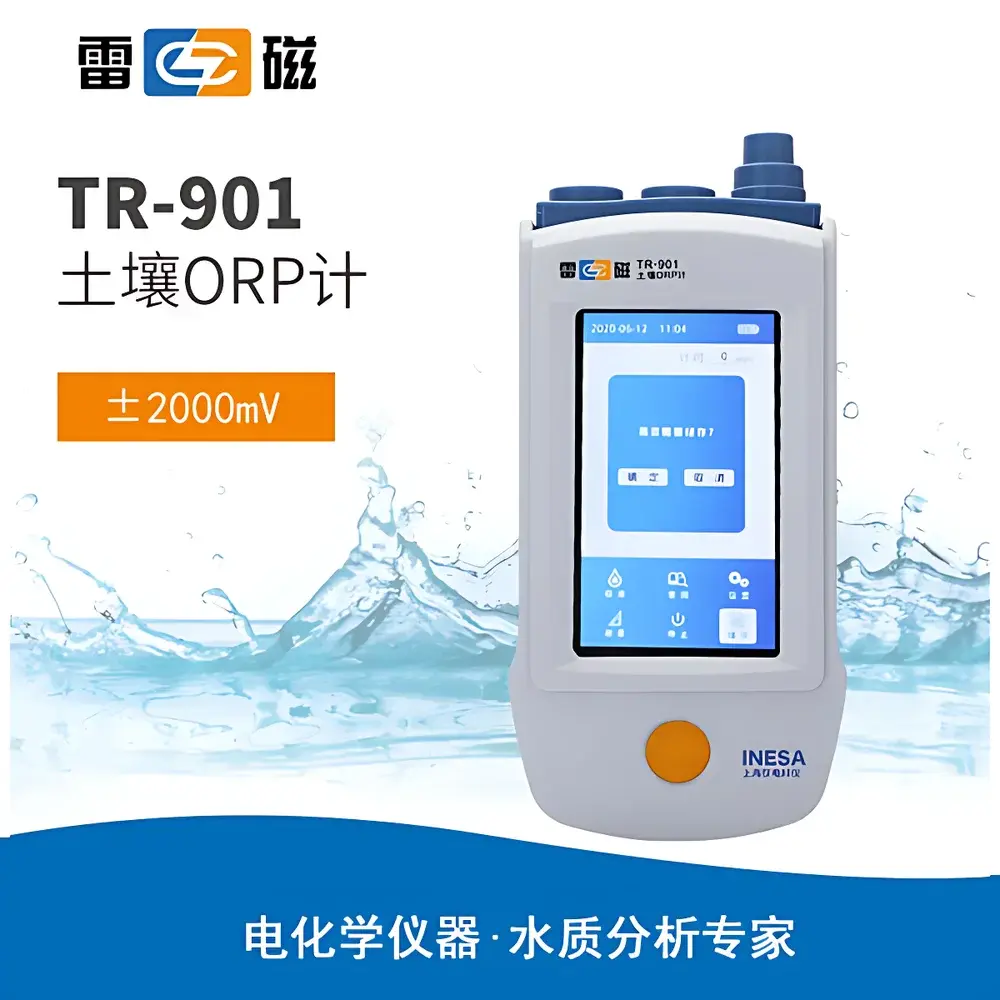
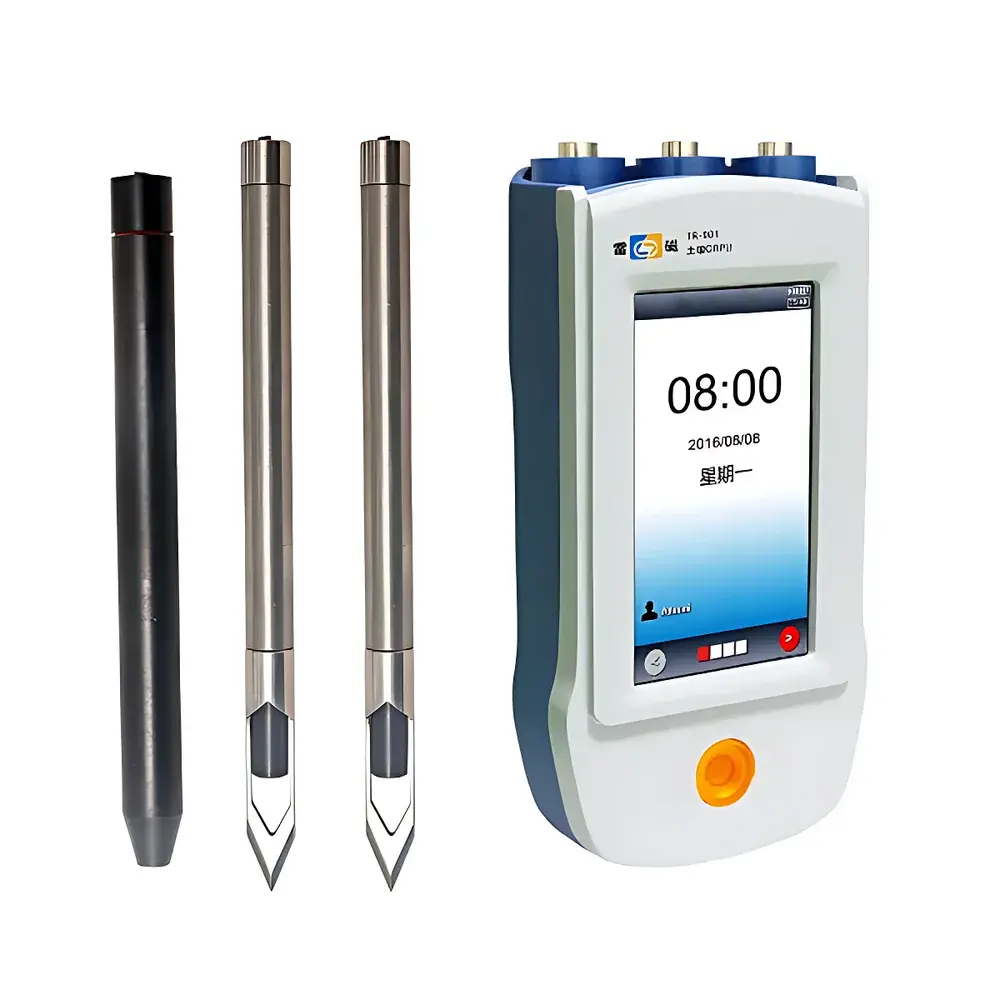
Leici TR-901 Soil ORP Meter
| Brand | Leici |
|---|---|
| Origin | Shanghai, China |
| Manufacturer Type | Authorized Distributor |
| Region of Manufacture | Domestic (China) |
| Model | TR-901 |
| Price | USD 920 (FOB Shanghai) |
| Instrument Type | Laboratory & Field-Portable Soil ORP Meter |
| Measurement Principle | Potentiometric Redox Potential (Eh) Determination via Dual-Electrode Cell |
| Compliance | HJ 746–2015 (Chinese EPA Standard for Soil Oxidation-Reduction Potential Determination by Potentiometry) |
| Protection Rating | IP65 |
| Power Supply | Rechargeable Li-ion Battery (USB-C input compatible with external power banks) |
| Data Storage | 500 measurement records with timestamp, temperature, and electrode status metadata |
Overview
The Leici TR-901 Soil ORP Meter is a field-deployable, dual-channel potentiometric instrument engineered for in-situ determination of oxidation-reduction potential (Eh) in moist or freshly sampled soils. Based on the Nernst equation and calibrated against standard redox couples (e.g., quinhydrone or Ag/AgCl reference systems), the TR-901 measures the electrical potential difference between a noble-metal working electrode (typically Pt or Au) and a stable reference electrode under defined ionic conditions. Unlike aqueous solution ORP measurements, soil Eh assessment requires direct solid-phase contact and controlled moisture saturation to ensure representative electron-transfer kinetics at the electrode–soil interface. The TR-901 satisfies the methodological requirements of HJ 746–2015 — China’s national environmental monitoring standard — which specifies electrode geometry, insertion depth, equilibration time (≥3 min), and temperature compensation protocols for reproducible field data acquisition. Its design bridges laboratory-grade metrological rigor with ruggedized portability, enabling consistent Eh profiling across agricultural fields, wetland restoration sites, contaminated land assessments, and biogeochemical research transects.
Key Features
- Dual independent ORP measurement channels: Enables simultaneous verification using redundant electrode pairs or comparative analysis between adjacent soil horizons or treatments.
- Integrated stainless-steel hollow probe assembly: Combines Pt working electrode, Ag/AgCl reference electrode, and porous ceramic junction in a single 12 mm diameter, 300 mm length rod for minimal soil disturbance during insertion.
- High-resolution color TFT touchscreen (480 × 272 pixels): Intuitive navigation menu supports multilingual UI (English, Chinese, Spanish), real-time trend graphing, and contextual help overlays.
- Automatic and manual temperature compensation: Compensates Eh readings per the Nernst slope (−59.16 mV/pH unit at 25 °C), using either built-in thermistor (range: 5.0–60.0 °C, resolution: 0.1 °C) or user-input ambient value.
- Two-point calibration capability: Supports calibration with certified buffer solutions (e.g., +430 mV Zobell’s solution and −200 mV sulfide buffer) to verify linearity across the full ±2000 mV range.
- Auto-read stabilization logic: Locks reading only after potential drift falls below 0.5 mV/10 s for ≥5 s, ensuring thermodynamic equilibrium is reached prior to recording.
- Configurable data logging interval: Sampling intervals adjustable from 1 minute to 60 minutes, with automatic timestamping (RTC-backed), GPS-tagging optional via Bluetooth pairing with mobile devices.
- Extended battery life: 8-hour continuous operation on single charge; USB-C rechargeable Li-ion battery supports hot-swappable external power bank integration without interrupting measurement.
Sample Compatibility & Compliance
The TR-901 is validated for use with mineral soils (clay, loam, sand), organic-rich peats (up to 85% OM), and saturated hydric soils exhibiting redoximorphic features. It is not intended for dry, compacted, or highly calcareous substrates (>15% CaCO₃) where electrode polarization or junction clogging may compromise accuracy. All measurements adhere to HJ 746–2015 procedural constraints: soil moisture maintained at field capacity (−33 kPa matric potential), electrode insertion depth ≥10 cm, and minimum equilibration time of 180 seconds before final reading. While not certified to ISO/IEC 17025 or ASTM D3740, the instrument’s traceable calibration protocol, documented uncertainty budget (±1 mV within ±1000 mV range), and audit-ready data export (CSV via microSD or USB) support GLP-aligned field reporting. Full compliance documentation—including certificate of conformance, calibration log template, and raw data file structure—is supplied with each unit.
Software & Data Management
Data are stored internally as structured CSV files containing: measurement ID, date/time (ISO 8601), Eh (mV), temperature (°C), channel ID, calibration status flag, and operator notes field. Export is supported via microSD card (FAT32 formatted, up to 32 GB) or direct USB-Mass Storage mode. Leici provides free desktop software (Windows/macOS) for batch processing, statistical summary (mean, SD, min/max per site), and overlay plotting against ancillary parameters (e.g., pH, Fe²⁺ concentration). Audit trail functionality includes immutable timestamps, user login tracking (optional password protection), and change logs for calibration events — aligning with basic FDA 21 CFR Part 11 data integrity expectations for non-GMP environmental monitoring applications.
Applications
- Wetland biogeochemistry: Mapping Eh gradients across redox clines to infer dominant terminal electron acceptors (O₂ → NO₃⁻ → Mn⁴⁺ → Fe³⁺ → SO₄²⁻ → CO₂).
- Agricultural soil health assessment: Monitoring Eh shifts during rice paddy flooding cycles or cover crop decomposition to optimize nitrogen use efficiency.
- Contaminated site characterization: Screening for anaerobic degradation potential in petroleum- or chlorinated solvent-impacted soils.
- Landfill leachate plume tracking: Correlating subsurface Eh anomalies with dissolved Fe²⁺, CH₄, or H₂S concentrations.
- Educational field labs: Teaching principles of soil electrochemistry, microbial respiration pathways, and redox buffering capacity.
FAQ
Does the TR-901 require electrolyte refilling or gel replacement in its reference electrode?
No — the Ag/AgCl reference element is sealed with polymerized KCl gel and rated for ≥2 years of field use without maintenance.
Can the instrument be used in submerged sediments or waterlogged porewater?
Yes, but only when the probe is fully inserted into the solid matrix; direct immersion in standing water invalidates HJ 746–2015 compliance and introduces liquid-junction errors.
Is third-party calibration certification available?
Leici offers optional NIST-traceable calibration verification service (certified report + uncertainty statement) upon request, valid for 12 months.
What is the recommended storage protocol for long-term idle periods?
Store with electrodes hydrated in 3 mol/L KCl solution, powered off, and battery charged to 40–60%; avoid freezing or >40 °C environments.
Does the TR-901 support Bluetooth or Wi-Fi connectivity?
Bluetooth 4.2 is embedded for optional GPS tagging and remote firmware updates; Wi-Fi is not implemented to preserve electromagnetic noise immunity in field deployments.




