
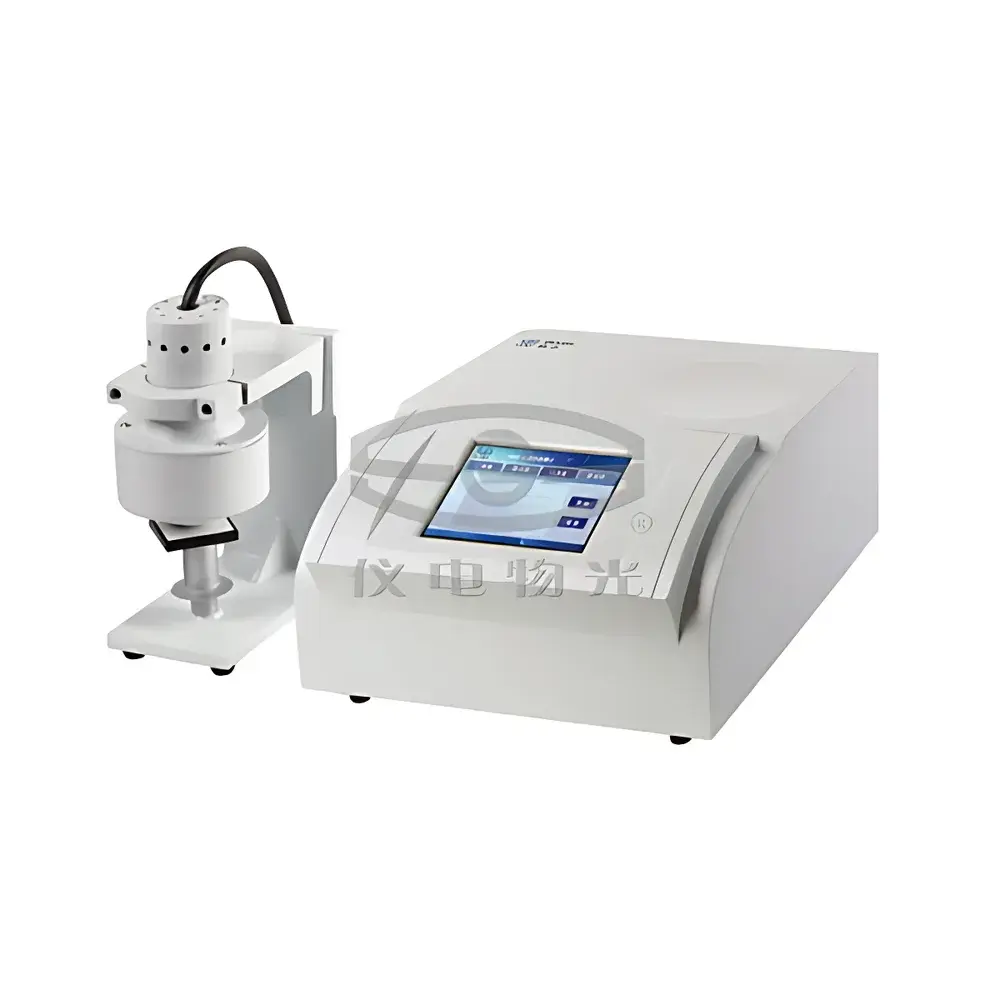
YDWG WSC-2S Desktop Color Difference Meter
| Brand | YDWG |
|---|---|
| Origin | Shanghai, China |
| Model | WSC-2S |
| Instrument Type | Desktop |
| Optical Geometry | 0°/45° integrating sphere |
| Illuminant | CIE Standard Illuminant D65 (10° observer) |
| Spectral Response | Equivalent to CIE 1964 10° standard observer tristimulus values X, Y, Z |
| Repeatability | δu(Y) ≤ 0.2, δu(x) ≤ 0.003, δu(y) ≤ 0.003 |
| Display | 7-inch capacitive touch screen |
| Color Spaces | CIE XYZ, CIE Yxy, CIELAB (L*a*b*), CIELCh, CIELUV, Hunter Lab |
| Whiteness Indices | Ganz, CIE Blue-Reflectance (W = B), ASTM E313 Yellowness Index (YI), Hunter Whiteness (Wh), Building Materials Whiteness (Wj), Taber (W = 4B − 3G) |
| Data Storage | 1,000 measurement sets with recall capability |
| Interfaces | USB host/device, USB flash drive support |
| Compliance | JJG 595–2002 (Class I), GB/T 13173–2021, GB/T 5950–2008, GB/T 17644–1998, ASTM E313, ISO 2470–1 |
Overview
The YDWG WSC-2S Desktop Color Difference Meter is a precision optical instrument engineered for quantitative colorimetric analysis in industrial quality control and R&D laboratories. It operates on the CIE 0°/45° illumination/viewing geometry—standardized under ISO 7724-1 and ASTM E308—ensuring high geometric fidelity for surface reflectance measurements of non-fluorescent, matte to semi-gloss samples. The instrument’s spectral response is calibrated to emulate the CIE 1964 10° standard observer under D65 illuminant conditions, enabling traceable computation of tristimulus values (X, Y, Z) and derived color spaces including CIELAB, CIELCh, and CIELUV. Designed for metrological rigor, the WSC-2S complies with JJG 595–2002 Class I accuracy requirements and supports white and yellowness index calculations per GB/T 5950–2008, GB/T 13173–2021, and ASTM E313—making it suitable for regulated environments requiring documented measurement uncertainty and repeatability.
Key Features
- 7-inch high-resolution capacitive touch screen interface with intuitive icon-driven navigation and real-time spectral preview
- Dual-mode data output: direct thermal printing (RD TH-32SC optional), USB-host connectivity for PC-based reporting, and plug-and-play USB flash drive export in CSV format
- Onboard storage for up to 1,000 measurement records—including reference spectra, sample IDs, timestamps, and operator annotations—with full recall and comparative delta-E evaluation
- Multi-standard whiteness engine supporting six distinct algorithms: Ganz, Blue-Reflectance (W = B), Taber (W = 4B − 3G), Hunter Whiteness (Wh), Building Materials Whiteness (Wj), and ASTM E313 Yellowness Index (YI)
- Robust mechanical architecture with integrated 0°/45° optical head (Φ120 mm × 170 mm) and stable 220 V ±10 %, 50 Hz power supply (30 W max), optimized for continuous operation in QC labs
Sample Compatibility & Compliance
The WSC-2S accepts flat, rigid, or moderately curved opaque samples with minimum diameter ≥25 mm and surface roughness < Ra 3.2 µm. It is validated for use across textiles, paper, ceramics, plastics, paints, food packaging, and construction materials—including porcelain enamel, gypsum board, and bleached pulp. All measurement protocols align with national and international standards: GB/T 17644–1998 (textile fiber whiteness), GB/T 5950–2008 (ceramic and mineral product whiteness), and GB/T 13173–2021 (detergent brightness). While not FDA 21 CFR Part 11–certified out-of-the-box, its audit-ready data logs (with timestamped operator entries and version-controlled firmware) support GLP/GMP-aligned documentation workflows when deployed with controlled access and SOP-defined calibration intervals.
Software & Data Management
Data acquisition and reporting are fully self-contained within the embedded firmware—no proprietary PC software required. Measurement files include raw tristimulus values, calculated color coordinates, ΔE metrics (ΔEab, ΔEuv, ΔE00), and whiteness/yellowness indices—all timestamped and tagged with user-defined batch IDs. USB export generates ISO/IEC 27001–compatible CSV files containing metadata headers compliant with ISO/IEC 17025 Annex A.3 requirements for result traceability. Optional thermal printer output includes instrument ID, calibration date, standard reference ID (e.g., NPL-certified ceramic tile), and statistical summary (mean ΔE, SD, n=3).
Applications
- Textile dye lot consistency verification against master standards per AATCC Evaluation Procedure 1
- Whiteness grading of paper and pulp per ISO 2470–1 and TAPPI T485
- Ceramic glaze color matching in architectural tile manufacturing
- Quality release testing of pharmaceutical tablet coatings using L*a*b* tolerancing (±0.5 ΔEab)
- Raw material incoming inspection for pigment dispersion uniformity in paint formulation
- Regulatory compliance reporting for food contact packaging color stability under accelerated aging (ASTM D4303)
FAQ
Does the WSC-2S support CIE DE2000 (ΔE00) calculation?
Yes—firmware v2.3+ includes full CIEDE2000 algorithm implementation with default weighting parameters (kL=kC=kH=1) and chroma-dependent compensation.
Is calibration traceable to national standards?
The instrument ships with a factory certificate referencing NIM (National Institute of Metrology, China)–verified ceramic tile standards. Users may perform intermediate verification using supplied calibration tiles (certified SRM equivalents).
Can measurement data be integrated into LIMS or SAP QM modules?
CSV exports are structured for direct ingestion into common LIMS platforms (e.g., Thermo Fisher SampleManager, LabVantage) via scheduled file polling or API middleware; no native HL7 or ASTM E1384 support is provided.
What is the recommended recalibration interval?
Per JJG 595–2002, annual verification against traceable standards is mandatory; daily zero calibration and weekly white tile validation are advised for critical applications.
Is the optical head interchangeable with other WSC-series models?
No—the 0°/45° head is mechanically and optically tuned to the WSC-2S detector array and firmware; cross-model interchange voids metrological certification.




