
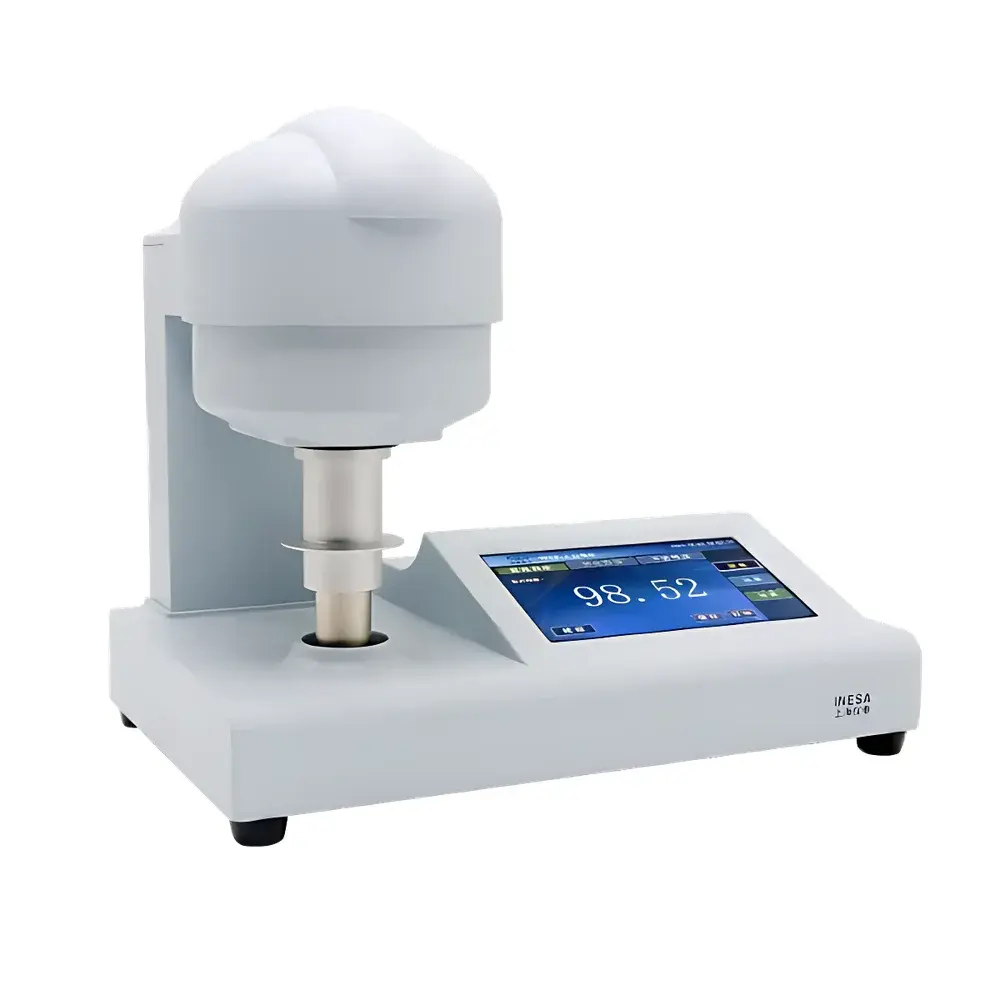
YDWO WSB-3 Whiteness Meter
| Brand | YDWO |
|---|---|
| Origin | Shanghai, China |
| Model | WSB-3 |
| Measurement Modes | R457 Blue-Light Whiteness, Fluorescent Whiteness, Opacity |
| Illumination Geometry | d/0 and 45/0 compliant |
| Spectral Peak | 457 nm ±2 nm, FWHM: 45 nm ±5 nm |
| Detector | Silicon Photodiode |
| Aperture | 20 mm |
| Range | 0–150 WHITENESS UNITS |
| Resolution | 0.01 unit |
| Accuracy | ±1.0 units |
| Repeatability | ≤0.2 units |
| Stability (8-hr drift) | ≤0.1 units |
| Display | 7-inch color capacitive touchscreen |
| Data Storage | 200 test records |
| Interface | USB host for U-disk export |
| Power | 100–240 VAC, 50/60 Hz, 40 W |
| Dimensions (W×D×H) | 360 × 228 × 312 mm |
| Net Weight | 4.8 kg |
Overview
The YDWO WSB-3 Whiteness Meter is a precision optical instrument engineered for standardized measurement of whiteness and opacity across diverse industrial and quality control laboratories. Based on the internationally recognized R457 blue-light reflectance method (defined in ISO 2470-1, GB/T 7974, and TAPPI T427), the instrument employs a stabilized blue LED source centered at 457 nm (±2 nm) with a spectral bandwidth of 45 nm (±5 nm) to quantify diffuse reflectance from planar, non-transparent, or semi-transparent samples. Its dual-geometry optical design supports both d/0 (diffuse illumination, 0° viewing) and 45/0 (45° annular illumination, 0° viewing) configurations—enabling compliance with multiple national and industry-specific standards including QB/T 2804-2006 (paper/board), GB/T 1543-2005 (opacity), GB/T 22427.6-2008 (starch), and GB/T 2913-1982 (plastics). The integrated fluorescent excitation source allows simultaneous evaluation of optical brightener response under UV-enhanced conditions, critical for assessing treated papers, textiles, and synthetic polymers.
Key Features
- Dual-source optical architecture: Independent blue LED (457 nm) and UV-augmented fluorescent excitation for R457 and fluorescent whiteness measurements in a single platform
- Compliant illumination geometries: Hardware-switchable d/0 and 45/0 optical paths—no mechanical reconfiguration required—ensuring traceable alignment per ISO/CIE recommendations
- High-stability photometric system: Calibrated silicon photodiode detector with temperature-compensated signal conditioning; long-term stability maintained at ≤0.1 unit over 8 hours
- Intuitive human interface: 7-inch capacitive color touchscreen with icon-driven navigation, real-time graphing, and on-screen calibration prompts
- Robust data integrity: Local storage of 200 test records with timestamp, sample ID, geometry mode, and measurement type; USB host port enables direct export to FAT32-formatted U-disk in CSV format
- Modular peripheral support: Optional thermal printer (USB-connected) for GLP-compliant hardcopy output with embedded instrument ID, date/time, and operator tag
Sample Compatibility & Compliance
The WSB-3 accommodates flat, rigid, or lightly compressible solid samples up to 20 mm in diameter—including paper sheets, ceramic tiles, polymer pellets (ground or pressed), powdered minerals (e.g., kaolin, calcium carbonate, TiO₂), food-grade starches, and salt crystals. Sample presentation follows standard specimen preparation protocols defined in GB/T 7974-2013 (pulp), GB/T 13025.2-2008 (salt), and GB/T 23774-2009 (inorganic chemicals). All optical pathways are aligned and validated against NIST-traceable ceramic white standards (certified L* ≥97.5, CIE Whiteness ≥150). The instrument meets electromagnetic compatibility (EMC) requirements per GB/T 18268.1-2010 and safety specifications per GB 4793.1-2007, supporting routine use in ISO/IEC 17025-accredited testing environments.
Software & Data Management
Data acquisition and reporting are fully embedded within the firmware—no external PC software is required for basic operation. Each stored record includes: measurement mode (R457/fluorescent/opacity), geometry selection, raw reflectance value, calculated whiteness index, operator ID (manually entered), and UTC timestamp. Exported CSV files contain column headers compatible with LIMS integration (e.g., “Sample_ID”, “Whiteness_R457”, “Geometry”, “Date_UTC”, “Instrument_Serial”). Audit trail functionality logs all calibration events, zero adjustments, and geometry changes—supporting GLP documentation and FDA 21 CFR Part 11 readiness when paired with controlled user access (via optional password-protected admin mode).
Applications
- Quality assurance of paper and board products: R457 whiteness verification per QB/T 2804-2006 and opacity assessment per GB/T 1543-2005
- Food-grade starch and salt manufacturing: Compliance testing per GB/T 22427.6-2008 and GB/T 13025.2-2008
- Inorganic pigment production: TiO₂, precipitated calcium carbonate, and talc whiteness screening per GB/T 23774-2009
- Plastics and synthetic fibers: ASTM D534-18 equivalent R457 evaluation for masterbatch and finished goods
- Ceramic and enamel glaze development: Reflectance uniformity mapping across fired tile surfaces
- Textile and nonwoven processing: Optical brightener quantification in bleached cotton and polyester blends
FAQ
What standards does the WSB-3 directly support?
The instrument implements R457 whiteness per ISO 2470-1, GB/T 7974-2013, and TAPPI T427; opacity per GB/T 1543-2005; fluorescent whiteness per GB/T 22427.6-2008; and salt/starch/plastic methods referenced in their respective Chinese national standards.
Is calibration traceable to national standards?
Yes—factory calibration uses NIST-traceable white ceramic standards certified by the Shanghai Institute of Measurement and Testing Technology (SIMT), with full calibration certificate provided upon request.
Can the WSB-3 measure liquid suspensions?
No—the instrument is designed exclusively for solid or powder samples presented on a flat, opaque backing; liquid-phase transmission or turbidity measurement is outside its operational scope.
Does it support automated pass/fail judgment against preset limits?
Yes—user-defined upper/lower thresholds can be assigned per measurement mode; results display color-coded status (green/pass, red/fail) on screen and in exported reports.
Is firmware upgrade capability available?
Firmware updates are delivered via USB U-disk using signed binary packages; version history and update logs are retained in system memory for audit purposes.




