
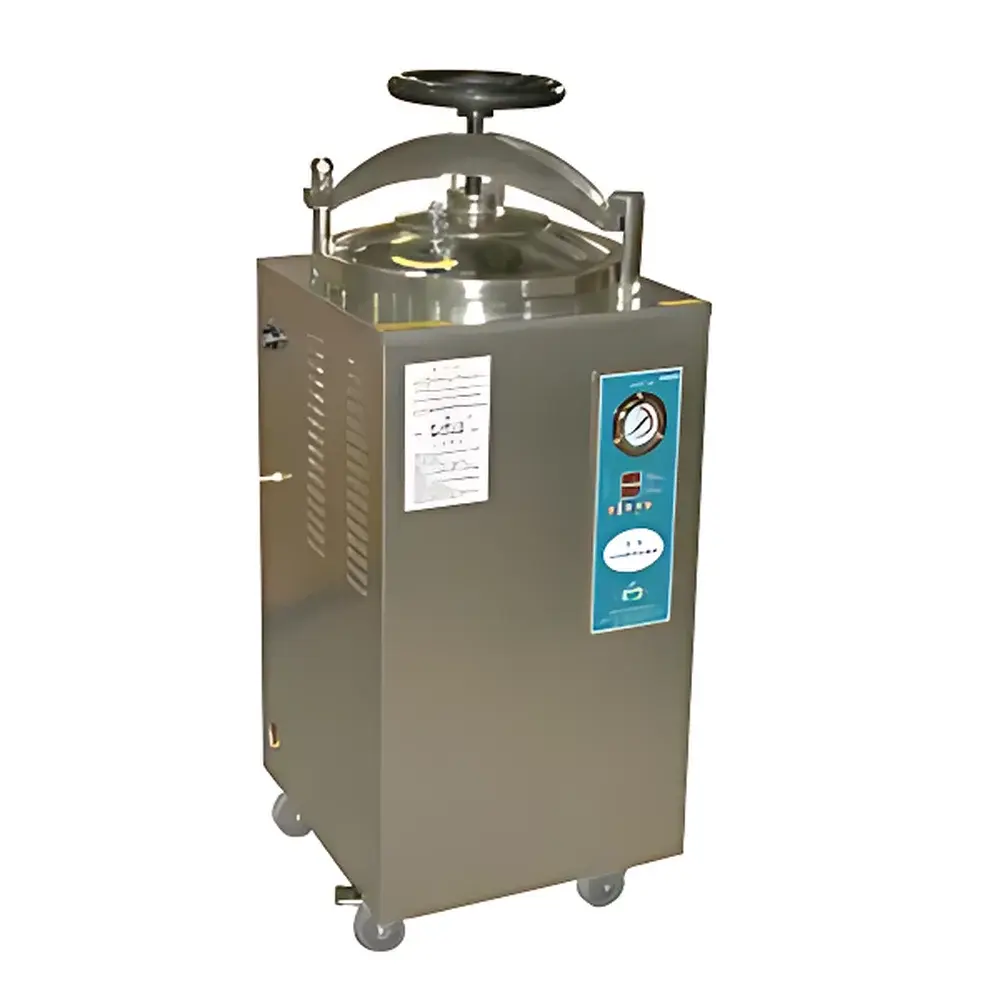
BOXUN YXQ-50SII Vertical Steam Sterilizer
| Brand | BOXUN |
|---|---|
| Origin | Shanghai, China |
| Model | YXQ-50SII |
| Instrument Type | Vertical |
| Max Temperature | 135 °C |
| Max Pressure | 0.22 MPa |
| Chamber Dimensions | Φ400 × 630 mm |
| Chamber Volume | 50 L |
| External Dimensions | 485 × 485 × 1120 mm |
| Power | 3.1 kW |
| Voltage/Frequency | 220 V ±10%, 50 Hz ±2% |
| Timer Range | 0–120 min |
| Design Temp/Pressure | 138 °C / 0.25 MPa |
| Basket Size | Φ360 × 240 mm (2 pcs) |
Overview
The BOXUN YXQ-50SII Vertical Steam Sterilizer is a fully self-contained, microprocessor-controlled autoclave engineered for reliable saturated steam sterilization in laboratory, clinical, and research environments. It operates on the principle of moist heat sterilization—utilizing pressurized saturated steam at elevated temperatures to irreversibly denature microbial proteins and nucleic acids. Designed to meet fundamental requirements for sterilization validation and routine bioburden reduction, the unit delivers consistent lethality (F0 ≥ 12 min) across standard load configurations when operated within validated cycles (e.g., 121 °C for 15–20 min or 135 °C for 3–5 min). Its vertical orientation optimizes floor space utilization while maintaining full compliance with core safety and performance expectations for Class N (non-porous load) and Class B (porous, wrapped, and hollow load) sterilization per ISO 17665-1:2019.
Key Features
- Robust stainless steel construction: Chamber, inner door, and baskets fabricated from SUS304 austenitic stainless steel—resistant to corrosion from repeated exposure to steam, condensate, and common cleaning agents.
- Interlocked handwheel door mechanism: Complies with EN 285:2015 Annex C requirements for mechanical safety; prevents door opening under pressure and ensures positive sealing via an auto-expanding silicone gasket.
- Intelligent process control: Microprocessor-based controller manages temperature, pressure, and time parameters with real-time digital display; supports programmable cycle selection and manual override.
- Automated air removal: Integrated gravity displacement system with automatic cold air purge ensures complete air evacuation prior to steam saturation—critical for achieving uniform thermal penetration.
- Dual safety protection: Independent overtemperature cutoff (138 °C limit) and pressure relief valve (set at 0.25 MPa design pressure) provide redundant fail-safes against thermal or mechanical overpressure events.
- Operational safeguards: Low-water-level alarm with automatic power cutoff, pressure-dependent interlock logic, audible end-of-cycle alert, and visual status indicators for all critical phases (heat-up, sterilize, exhaust, dry).
Sample Compatibility & Compliance
The YXQ-50SII accommodates a broad range of sterilizable materials including surgical instruments, glassware (flasks, Petri dishes), textile packs (gauze, drapes), liquid media (in vented containers), and polymer-based labware compatible with moist heat. Chamber geometry (Φ400 × 630 mm) and dual-tier basket configuration (Φ360 × 240 mm × 2) support flexible loading patterns while preserving steam circulation integrity. The unit meets essential safety and functional criteria aligned with GB 8599–2008 (Chinese national standard for large steam sterilizers), and its operational logic supports adherence to ISO 13485 quality management systems for medical device reprocessing. While not pre-certified to EN 285 or FDA 21 CFR Part 820 out-of-the-box, its architecture permits integration into GLP/GMP workflows when paired with external validation protocols (e.g., biological indicators, thermocouple mapping, cycle documentation).
Software & Data Management
The embedded controller logs cycle start time, setpoints, actual temperature/pressure profiles, and completion status to internal non-volatile memory (retains ≥100 cycles). Optional RS232 or USB interface enables data export for audit trail generation—supporting basic traceability requirements under ISO 9001 or internal QA procedures. Though no proprietary software suite is bundled, exported CSV files are compatible with common spreadsheet and LIMS platforms. For regulated environments requiring electronic record integrity, users may implement third-party validation-compatible data acquisition systems connected via analog outputs (0–5 V or 4–20 mA) for continuous thermal profiling and long-term archive.
Applications
- Routine sterilization of reusable laboratory tools (forceps, scalpels, pipette tips) in academic and industrial research labs.
- Preparation of sterile culture media, buffers, and reagents for microbiology, cell culture, and molecular biology workflows.
- Decontamination of biohazardous waste (e.g., agar plates, liquid cultures) prior to disposal, in alignment with institutional biosafety level (BSL-2) protocols.
- Processing of surgical kits and wound dressings in small-scale clinical or veterinary settings where centralized sterilization services are unavailable.
- Validation support for sterilization process development—serving as a reference platform for F0 calculation, BI challenge testing, and load distribution studies.
FAQ
What is the maximum validated load capacity for liquid sterilization?
The chamber volume (50 L) supports up to 30 L of liquid load in vented containers; exceeding this volume risks boil-over and incomplete sterilization due to inadequate steam penetration.
Does the unit comply with FDA 21 CFR Part 11 for electronic records?
No—the onboard controller does not provide audit trail, electronic signature, or data integrity features required by Part 11; external validation-grade data loggers must be used for regulated submissions.
Can I sterilize wrapped instruments using the YXQ-50SII?
Yes, provided the wrapping material is steam-permeable (e.g., medical-grade paper-plastic pouches) and loads are arranged to allow unobstructed steam flow; cycle selection must include sufficient pre-vacuum or gravity purge time.
Is a printer interface standard or optional?
Printer connectivity is optional and requires external serial-to-thermal-printer adapters; no built-in thermal printer is included.
What maintenance intervals are recommended for long-term reliability?
Daily: Check water level and door seal integrity. Weekly: Clean chamber interior and drain filter. Annually: Calibrate temperature/pressure sensors and verify safety valve function per manufacturer guidelines.



