
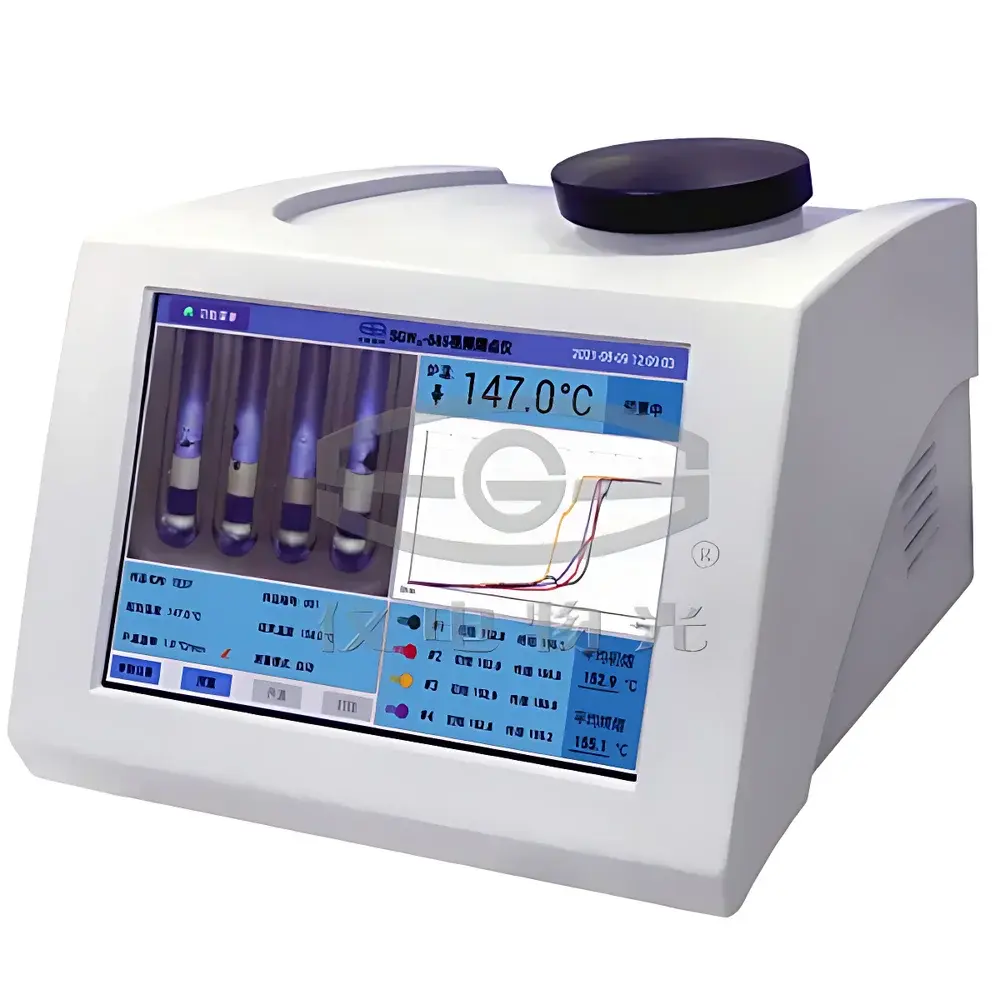
YDWG SGW®-682 Automated Video Melting Point Apparatus
| Brand | YDWG |
|---|---|
| Origin | Shanghai, China |
| Model | SGW®-682 |
| Temperature Range | Ambient to 360 °C |
| Heating Rate | 0.1–20.0 °C/min (continuously adjustable) |
| Temperature Accuracy | ≤200 °C ±0.4 °C |
| Temperature Repeatability | ±0.3 °C at 1.0 °C/min |
| Temperature Resolution | 0.1 °C |
| Capillary Dimensions | OD 1.4 mm, ID 1.0 mm, Length 90 mm |
| Sample Capacity | 4 capillaries simultaneously |
| Display | 10.1″ IPS capacitive touchscreen |
| Camera | 720p @ 30 fps |
| Data Storage | 64 GB internal |
| Operating System | Android |
| Compliance Options | FDA 21 CFR Part 11 audit trail (optional), GLP/GMP-ready |
Overview
The YDWG SGW®-682 Automated Video Melting Point Apparatus is a precision thermal analysis instrument engineered for pharmaceutical, chemical, and academic laboratories requiring regulatory-compliant, high-fidelity melting point determination. It operates on the principle of real-time optical monitoring of solid-to-liquid phase transition under controlled linear heating, using calibrated platinum resistance thermometry and synchronized high-frame-rate video capture. Unlike traditional analog or semi-automated units, the SGW®-682 integrates a dedicated Android-based embedded platform with industrial-grade thermal control architecture—combining PID feedback regulation and PWM-driven heating elements—to deliver stable, reproducible temperature ramps across its full operational range (ambient to 360 °C). The system adheres to pharmacopeial standards—including USP <741>, EP 2.2.17, and ChP Section IV—by employing standard 1.0 mm ID / 1.4 mm OD / 90 mm length capillaries and supporting both automatic endpoint detection and manual visual verification via live video feed.
Key Features
- 10.1-inch IPS capacitive touchscreen interface with intuitive Android OS navigation, enabling method setup, real-time monitoring, and post-analysis review without external computing hardware
- 720p high-definition camera operating at 30 frames per second, delivering smooth, artifact-free video recording of sample melting dynamics—including onset (initial collapse), clear point (complete liquefaction), and intermediate morphological changes
- Dual-mode detection: auto-triggered melting point identification via high-sensitivity photodiode array combined with user-adjustable illumination intensity and detection threshold—optimized for low-contrast samples such as dark pigments, crystalline hydrates, or translucent polymers
- Integrated 64 GB internal storage supporting up to 20,000 complete measurement records, each containing time-stamped temperature profiles, annotated video clips (MP4), and digital calibration logs
- Precision heating block with Pt100 sensor and active thermal mass compensation, achieving ±0.3 °C repeatability at 1.0 °C/min ramp rate and <±10% linearity deviation across the full 0.1–20.0 °C/min range
- Modular connectivity suite: RS232 serial port, three USB 2.0 host ports (for printer, U-disk, or peripheral integration), and built-in Wi-Fi/Ethernet for LIMS or ELN synchronization
Sample Compatibility & Compliance
The SGW®-682 accommodates four standard pharmacopeial capillaries (1.0 mm inner diameter, 1.4 mm outer diameter, 90 mm length) loaded with 2–3 mm sample columns—ensuring consistency with USP, EP, JP, and ChP requirements. Its optical detection system supports heterogeneous sample types: highly colored organics, hygroscopic solids, and thermally labile compounds that exhibit gradual softening prior to sharp melting. Regulatory readiness is reinforced through optional FDA 21 CFR Part 11-compliant software, featuring four-tier user authentication, electronic signatures, immutable audit trails with timestamped operator actions, and full data integrity logging. All firmware and calibration events are cryptographically signed and retained within the device’s secure partition, satisfying GLP and GMP documentation expectations during inspection or validation.
Software & Data Management
Built on a hardened Android framework, the instrument’s native software enables creation and storage of up to 150 pre-configured methods—including custom ramp profiles, dwell times, and detection sensitivity presets. Measurement reports are exportable in PDF format with embedded video thumbnails and full-resolution MP4 files—directly to USB drives or network shares. Raw thermal data (time vs. temperature) is saved in CSV for third-party statistical analysis. The open API supports HL7, ASTM E1384, and ASTM E2500-compliant data exchange protocols, facilitating bidirectional integration with enterprise LIMS, QMS, or ERP systems. Calibration history—including multi-point NIST-traceable reference checks—is stored with metadata (operator ID, date, ambient conditions) and accessible via encrypted export.
Applications
- Pharmaceutical quality control: identity verification and purity assessment of active pharmaceutical ingredients (APIs) and excipients per ICH Q5 and Q6 guidelines
- Chemical synthesis validation: monitoring reaction endpoints and characterizing intermediate stability during process development
- Academic research: kinetic studies of polymorphic transitions, eutectic behavior, and decomposition onset in metal-organic frameworks (MOFs) or co-crystals
- Regulatory submissions: generation of auditable, timestamped evidence packages compliant with FDA, EMA, and PMDA review requirements
- Material science: thermal characterization of organic semiconductors, liquid crystals, and polymer additives where optical clarity correlates with phase homogeneity
FAQ
Does the SGW®-682 support multi-point temperature calibration traceable to NIST standards?
Yes—calibration routines include up to five user-defined reference points using certified melting standards (e.g., indium, tin, lead), with all coefficients and deviations logged in the audit trail.
Can video recordings be exported in formats compatible with electronic lab notebooks (ELNs)?
All video exports are H.264-encoded MP4 files with embedded UTC timestamps and synchronized thermal metadata, supporting direct ingestion into major ELN platforms including LabArchives and Benchling.
Is remote operation possible via network connection?
The instrument supports secure HTTPS-based web interface access and VNC-compatible remote desktop control when deployed on a local intranet or VLAN, subject to IT security policy approval.
What is the maximum allowable sample height deviation before measurement accuracy degrades?
For optimal photometric detection and thermal uniformity, sample column height must be maintained between 2.5 mm and 3.5 mm; deviations beyond this range may affect onset detection consistency due to axial temperature gradients.
How does the system handle samples that decompose before melting?
The software includes a “decomposition mode” that flags discoloration, bubbling, or charring events independently of melting—allowing dual-parameter reporting (onset of decomposition + melting point) with separate confidence indicators.



