
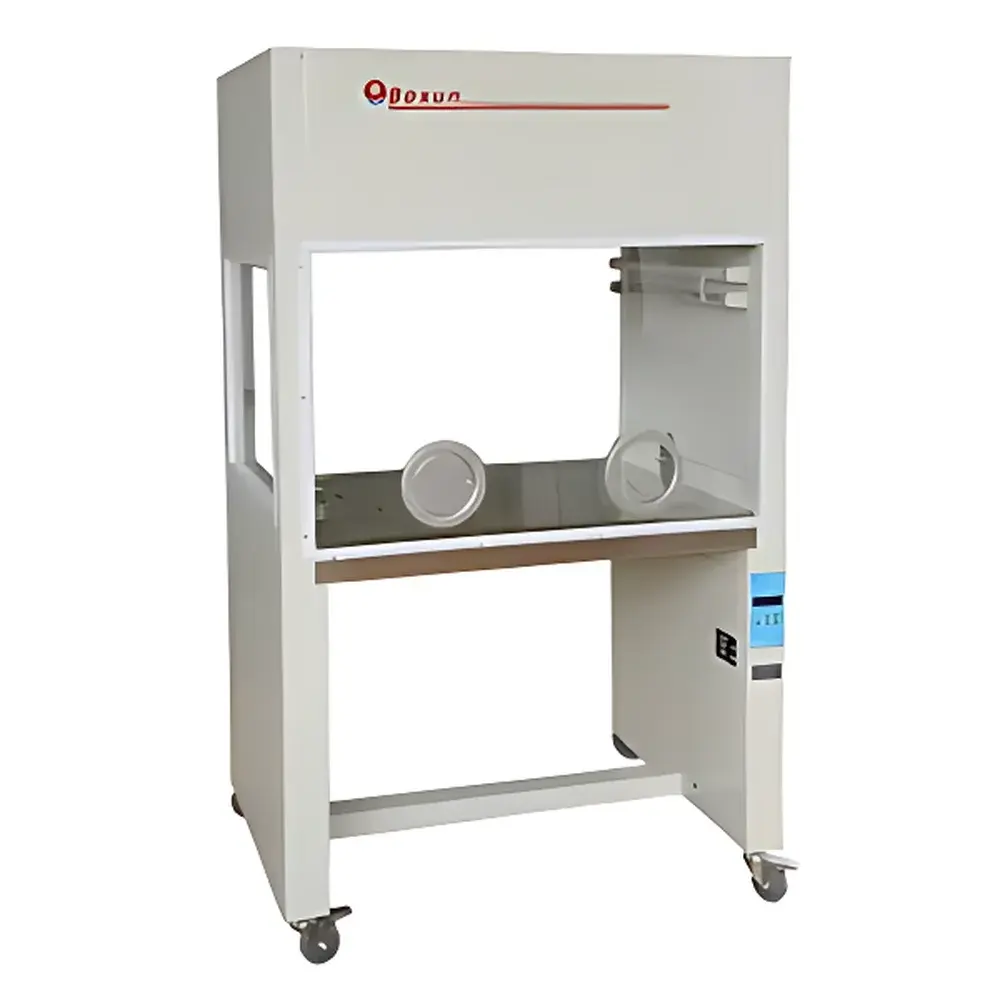
BOXUN SW-CJ-1FD Vertical Laminar Flow Clean Bench
| Brand | BOXUN |
|---|---|
| Origin | Shanghai, China |
| Manufacturer Type | Authorized Distributor |
| Product Category | Domestic |
| Model | SW-CJ-1FD |
| Instrument Type | Vertical Laminar Flow Clean Bench |
| Cleanliness Class | ISO Class 5 (100 @ ≥0.5 µm, ≥99.99% HEPA filtration efficiency) |
| Noise Level | ≤67 dB(A) |
| User Capacity | Single-user, single-face configuration |
| Airflow Pattern | Vertical downward laminar flow |
| Working Area Air Velocity Range | 0.3–0.6 m/s (adjustable in six steps) |
| Vibration Displacement (peak-to-peak) | ≤5 µm (X/Y/Z axes) |
| Illumination | ≥300 lux |
| Working Chamber Dimensions (W×D×H) | 870 × 700 × 520 mm |
| Overall Dimensions (W×D×H) | 990 × 724 × 1650 mm |
| HEPA Filter Specification | 820 × 615 × 50 mm (single unit) |
| Lighting | 20 W fluorescent lamp × 1 |
| UV Germicidal Lamp | 20 W × 1 (timer adjustable 0–999 min) |
| Net Weight | 110 kg |
| Power Consumption | 0.15 kW |
| Electrical Supply | AC 220 V ±10%, 50/60 Hz |
Overview
The BOXUN SW-CJ-1FD Vertical Laminar Flow Clean Bench is an ISO Class 5-certified local containment device engineered for applications requiring particle-free working environments at the benchtop level. It operates on the principle of vertical unidirectional laminar airflow—air drawn from the ambient laboratory environment passes sequentially through a pre-filter (medium-efficiency), then a certified HEPA filter (≥99.99% efficiency for particles ≥0.5 µm), and is delivered vertically downward across the work surface at a controlled, uniform velocity (0.3–0.6 m/s). This downward laminar curtain forms a physical barrier that isolates the work area from surrounding airborne contaminants, preventing cross-contamination between samples and operators. Unlike biological safety cabinets, the SW-CJ-1FD does not recirculate air nor provide personnel or environmental protection against hazardous aerosols; it is strictly intended for non-hazardous procedures where product protection is the primary objective—such as aseptic handling of cell cultures, sterile media preparation, microbiological plating, and precision assembly of sensitive optical or electronic components.
Key Features
- Robust structural design featuring a cold-rolled steel outer casing with electrostatic powder coating and a 304 stainless steel work surface—resistant to corrosion, chemical exposure, and routine decontamination protocols.
- High-stability centrifugal blower system delivering consistent airflow with low acoustic signature (≤67 dB[A] at 1 m), minimizing operator fatigue during extended use.
- Intuitive LCD control panel with tactile membrane switches enabling precise six-step fan speed adjustment, independent dual-channel control for UV germicidal irradiation and general illumination, and programmable UV timer (0–999 minutes).
- Vertically oriented, quasi-enclosed work chamber with a sliding sash window and integrated auxiliary access door—designed to limit lateral air intrusion while mitigating odor dispersion toward the operator.
- Dual-stage filtration architecture: a washable medium-efficiency pre-filter extends the service life of the primary HEPA filter (820 × 615 × 50 mm); both filters comply with EN 1822-1:2019 classification standards.
- Integrated 20 W fluorescent lamp (≥300 lux at work surface) and 20 W UV-C lamp (253.7 nm) mounted within the upper plenum, each independently switchable and time-controlled.
Sample Compatibility & Compliance
The SW-CJ-1FD supports a broad range of non-volatile, non-hazardous sample types—including microbial cultures, plant and animal tissue explants, sterile reagents, pharmaceutical intermediates, and microelectronic substrates. Its ISO Class 5 performance aligns with critical requirements defined in ISO 14644-1:2015 for cleanroom environments and supports adherence to Good Laboratory Practice (GLP) and Good Manufacturing Practice (GMP) frameworks where localized particulate control is mandated. While not certified to NSF/ANSI 49 or EN 12469 (as it lacks containment capability for biohazards), its filtration integrity and airflow uniformity are validated per IEST-RP-CC002.3 for laminar flow devices. Routine certification per ISO 14644-3:2019—covering airflow visualization, velocity mapping, particle counting, and filter leak testing—is recommended every 6–12 months depending on usage intensity and facility SOPs.
Software & Data Management
The SW-CJ-1FD operates via embedded firmware without external software dependency. All operational parameters—including fan speed setting, UV runtime, and lamp status—are retained in non-volatile memory and displayed in real time on the front-panel LCD. Though no PC interface or data logging capability is built-in, the device’s mechanical and electrical architecture supports integration into centralized lab monitoring systems via optional analog voltage output modules (0–10 V) for fan speed and UV duty cycle—enabling traceability in regulated environments subject to FDA 21 CFR Part 11 or EU Annex 11 requirements when paired with validated third-party SCADA or BMS platforms.
Applications
- Aseptic transfer and maintenance of mammalian and insect cell lines in academic and industrial bioprocessing labs.
- Preparation and dispensing of sterile culture media, buffers, and diagnostic reagents under GMP-aligned workflows.
- Handling of sensitive semiconductor wafers, optical lenses, and MEMS devices where sub-micron particulate deposition must be minimized.
- Environmental microbiology—processing of water, soil, and air samples prior to colony isolation or molecular analysis.
- Quality control testing of non-sterile pharmaceutical excipients and medical device packaging components.
- Teaching laboratories conducting foundational microbiology, tissue culture, and biotechnology experiments requiring reproducible contamination control.
FAQ
What ISO cleanliness class does the SW-CJ-1FD achieve?
It meets ISO Class 5 (formerly Federal Standard 209E Class 100) for particles ≥0.5 µm, verified by ≥99.99% filtration efficiency of its certified HEPA filter.
Can this unit be used for handling pathogenic organisms?
No. The SW-CJ-1FD provides product protection only—not personnel or environmental protection. Biosafety Level 1 (BSL-1) non-pathogenic work is appropriate; BSL-2 or higher agents require a certified Class II Biological Safety Cabinet.
How often should the HEPA filter be replaced?
Under typical laboratory conditions (8 h/day, 5 days/week), replacement is recommended every 18–24 months—or sooner if differential pressure across the filter exceeds manufacturer-specified thresholds (typically >250 Pa) or particle counts exceed ISO Class 5 limits during periodic certification.
Is the UV lamp ozone-free?
Yes. The installed 20 W low-pressure mercury UV-C lamp emits primarily at 253.7 nm and is quartz-sleeved to minimize ozone generation, complying with OSHA and ACGIH TLV guidelines for occupational UV exposure.
Does the unit comply with electromagnetic compatibility (EMC) directives?
Yes. It conforms to EN 61326-1:2013 for laboratory equipment EMC and EN 61000-6-3:2011 for emission limits, ensuring stable operation in shared instrumentation environments.
Related Products



