
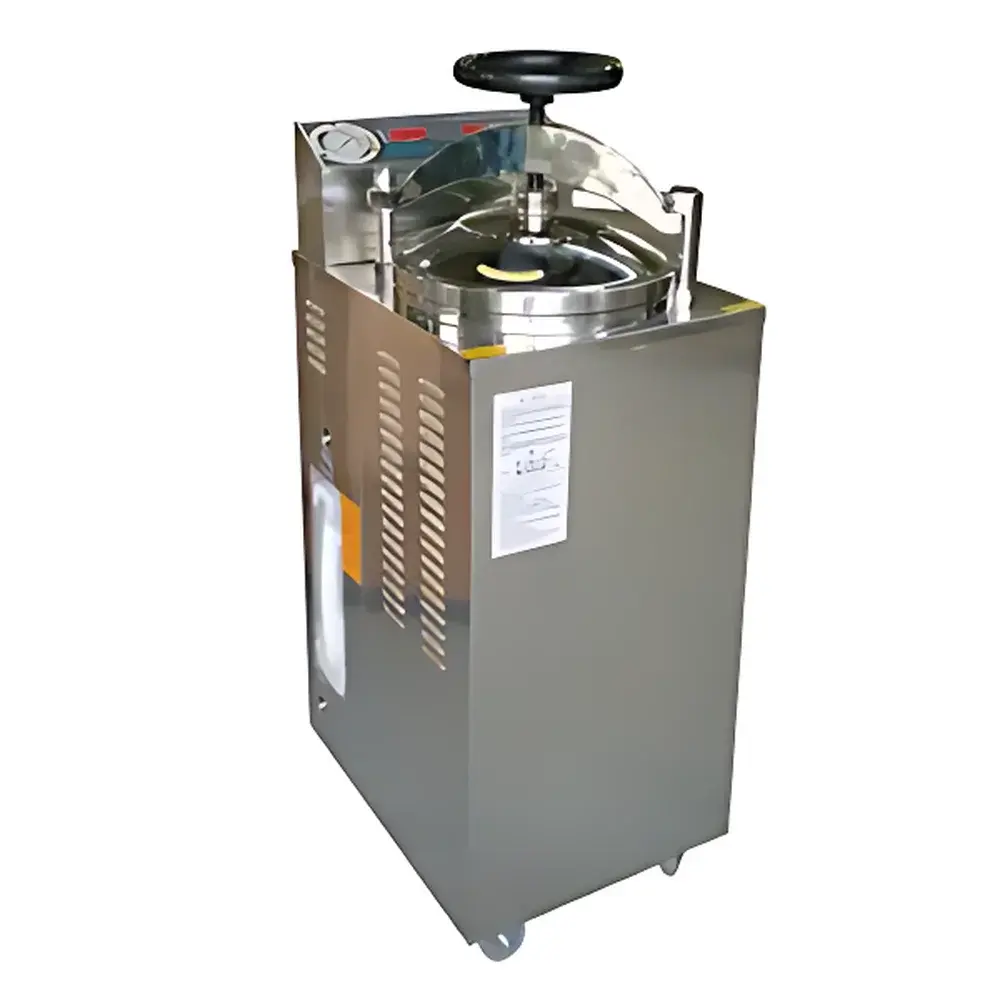
BOXUN YXQ-100A Vertical Steam Autoclave
| Brand | BOXUN |
|---|---|
| Origin | Shanghai, China |
| Model | YXQ-100A |
| Instrument Type | Vertical Autoclave |
| Max Temperature | 135°C |
| Max Pressure | 0.22 MPa |
| Chamber Dimensions | Ø400 × 830 mm |
| Chamber Volume | 100 L |
| External Dimensions | 485 × 605 × 1290 mm |
| Power Rating | 3.5 kW |
| Voltage/Frequency | 220 V ±10%, 50 Hz ±2% |
| Operating Temperature Range | 105–135°C |
| Design Temperature | 138°C |
| Design Pressure | 0.25 MPa |
| Timer Range | 0–120 min |
| Basket Dimensions | Ø360 × 240 mm (3 pcs) |
| Safety Features | Automatic water-level monitoring, overtemperature cutoff, pressure relief valve, self-sealing gasket, cold-air purge cycle, programmable exhaust modes (fast/slow/no exhaust), audible end-of-cycle alert |
Overview
The BOXUN YXQ-100A Vertical Steam Autoclave is a CE-compliant, microprocessor-controlled sterilization system engineered for precision, repeatability, and operational safety in regulated laboratory and clinical environments. It operates on the fundamental principle of saturated steam under controlled pressure—leveraging the thermal lethality of moist heat to achieve sterility assurance levels (SAL) of 10−6 for microbiological contaminants including bacterial spores, viruses, and prions. Designed in accordance with ISO 17665-1:2017 (Sterilization of health care products — Moist heat — Part 1: Requirements for the development, validation and routine control of a sterilization process for medical devices), the YXQ-100A delivers validated, traceable cycles suitable for sterilizing reusable instruments, culture media, glassware, textiles, and liquid preparations. Its vertical configuration optimizes floor space without compromising chamber volume, making it ideal for medium-throughput labs in hospitals, pharmaceutical QC units, academic research facilities, and biotechnology startups.
Key Features
- Robust stainless-steel construction: Chamber, jacket, and baskets fabricated from AISI 304 stainless steel (EN 10088-1), ensuring long-term resistance to corrosion from repeated exposure to steam, condensate, and alkaline cleaning agents.
- Integrated safety interlock system: Dual-redundant door locking mechanism prevents accidental opening during pressurized operation; automatic pressure release prior to door unlatching complies with EN 61010-1 and PED 2014/68/EU requirements.
- Intelligent process control: Microprocessor-based controller enables precise regulation of temperature, pressure, and time across three programmable cycle types—fast exhaust (for solids), slow exhaust (for liquids), and no-exhaust (for sealed containers or agar media).
- Automated pre-vacuum air removal: Built-in gravity displacement with dynamic cold-air purge ensures uniform steam penetration and eliminates air pockets that compromise sterilization efficacy.
- Real-time monitoring & fail-safes: Continuous detection of water level (high/low alarm), temperature deviation (>±2°C threshold), pressure over-limit (0.22 MPa cut-off), and dry-run protection (auto-shutdown if water supply fails).
- Ergonomic fast-opening door: Lever-actuated, self-sealing silicone gasket design minimizes operator effort while maintaining leak-tight integrity up to rated pressure.
Sample Compatibility & Compliance
The YXQ-100A accommodates a broad range of load configurations—including wrapped surgical kits, unwrapped metal instruments, porous loads (e.g., gauze packs), and heat-stable liquids (up to 5 L per container). Its 100 L chamber supports standard DIN 58953-compliant instrument trays and allows simultaneous processing of multiple sterilization loads per cycle. All operational parameters are documented in accordance with GLP and GMP principles. Optional printer integration enables hard-copy record generation compliant with FDA 21 CFR Part 11 (when paired with audit-trail-enabled firmware). The unit meets national safety standards GB 4793.1–2019 (IEC 61010-1) and pressure equipment directives applicable to Class I sterilizers.
Software & Data Management
The embedded control interface provides intuitive navigation via LED display and tactile membrane keys. Cycle logs—including start/end timestamps, setpoints, actual temperature/pressure profiles, and fault codes—are stored internally for ≥1,000 cycles. With optional RS232 or USB data export, users can archive raw cycle data in CSV format for trend analysis, internal audits, or regulatory submissions. Firmware supports user-defined cycle naming, password-protected parameter modification, and configurable alarm thresholds—enabling alignment with institutional SOPs and ISO 13485 quality management systems.
Applications
- Sterilization of reusable surgical tools, dental handpieces, and endoscopes (after proper cleaning and drying)
- Preparation of microbiological growth media (e.g., nutrient agar, LB broth) without thermal degradation
- Decontamination of biohazardous waste (Biosafety Level 1–2) prior to disposal
- Processing of textile-based lab apparel and filtration membranes
- Validation support for autoclave qualification (IQ/OQ/PQ) using biological indicators (e.g., Geobacillus stearothermophilus spore strips)
FAQ
What is the maximum recommended load weight for the YXQ-100A chamber?
The unit is rated for a maximum load mass of 65 kg when uniformly distributed across three stacked baskets.
Can the YXQ-100A be used for liquid sterilization without boil-over?
Yes—its slow-exhaust mode maintains chamber pressure during cooling, preventing violent boiling and container rupture; recommended for volumes ≤3 L per vessel.
Is third-party validation support available for this model?
BOXUN provides technical documentation packages (including DQ/IQ templates and calibration certificates) compatible with vendor-qualified validation service providers.
Does the unit comply with international shipping and electrical safety standards?
It carries CE marking per Machinery Directive 2006/42/EC and Low Voltage Directive 2014/35/EU, with full conformity documentation supplied upon request.
How often should the door gasket be replaced?
Under typical usage (2–4 cycles/day), the silicone gasket requires replacement every 18–24 months or immediately upon visible cracking, hardening, or steam leakage.



