
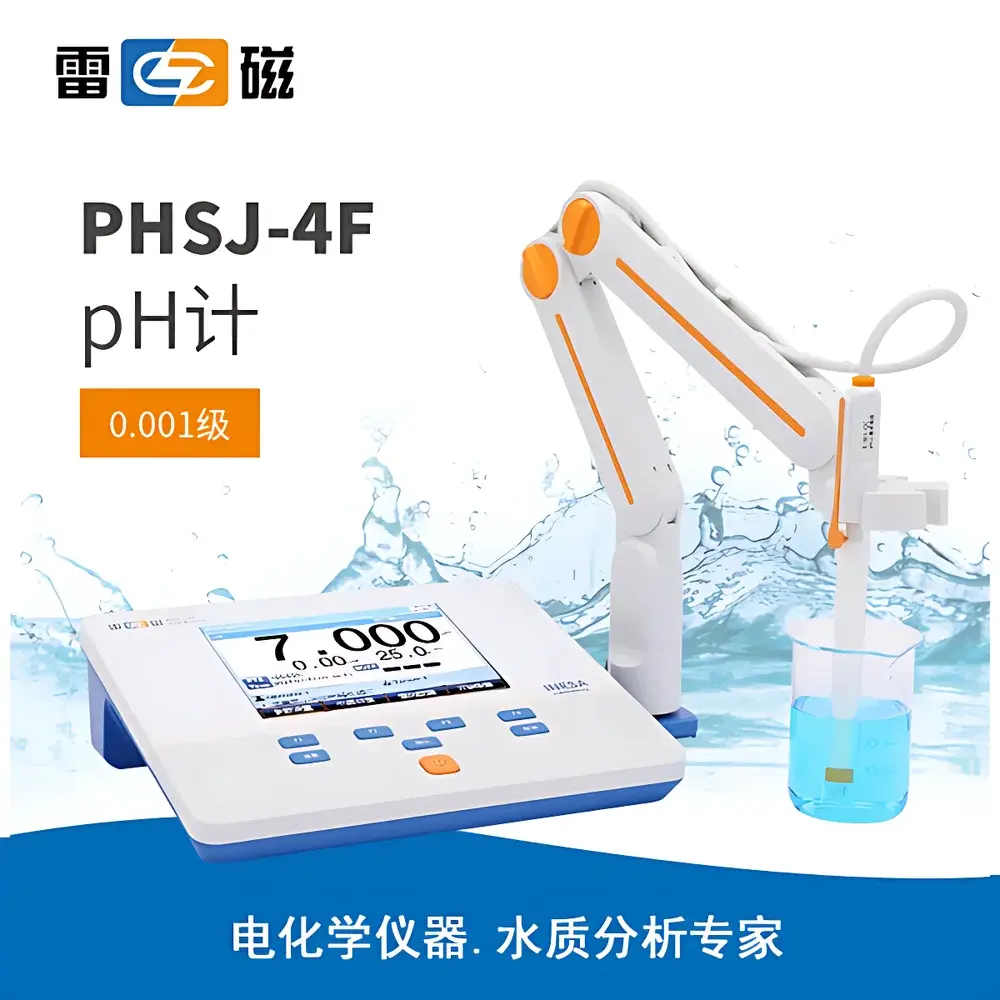
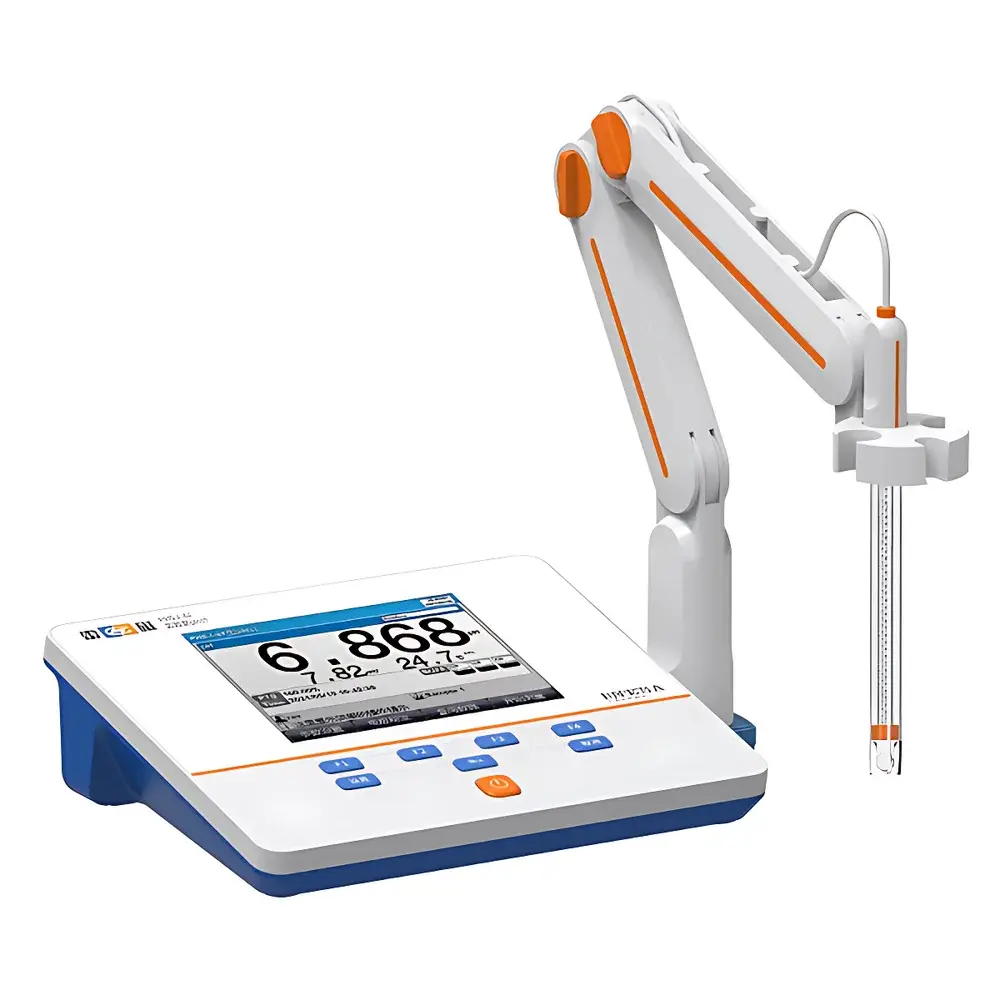
Leici PHSJ-4F Benchtop pH Meter
| Brand | Leici |
|---|---|
| Origin | Shanghai, China |
| Instrument Type | Benchtop |
| Parameter Type | Single-parameter (pH/mV/Temp) |
| Measurement Accuracy | ±0.002 pH |
| pH Range | −2.000 to 20.000 pH |
| Resolution | 0.001 pH |
| mV Range | −2000.00 to 2000.00 mV |
| mV Resolution | 0.01 mV |
| Temperature Range | −10.0 to 135.0 °C |
| Temperature Resolution | 0.1 °C |
| Calibration Standards Supported | GB, DIN, NIST, USA, MERK |
| IP Rating | IP54 |
| Data Storage Capacity | 500 sets |
| Interface | RS-232, USB |
| Compliance | GLP-compliant data logging |
Overview
The Leici PHSJ-4F is a high-precision benchtop pH meter engineered for routine and regulated laboratory applications in quality control, environmental testing, pharmaceutical manufacturing, and academic research. It operates on the fundamental principle of potentiometric measurement: detecting the electromotive force (EMF) generated across a glass pH electrode immersed in an aqueous sample, relative to a stable reference electrode. This EMF—expressed in millivolts—is converted into pH values using the Nernst equation, with built-in temperature compensation ensuring thermodynamic accuracy across wide thermal ranges. Designed to meet ISO/IEC 17025–aligned operational rigor, the PHSJ-4F delivers 0.001-pH resolution and ±0.002-pH electronic accuracy at 25 °C, making it suitable for applications requiring trace-level pH discrimination—such as buffer validation, dissolution testing, and electrochemical method development.
Key Features
- High-resolution 4.3-inch color TFT LCD display with adjustable backlight for optimal readability under varied ambient lighting conditions
- Selectable measurement resolutions: pH (0.001 / 0.01 / 0.1), mV (0.01 / 0.1 / 1), and temperature (0.1 °C or 0.1 °F)
- Intelligent endpoint detection algorithms support automatic reading stabilization, timed acquisition (1–120 s intervals), and manual capture—minimizing operator-dependent variability
- Five-point pH calibration capability with auto-recognition of five internationally referenced buffer groups (GB, DIN, NIST, USA, MERK); user-defined buffer sets can be saved and recalled
- Automatic temperature compensation (ATC) via integrated Pt1000 sensor or manual input; supports both Celsius and Fahrenheit units
- Rugged industrial design rated IP54 for dust resistance and limited water splashing protection—suitable for shared lab environments and QC benches
- Firmware-upgradable architecture enables future protocol enhancements and regulatory alignment without hardware replacement
Sample Compatibility & Compliance
The PHSJ-4F accommodates standard 12-mm diameter combination pH electrodes (including the included triple-junction electrode), supporting measurements in aqueous solutions, low-ionic-strength samples, and moderately aggressive matrices (e.g., dilute acids/bases, buffer salts, biological media). It complies with general requirements for electrochemical instrumentation defined in IEC 61010-1 (safety) and IEC 61326-1 (EMC). All stored data include mandatory GLP metadata: timestamp, operator ID (user-definable), electrode serial number, calibration history, ambient temperature, and buffer IDs—ensuring full auditability per FDA 21 CFR Part 11 (when used with validated PC software and access controls). The instrument’s calibration log retains up to 10 recent calibrations with slope, offset, and asymmetry potential diagnostics.
Software & Data Management
Data integrity is maintained through dual-interface connectivity: RS-232 enables direct printing to compliant serial printers (e.g., Epson TM-U220) with customizable report formats—including header fields, statistical summaries, and GLP footers. USB interface allows bidirectional communication with Windows-based PCs using Leici’s certified communication suite (v3.2+), supporting batch export to CSV or Excel-compatible XML. Stored records (max. 500 entries) retain full contextual metadata and are non-editable post-acquisition—preventing unauthorized modification. Exported files include digital signatures and checksum verification to satisfy ALCOA+ principles (Attributable, Legible, Contemporaneous, Original, Accurate).
Applications
- Pharmaceutical QC: USP pH verification of injectables, oral suspensions, and cleaning validation swab extracts
- Environmental labs: ASTM D1293-compliant pH analysis of surface water, wastewater, and soil leachates
- Food & beverage: AOAC 984.27-aligned titratable acidity correlation and process solution monitoring
- Academic teaching labs: Electrochemistry fundamentals, Nernstian behavior demonstration, and electrode response kinetics
- Biotechnology: Cell culture media pH tracking, fermentation broth monitoring, and buffer preparation QA
FAQ
What calibration standards does the PHSJ-4F recognize automatically?
It identifies five preloaded buffer groups (GB, DIN, NIST, USA, MERK) by measured pH and temperature; users may assign custom names and values to additional buffers.
Is the instrument compatible with LIMS integration?
Yes—via ASCII-formatted RS-232 output or structured CSV/Excel export through USB; requires middleware configuration for HL7 or ASTM E1384 mapping.
Does it support differential pH measurement (ΔpH)?
No—the PHSJ-4F performs absolute pH, mV, and temperature measurements only; delta calculations must be performed externally.
What is the recommended electrode maintenance schedule?
Daily rinsing with deionized water, weekly storage in 3 M KCl solution, and monthly performance verification using two-point calibration with fresh buffers.
Can measurement uncertainty be calculated per ISO/IEC 17025?
Yes—uncertainty budgets may be constructed using documented contributions from calibration uncertainty (±0.001 pH), temperature probe error (±0.1 °C), repeatability (RSD ≤ 0.0015 pH), and electrode drift (≤ 0.002 pH/24 h).
Related Products



