
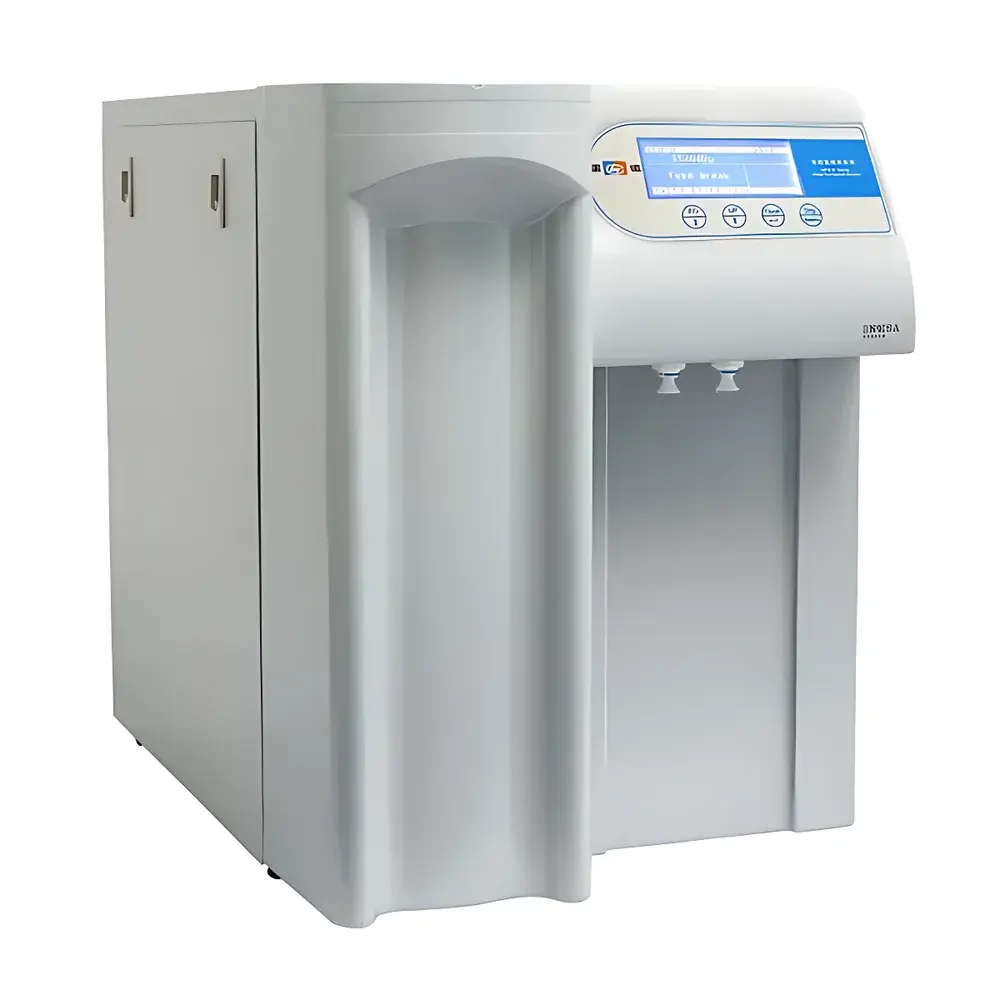
LeiCi UPW Series Ultra-Pure Water System
| Brand | LeiCi |
|---|---|
| Origin | Shanghai, China |
| Manufacturer Type | Authorized Distributor |
| Product Category | Domestic |
| Model | UPW |
| Price Range | USD 2,100–2,700 (FOB Shanghai) |
| Water Grade | ASTM Type I / ISO 3696 Grade 1 |
| Resistivity | 18.2 MΩ·cm @ 25°C |
| Heavy Metals & Soluble Silica | <0.1 ppb |
| Total Organic Carbon (TOC) | <3 ppb |
| Microbial Count | <0.001 EU/mL |
| Particles (>0.1 µm) | <1 pc/mL |
Overview
The LeiCi UPW Series Ultra-Pure Water System is an integrated, laboratory-grade water purification platform engineered for the consistent production of ASTM Type I (ISO 3696 Grade 1) ultrapure water. Utilizing a multi-stage purification architecture—including pre-treatment with activated carbon and polypropylene sediment filtration, high-rejection reverse osmosis (RO), dual-bed ion exchange, dual-wavelength UV photo-oxidation (185 nm + 254 nm), and final 0.22 µm terminal filtration—the system delivers water meeting stringent requirements for analytical chemistry, molecular biology, HPLC, LC-MS, cell culture, and semiconductor rinsing applications. Designed for operational reliability in regulated environments, the UPW Series incorporates real-time conductivity monitoring with temperature-compensated sensors (cell constant 0.01 cm⁻¹), leak detection, and fail-safe standby protocols to maintain system integrity and data traceability.
Key Features
- Modular configuration options: UPW-R (pure water), UPW-H (high-purity water), UPW-N (ultrapure water with dual-wavelength UV), and UPW-P (ultrapure water polishing unit for feed from existing RO or DI systems)
- Compact integrated design with built-in 2-gallon pressurized storage tank—reducing footprint while ensuring stable flow delivery at 1.5–2 L/min for UPW-N and UPW-P models
- Quick-connect fluidic architecture enabling tool-free maintenance and rapid cartridge replacement of pre-filters, RO membranes, ion exchange columns, and UV modules
- Dual-column ion exchange design: high-capacity precision resin in purification columns; nuclear-grade polished resin in ultrapure columns for sustained 18.2 MΩ·cm resistivity
- Triple conductivity sensor array: one for raw feedwater, one for RO permeate, and one high-accuracy sensor (0.01 cm⁻¹) with automatic temperature compensation for ultrapure water monitoring
- Leak detection system with embedded moisture sensors triggering audible/visual alarms and automatic pump shutdown to prevent lab flooding
- LCD interface displaying real-time resistivity, TOC, flow rate, system pressure, consumable life status, and event logs with timestamped entries
Sample Compatibility & Compliance
The UPW Series accommodates municipal tap water feed (conductivity ≤400 µS/cm, temperature 5–40°C, pressure 0.1–0.5 MPa) and supports optional pretreatment for higher TOC or hardness loads (inlet TOC ≤1000 ppb for UPW-N; ≤50 ppb for UPW-P). All models comply with ASTM D1193-20 (Type I water specifications), ISO 3696:1987 (Grade 1), and CLSI EP23-A guidelines for clinical laboratory water quality. The UPW-N and UPW-P configurations meet USP purified water and water for injection (WFI)-adjacent performance criteria for endotoxin and microbial control (<0.001 EU/mL, <1 CFU/mL). System architecture supports GLP/GMP-aligned documentation practices, including audit-trail-capable event logging and configurable alarm thresholds for critical parameters.
Software & Data Management
While the UPW Series operates via embedded firmware without external PC dependency, its LCD interface provides full local data visibility—including historical conductivity trends (72-hour buffer), cumulative volume dispensed, and consumable usage metrics. All alarm events (e.g., low pressure, high TOC, leak detection) are time-stamped and retained in non-volatile memory for review. For integration into centralized lab infrastructure, optional RS-232 or analog 4–20 mA output interfaces support connection to building management systems (BMS) or LIMS. The system’s hardware-level fail-safes—including automatic shutdown on sensor fault, pressure loss, or UV lamp failure—ensure compliance with FDA 21 CFR Part 11 principles for instrument qualification and data integrity in regulated workflows.
Applications
The UPW Series serves as a primary or secondary water source across diverse scientific domains: preparation of mobile phases and standards for HPLC, UHPLC, and IC; diluent and rinse water for ICP-MS and AAS sample introduction; reagent formulation in qPCR, ELISA, and NGS library prep; media and buffer preparation for mammalian cell culture; cleaning of optical components and microfluidic devices; and final rinse in cleanroom wafer processing. The UPW-P model is specifically validated for polishing pre-purified feed water (e.g., from central RO systems), extending service life of downstream analytical instruments and reducing long-term operational cost per liter.
FAQ
What feed water quality is required for optimal UPW-N system performance?
Municipal tap water with conductivity ≤400 µS/cm, TOC ≤1000 ppb, and free chlorine ≤1 ppm is recommended. Pre-treatment (e.g., additional carbon filtration) is advised if feed water exceeds these limits.
Can the UPW-P model operate without a built-in RO stage?
Yes—the UPW-P is a dedicated polishing unit requiring inlet water with conductivity <20 µS/cm (e.g., from a standalone RO or DI system); it contains no RO membrane and relies entirely on its dual-wavelength UV, mixed-bed resin, and ultrafiltration stages.
How often must consumables be replaced under typical lab usage?
Pre-filters: every 3–6 months; RO membranes: 12–24 months depending on feed quality; purification columns: 6–12 months; ultrapure columns: 6–18 months; UV lamps: 9–12 months (lamp intensity decay monitored internally).
Does the system support regulatory compliance documentation for audits?
Yes—event logs, alarm history, and sensor calibration records are stored locally with timestamps. Optional external data export (via RS-232) enables integration with electronic lab notebooks (ELN) or LIMS for full traceability in GLP/GMP environments.
Is remote monitoring or network connectivity available?
Standard configuration includes local display and alarm outputs only. Ethernet or Wi-Fi modules are not included but may be added via third-party industrial IoT gateways compatible with Modbus RTU protocol (available upon request for OEM integration).



