
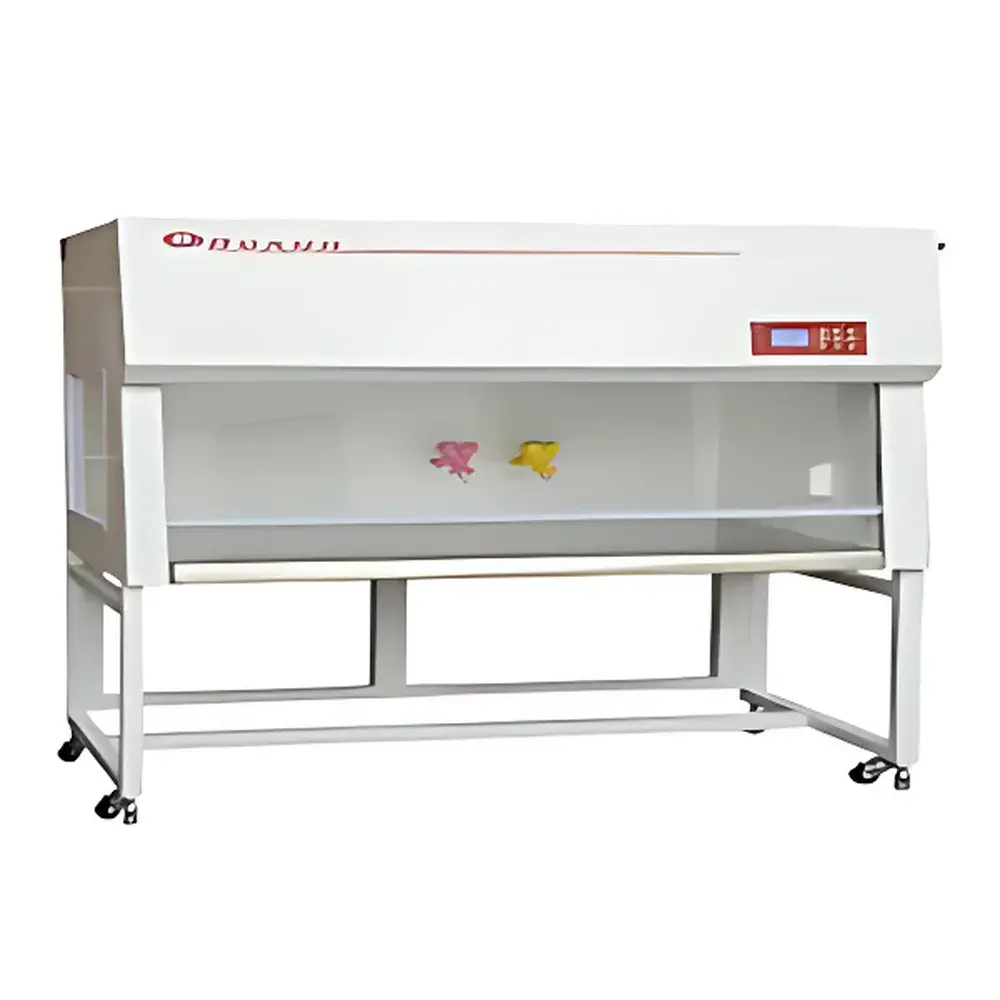
BOXUN BJ-3CD Vertical Laminar Flow Clean Bench
| Brand | BOXUN |
|---|---|
| Origin | Shanghai, China |
| Model | BJ-3CD |
| Instrument Category | Vertical Laminar Flow Clean Bench |
| Cleanliness Class | ISO Class 5 (100-level, ≥99.99% efficiency for particles ≥0.5 µm) |
| Noise Level | ≤67 dB(A) |
| Airflow Pattern | Vertical Downflow |
| Rated User Capacity | Three-person, single-sided operation |
| Working Surface Dimensions (W×D×H) | 1800 × 700 × 495 mm |
| Overall Dimensions (W×D×H) | 1960 × 744 × 1680 mm |
| HEPA Filter Specification | 1770 × 604 × 50 mm, single unit |
| Illumination | ≥300 lux (fluorescent lamp, 30 W × 2) |
| UV Lamp | 30 W × 1 |
| Average Air Velocity Range | 0.3–0.6 m/s (6-step adjustable, real-time digital display) |
| Vibration Peak-to-Peak Amplitude | ≤5 µm (X/Y/Z axes) |
| Power Supply | AC 220 V ±10%, 50/60 Hz |
| Rated Power | 0.55 kW |
| Net Weight | 280 kg |
| Construction Materials | Cold-rolled steel housing |
Overview
The BOXUN BJ-3CD Vertical Laminar Flow Clean Bench is an ISO Class 5 (formerly “100-level”) laminar flow workstation engineered for localized particle-free environments in research and production laboratories. It operates on the principle of unidirectional vertical airflow: ambient air is drawn through a pre-filter (medium-efficiency), then pressurized into a plenum chamber and uniformly distributed downward across the work surface after passing through a certified HEPA filter (EN 1822-1 H14 or equivalent, ≥99.99% removal efficiency for ≥0.5 µm particles). This controlled downflow establishes a sterile barrier between the operator and the work area, minimizing cross-contamination during aseptic handling of cell cultures, pharmaceutical preparations, microbiological assays, and sensitive electronic components. Designed for continuous-duty operation in GLP-compliant and GMP-aligned facilities, the BJ-3CD meets structural and performance requirements outlined in ISO 14644-1, NSF/ANSI 49 (Class I/II equivalence for non-recirculating configurations), and relevant sections of EU GMP Annex 1 regarding cleanroom support equipment.
Key Features
- Real-time digital monitoring via large LCD interface displaying face velocity (0.3–0.6 m/s, 6-step adjustable with decimal resolution), differential pressure across HEPA filter, cumulative operating hours, system clock, and HEPA operational status.
- Dual-safety interlock: UV germicidal lamp (30 W) automatically deactivates when sash is opened; main lighting (dual 30 W fluorescent) activates only when UV is off — compliant with IEC 61000-6-3 and occupational safety directives.
- Counterbalanced vertical sliding sash with smooth positioning across full travel range, enabling ergonomic access while maintaining laminar integrity.
- Integrated utility interfaces: splash-proof 220 V AC power outlets (IEC 60320 C13), compressed air and liquid supply ports recessed within the work surface perimeter.
- Anthropometric design: 5° forward tilt of front panel reduces operator fatigue during extended procedures; castor-mounted base with leveling feet ensures stable deployment on standard laboratory flooring.
- Acoustically optimized centrifugal blower system delivering stable airflow at ≤67 dB(A) at 1 m — suitable for shared lab environments requiring low ambient noise.
Sample Compatibility & Compliance
The BJ-3CD accommodates standard biosafety protocols for non-hazardous biological agents (BSL-1 and BSL-2 applications per CDC/NIH guidelines), microbial culture maintenance, sterile media preparation, and precision assembly of optical or microelectronic components. Its stainless steel (SUS304) work surface resists corrosion from ethanol, isopropanol, and dilute sodium hypochlorite solutions, supporting validated cleaning SOPs. All electrical components comply with CE marking requirements (EMC Directive 2014/30/EU, Low Voltage Directive 2014/35/EU). The unit supports audit-ready documentation for FDA 21 CFR Part 11–aligned workflows when integrated with external data loggers or LIMS systems.
Software & Data Management
While the BJ-3CD operates as a standalone hardware platform without embedded network connectivity, its LCD interface provides traceable operational metadata: timestamped runtime logs, HEPA pressure drop trends, and service interval tracking (e.g., filter life estimation based on cumulative hours and ΔP thresholds). These parameters can be manually recorded or exported via optional RS-232/USB data capture modules (sold separately) for integration into laboratory quality management systems (QMS) adhering to ISO/IEC 17025 or ISO 9001 standards. Firmware supports user-defined alarm thresholds for HEPA degradation and fan failure detection.
Applications
- Aseptic transfer of mammalian and insect cell lines in academic and contract research organizations (CROs).
- Preparation of sterile pharmaceutical intermediates under cGMP Annex 1 Annex A conditions.
- Environmental microbiology: isolation and enumeration of airborne or surface-borne microorganisms using settle plates and contact agar methods.
- Microelectronics: handling of photomasks, MEMS devices, and optical coatings where sub-micron particulate control is critical.
- Plant tissue culture labs performing meristem excision and callus induction under defined sterility conditions.
- Quality control laboratories conducting USP and –aligned compounding verification tasks.
FAQ
What ISO cleanliness class does the BJ-3CD achieve?
It maintains ISO Class 5 (equivalent to Federal Standard 209E Class 100) in the work area, verified by particle counters per ISO 14644-1:2015 Annex B.
Is the HEPA filter certified to EN 1822-1 H14?
Yes — each unit ships with a manufacturer-certified H14-grade HEPA filter tested per EN 1822-3, accompanied by a test report indicating local penetration ≤0.005% at MPPS (~0.1–0.2 µm).
Can the unit be validated for GMP use?
Yes — it supports IQ/OQ protocols including airflow uniformity mapping (ASTM F2593), filter leak testing (DOP/PAO scan per ISO 14644-3), and vibration analysis (ISO 20816-1). Documentation templates available upon request.
Does the control system support audit trails or electronic signatures?
Not natively — however, external validation-grade data loggers (e.g., DeltaTrak or Testo) may be connected to record all displayed parameters with time-stamped, tamper-evident files compliant with ALCOA+ principles.
What maintenance intervals are recommended for the pre-filter and HEPA?
Pre-filter replacement every 3–6 months depending on ambient particulate load; HEPA replacement every 2–5 years, guided by differential pressure increase (>250 Pa above baseline) or scheduled qualification testing.



