
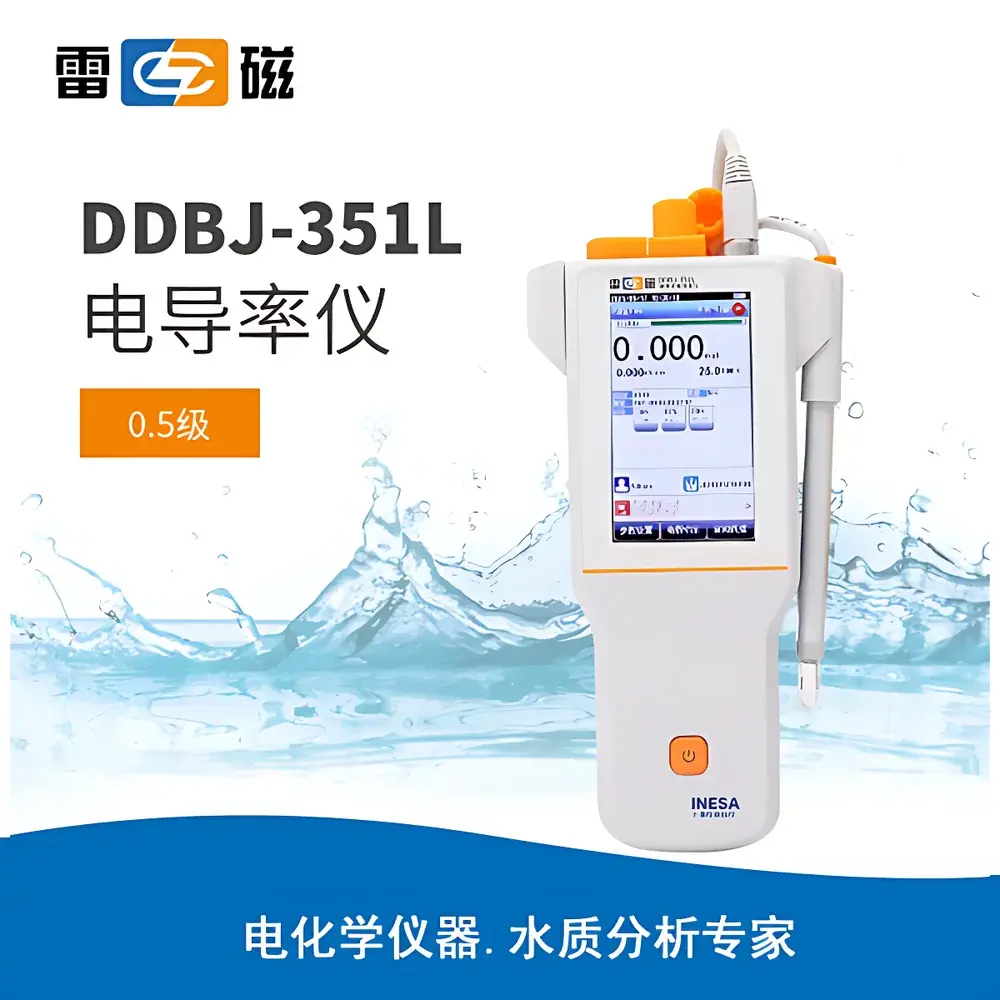
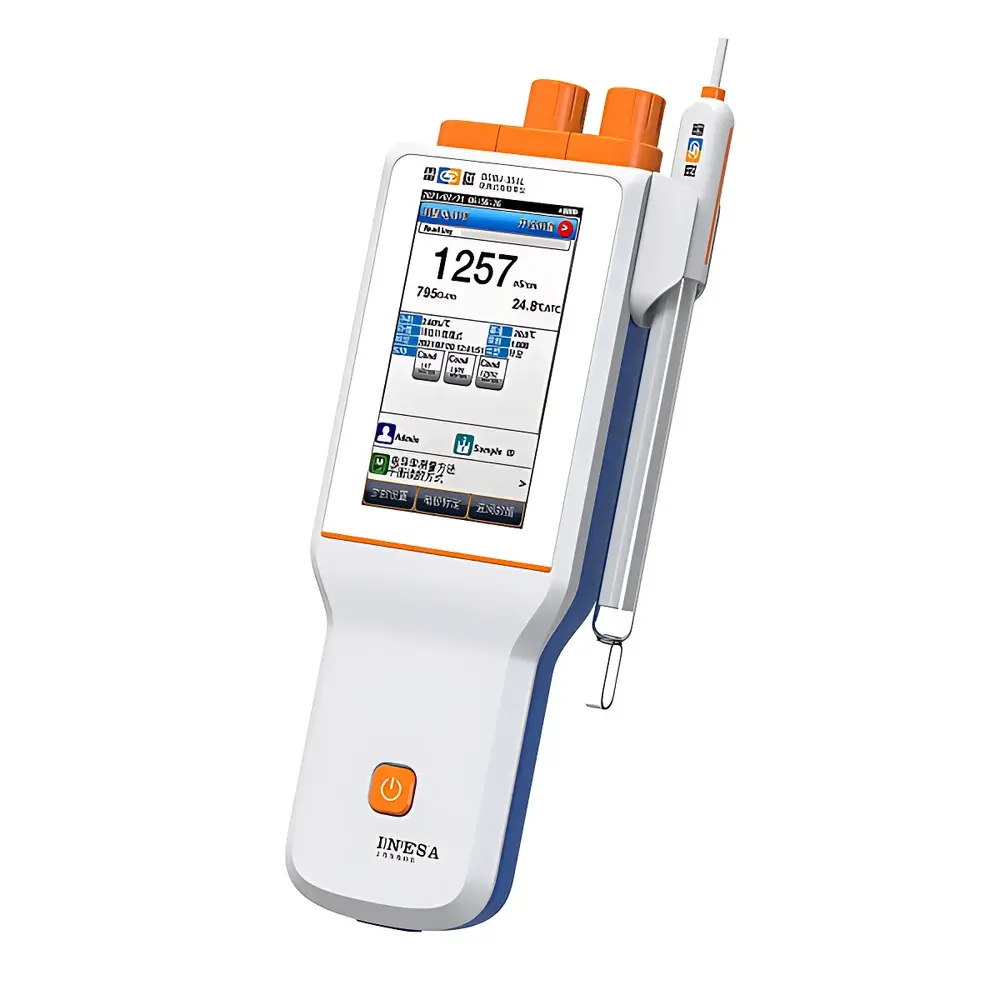
Leici DDBJ-351L Portable Conductivity Meter
| Brand | Leici |
|---|---|
| Origin | Shanghai, China |
| Model | DDBJ-351L |
| Portability | Portable |
| Application | Laboratory |
| Conductivity Range | 0.000 µS/cm to 3000 mS/cm |
| TDS Range | 0.000 mg/L to 1000 g/L |
| Resistivity Range | 5.00 Ω·cm to 100.0 MΩ·cm |
| Salinity Range | (0.00–8.00)% |
| Temperature Range | (−10.0–135.0) °C / (14.0–275.0) °F |
| Accuracy | ±0.5% FS (conductivity, resistivity, TDS), ±0.1% FS (salinity), ±0.1 °C (temperature) |
| Minimum Resolution | 0.001 µS/cm (conductivity), 0.01 Ω·cm (resistivity), 0.001 mg/L (TDS), 0.01% (salinity), 0.1 °C/°F (temperature) |
| IP Rating | IP65 |
| Compliance | GLP-compliant data management, supports ASTM D1125, ISO 7888, USP <645>, and IEC 61000-4 EMC standards |
Overview
The Leici DDBJ-351L Portable Conductivity Meter is a high-precision, multi-parameter electrochemical analyzer engineered for field-deployable and laboratory-based conductivity, resistivity, total dissolved solids (TDS), salinity, ash content, and temperature measurements. It operates on the principle of two-electrode or four-electrode conductometric measurement—applying an alternating current across a defined electrode cell geometry and calculating solution conductivity based on Ohm’s law and cell constant calibration. Designed for rigorous analytical workflows, the instrument complies with international standard methods including ASTM D1125 (Standard Test Methods for Electrical Conductivity of Water), ISO 7888 (Water Quality — Determination of Electrical Conductivity), and USP (Electrical Conductivity of Water for Pharmaceutical Use). Its robust architecture, combined with full-range automatic frequency switching and intelligent electrode recognition, ensures metrological traceability and measurement stability across diverse sample matrices—from ultrapure water (≥18.2 MΩ·cm) to aggressive industrial brines (up to 3000 mS/cm).
Key Features
- High-resolution 5.0-inch color TFT touchscreen with intuitive icon-driven navigation and dual-language support (English & Chinese)
- IP65-rated enclosure for dust-tight operation and protection against low-pressure water jets—suitable for humid labs, cleanrooms, and outdoor sampling sites
- Integrated rechargeable lithium-ion battery (≥12 h typical runtime); supports USB-C charging from PCs, power banks, or AC adapters (input: 100–240 VAC; output: 5 VDC)
- Smart electrode management: auto-detects cell constant (0.01, 0.1, 1.0 cm⁻¹), validates calibration status, and logs electrode history per GLP requirements
- Multi-mode temperature compensation: selectable reference temperatures (5.0, 10.0, 15.0, 18.0, 20.0, or 25.0 °C), linear, non-linear (pure water), or no compensation
- Endpoint detection algorithms: auto-read (stable-signal lock), timed reading (1–300 s intervals), manual trigger, and programmable endpoint tolerance (±0.01–±1.0 µS/cm)
- User-level access control with password-protected administrator, operator, and viewer roles—enabling audit-ready workflow segregation
Sample Compatibility & Compliance
The DDBJ-351L accommodates aqueous samples across pharmaceutical, environmental, food & beverage, and industrial process control applications. Its wide dynamic range supports direct measurement of deionized water (resistivity up to 100.0 MΩ·cm), boiler feedwater, seawater analogs, fruit syrup ash content (per GB/T 10498), and sugar refinery effluents. The instrument conforms to Good Laboratory Practice (GLP) requirements through mandatory timestamped metadata logging—including operator ID, electrode serial number, calibration date, ambient temperature, and environmental humidity (via optional external sensor). All stored datasets include digital signatures and immutable audit trails, satisfying FDA 21 CFR Part 11 readiness when used with validated PC software. Electrical safety and electromagnetic compatibility meet IEC 61000-4 series standards for industrial environments.
Software & Data Management
- On-device storage of ≥1000 complete measurement records, each containing raw values, compensated results, temperature, electrode ID, and user-defined sample IDs
- Statistical functions: mean, SD, RSD, min/max, trend analysis, and outlier detection (Grubbs’ test)
- USB 2.0 port for direct connection to Windows/Linux PCs using Leici’s certified LabLink Pro software—enabling batch export to CSV, PDF reports, or LIMS integration via ODBC
- Built-in Bluetooth 5.0 for secure wireless transmission to mobile devices (Android/iOS) and cloud platforms supporting HL7/FHIR protocols
- UVC-compliant USB host interface supports plug-and-play barcode scanners and USB flash drives (FAT32 formatted) for offline data offload
- Firmware upgrade capability via microSD card or over-the-air (OTA) download—ensuring long-term adaptability to evolving regulatory expectations
Applications
The DDBJ-351L serves critical quality control and research functions in multiple regulated sectors. In pharmaceutical manufacturing, it verifies conductivity of Purified Water (PW) and Water for Injection (WFI) per USP , including sequential temperature-controlled measurements at 25 °C and elevated temperatures. Environmental laboratories deploy it for EPA Method 120.1 compliance in surface water and wastewater monitoring. Food producers apply its dedicated ash calculation modes—calibrated for sucrose ash (GB/T 10498) and high-fructose corn syrup (HFCS)—to ensure label accuracy and regulatory alignment. Power generation facilities rely on its high-resistivity mode to monitor condensate purity in steam cycles, while semiconductor fabs use its sub-µS/cm resolution to qualify rinse water in wafer cleaning processes.
FAQ
Does the DDBJ-351L support calibration verification with NIST-traceable standards?
Yes—the instrument auto-recognizes certified KCl solutions (e.g., 84 µS/cm, 1413 µS/cm, 12.88 mS/cm) per ISO/IEC 17025 requirements and stores full calibration certificates with uncertainty budgets.
Can the device perform simultaneous multi-parameter logging during continuous monitoring?
It supports time-stamped interval logging (1–3600 s) for all five parameters (conductivity, resistivity, TDS, salinity, temperature) with real-time graphing on-screen and synchronized export.
Is the included composite conductivity electrode suitable for high-viscosity or particulate-laden samples?
The standard K=1.0 cell is optimized for clear, low-to-moderate viscosity solutions; for slurries or viscous media (e.g., syrups), we recommend optional K=0.1 or K=0.01 cells with flow-through housings and anti-fouling platinum black coating.
How does the instrument handle temperature drift during extended field use?
Its internal Pt1000 RTD sensor is thermally decoupled from the main PCB and housed in a dual-wall probe sleeve, achieving ±0.1 °C stability over 8-hr operation at ambient temperatures from −10 to 50 °C.
Are electronic records generated by the DDBJ-351L admissible in regulatory inspections?
When deployed with enabled audit trail, user authentication, and electronic signature modules—and paired with validated LabLink Pro software—they meet ALCOA+ (Attributable, Legible, Contemporaneous, Original, Accurate, Complete, Consistent, Enduring, Available) data integrity criteria.



