
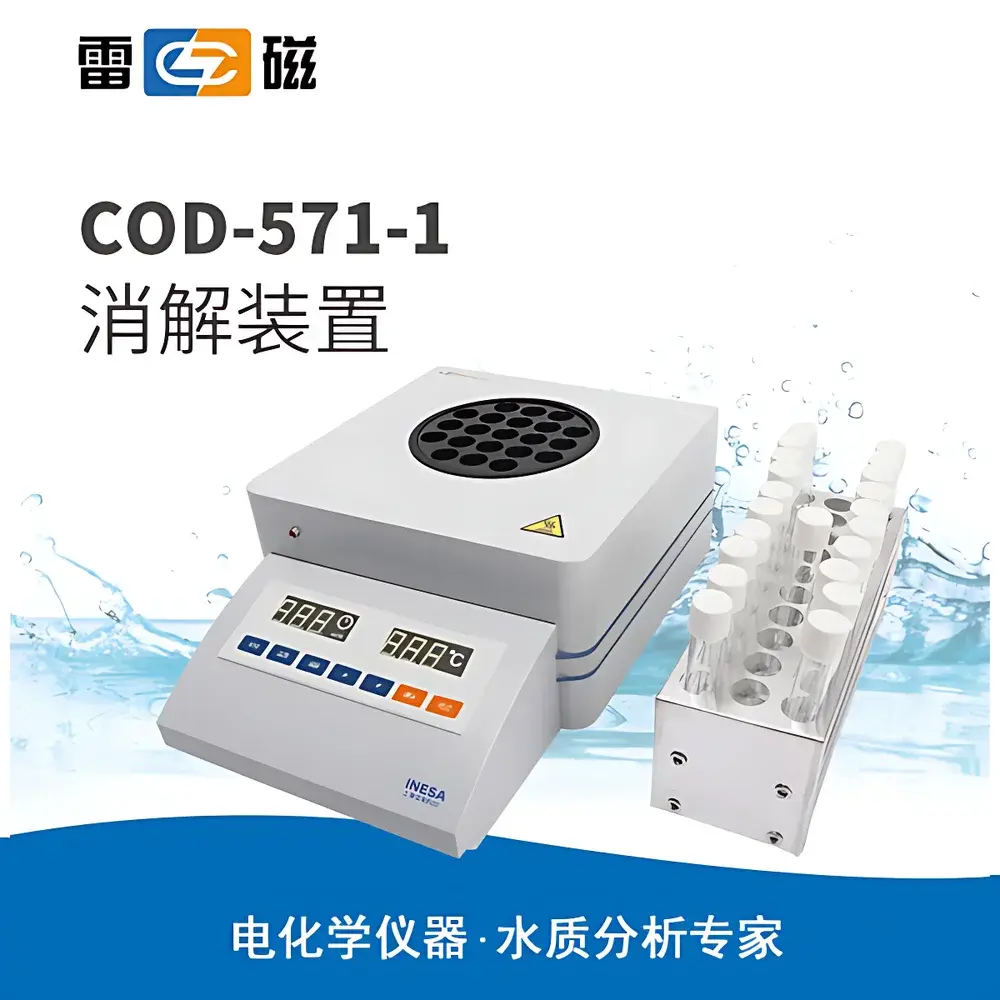
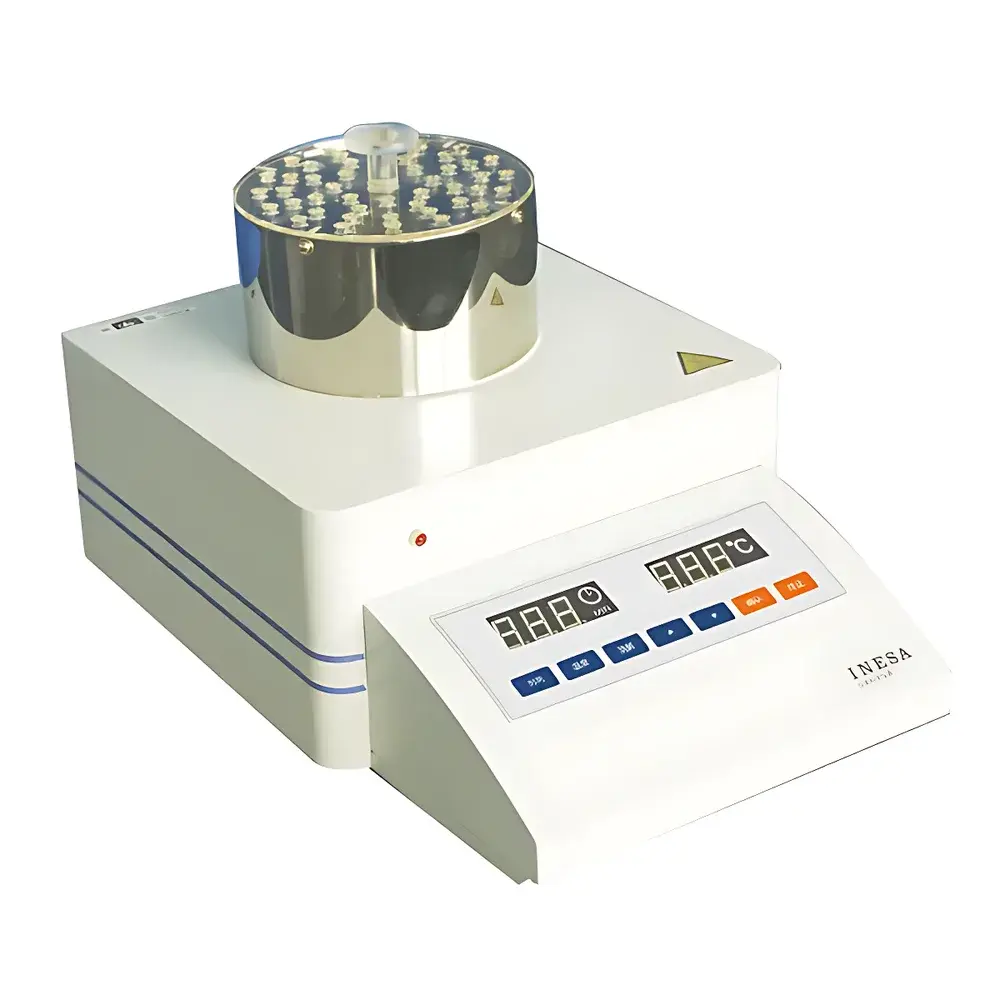
Leici COD-571-1 Reflux Digestion Block
| Brand | Leici |
|---|---|
| Origin | Shanghai, China |
| Manufacturer Type | Authorized Distributor |
| Country of Origin | China |
| Model | COD-571-1 |
| Digestion Method | Reflux Digestion |
| Heating Module | Aluminum Alloy Block with PID Temperature Control |
| Batch Capacity | 21 Samples |
| Temperature Range | 100–165 °C |
| Time Setting Range | 0–120 min |
| Safety Features | Over-Temperature Alarm, Auto Power-Off upon Completion |
| Design | Compact Benchtop Unit with Sealed Reflux Assembly |
Overview
The Leici COD-571-1 Reflux Digestion Block is a benchtop thermal digestion system engineered for precise and reproducible chemical oxygen demand (COD) analysis in accordance with standard wet-chemical oxidation protocols—primarily ASTM D1252 (Method B), ISO 6060, and China’s HJ 828–2017. It implements the sealed reflux digestion principle, wherein water samples are mixed with potassium dichromate (K₂Cr₂O₇) and sulfuric acid (H₂SO₄) under controlled thermal conditions to oxidize organic matter. The instrument maintains uniform temperature distribution across all 21 reaction positions using a high-thermal-conductivity aluminum alloy heating block with integrated PID feedback control, ensuring minimal inter-sample deviation (<±1.5 °C) and compliance with GLP data integrity requirements.
Key Features
- 21-position digestion capacity optimized for routine wastewater and surface water testing laboratories, reducing per-sample energy consumption by up to 35% compared to single-vessel systems.
- Precise temperature regulation from 100 °C to 165 °C in 1 °C increments, validated against NIST-traceable thermocouples; includes dual-stage over-temperature protection (hardware cutoff at 175 °C + software alarm threshold).
- Programmable digestion time from 0 to 120 minutes with ±10-second resolution; automatic power termination upon cycle completion eliminates operator dependency and supports unattended operation.
- Sealed reflux configuration minimizes reagent loss and volatile acid fume emission, aligning with OSHA 29 CFR 1910.1200 (Hazard Communication Standard) and local laboratory ventilation best practices.
- Compact footprint (280 × 320 × 140 mm) and low-profile design enable integration into laminar flow hoods or shared analytical workstations without compromising accessibility or heat dissipation.
Sample Compatibility & Compliance
The COD-571-1 accommodates standard 16-mm OD borosilicate glass digestion tubes (e.g., 15 mL or 20 mL volume), compatible with both open-reflux and closed-reflux tube formats specified in EPA 410.4 and ISO 6060 Annex A. Its thermal profile stability meets repeatability criteria defined in ISO/IEC 17025:2017 Clause 7.2.2 for method validation. While not certified to IEC 61000-6-3 (EMC) or UL 61010-1 as a standalone appliance, it operates within Class II laboratory environmental specifications when installed per manufacturer-specified clearance (≥10 cm rear/side ventilation gap). Documentation includes full traceability of calibration certificates for internal temperature sensors (valid for 12 months post-installation).
Software & Data Management
The COD-571-1 operates via an embedded microcontroller interface with tactile membrane keypad and dual-line LCD display (128 × 64 pixels). All parameter settings—including temperature setpoint, duration, and run log timestamps—are retained in non-volatile memory. Though no external software connectivity (USB/Bluetooth/Ethernet) is provided, the unit generates auditable operational records: each digestion cycle logs start time, target temperature, actual block temperature (averaged over 30 s intervals), end time, and fault codes (e.g., E01 = over-temp, E02 = sensor open-circuit). These entries satisfy minimum audit-trail requirements under FDA 21 CFR Part 11 for electronic records in regulated environmental testing labs when paired with lab notebook documentation.
Applications
- Routine COD determination in municipal wastewater influent/effluent monitoring per national discharge permits (e.g., China’s GB 8978–1996, EU Urban Wastewater Treatment Directive 91/271/EEC).
- Process control in industrial effluent treatment plants handling textile, food processing, or pharmaceutical wastewater streams.
- Educational use in university environmental engineering laboratories for method training aligned with APHA Standard Methods 5220B.
- Preparation of digested samples for subsequent spectrophotometric quantification (e.g., using Leici COD-572 or Hach DR3900) or titrimetric back-titration per ISO 6060 Section 6.2.
FAQ
Does the COD-571-1 support programmable ramping profiles (e.g., stepwise temperature increase)?
No. It operates with fixed-setpoint heating only; temperature ramps must be implemented manually via sequential setpoint adjustments.
Is the heating block compatible with PTFE-coated digestion tubes?
Yes—aluminum block geometry accepts standard 16-mm OD tubes regardless of wall material, though borosilicate glass remains recommended for thermal shock resistance during rapid cooling.
What maintenance is required to ensure long-term temperature accuracy?
Annual verification using a calibrated reference thermometer (Class A, ±0.1 °C) inserted into a dummy tube position is advised; cleaning of the block cavity with ethanol and lint-free cloth after each batch prevents residue buildup.
Can the unit be used for total phosphorus or total nitrogen digestion?
Not without method validation. While thermal parameters overlap with some TN/TP protocols (e.g., HJ 636–2012), the COD-571-1 lacks pressure-rated sealing and catalyst-specific thermal zoning required for those applications.
Is a CE mark or RoHS declaration available for export to the EU?
The unit complies with RoHS 2011/65/EU substance restrictions; however, it is supplied without CE marking as it falls outside the scope of the Machinery Directive and is intended for professional laboratory use under supervised conditions.
Related Products







