
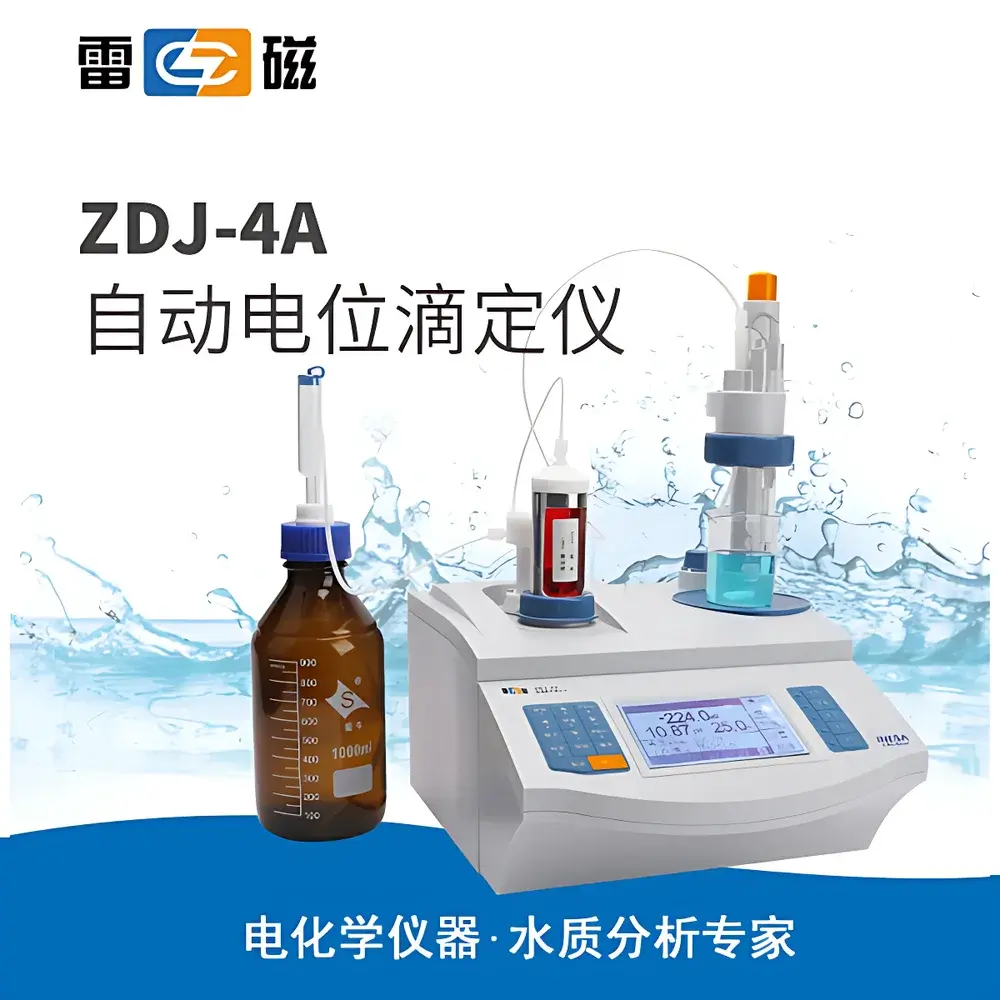
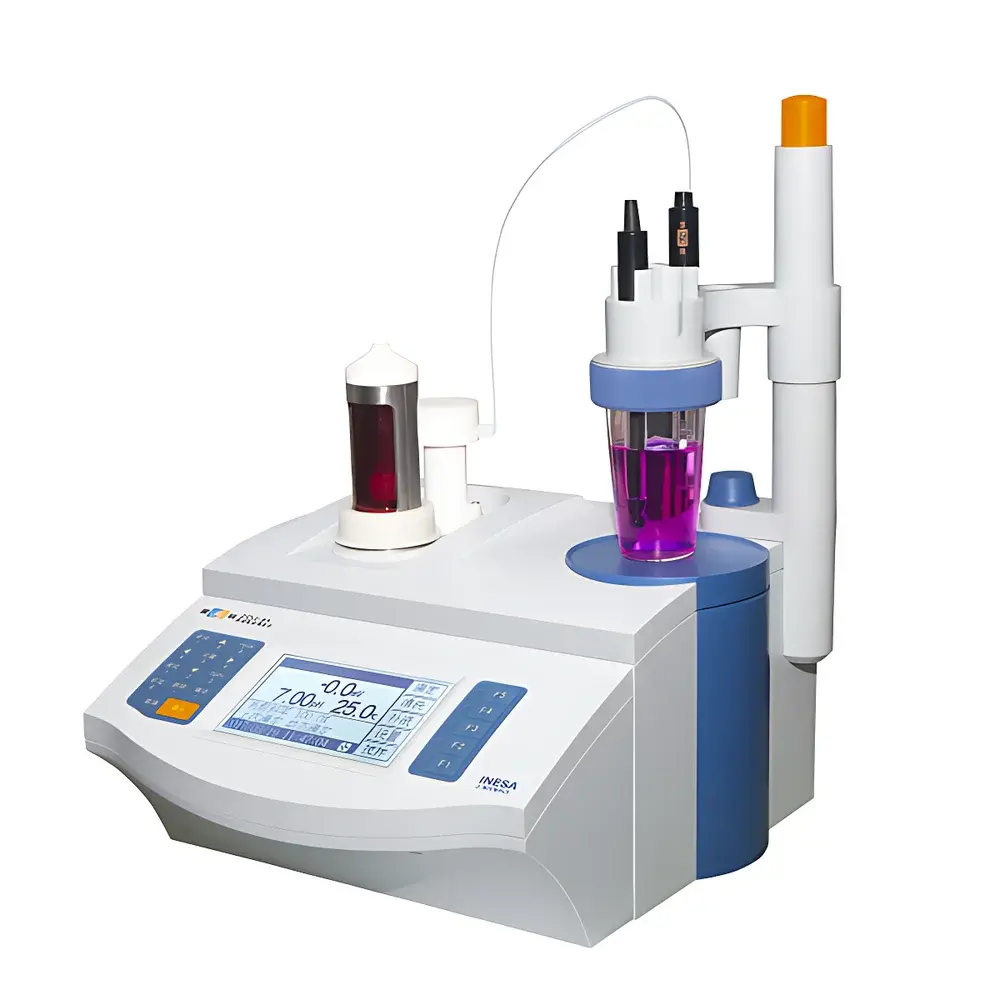
Leici ZDJ-4A Automatic Potentiometric Titrator
| Key | Brand: Leici |
|---|---|
| Origin | Shanghai, China |
| Model | ZDJ-4A |
| Instrument Type | General-purpose Potentiometric Titrator |
| pH Range | 0.00–14.00 |
| mV Range | −1800.0–+1800.0 |
| pH Resolution | 0.01 |
| mV Resolution | 0.1 |
| pH Accuracy | ±0.01 |
| mV Accuracy | ±0.03% FS |
| Stability | (±0.3 mV ±1 digit)/3 h |
| Titration Precision | 0.2% (repeatability) |
| 10 mL Burette Error | ±0.025 mL |
| 20 mL Burette Error | ±0.035 mL |
| 10 mL Burette Resolution | 1/20000 |
| 20 mL Burette Resolution | 1/10000 |
| Stirring Control | PWM-based digital speed regulation |
| Temperature Compensation Range | −5.0–105.0 °C |
| Temp. Resolution | 0.1 °C |
| Temp. Accuracy | ±0.3 °C |
| Power Supply | AC 220 V ±10%, 50 Hz |
| Dimensions (W×D×H) | 340 × 400 × 400 mm |
| Weight | 10 kg |
Overview
The Leici ZDJ-4A Automatic Potentiometric Titrator is a benchtop electrochemical analyzer engineered for precision potentiometric titration in routine QC laboratories, academic research settings, and industrial process control environments. It operates on the fundamental principle of detecting the potential change across a working electrode (e.g., glass pH electrode or redox-sensitive indicator electrode) relative to a stable reference electrode as titrant is incrementally delivered. The inflection point in the resulting E–V (potential vs. volume) curve—determined via first-derivative analysis or fixed-endpoint algorithms—defines the stoichiometric equivalence point with high reproducibility. Designed as a general-purpose platform, the ZDJ-4A supports classical volumetric methods including acid–base, redox, precipitation (e.g., argentometry), complexometric (e.g., EDTA), and non-aqueous titrations, while simultaneously functioning as a calibrated pH/mV meter for standalone electrode characterization and calibration verification.
Key Features
- Dot-matrix LCD display with intuitive keypad interface for real-time method navigation, live titration curve visualization, and immediate result readout—including equivalence point volume, concentration, and statistical summaries.
- Multi-mode titration engine supporting dynamic titration (adaptive addition based on dE/dV), preset endpoint titration (user-defined mV or pH threshold), equal-volume (fixed-step) addition, manual stepwise titration, and customizable method templates for standardized workflows.
- Dual-resolution burette support: interchangeable 10 mL (1/20000 resolution) and 20 mL (1/10000 resolution) glass burettes with certified volumetric accuracy per ISO 648 and ISO 1042; mechanical delivery error ≤ ±0.025 mL (10 mL) and ≤ ±0.035 mL (20 mL).
- Integrated PWM-controlled magnetic stirrer with software-adjustable speed (0–1200 rpm), ensuring homogeneous mixing without vortexing or splashing—critical for minimizing diffusion-layer artifacts in slow-reaction systems.
- Robust architecture with built-in power-fail recovery: automatically resumes interrupted titrations from last known state upon re-powering, preserving data integrity and reducing operator dependency.
- Comprehensive GLP-compliant data handling: stores up to 50 complete titration reports (including raw mV/pH values, derivative curves, and metadata) with timestamp, operator ID, and method name—each record cryptographically traceable and non-editable post-generation.
Sample Compatibility & Compliance
The ZDJ-4A accommodates aqueous, alcoholic, acetic anhydride, and other low-dielectric media commonly used in non-aqueous titrations (e.g., perchloric acid in glacial acetic acid). Its electrode input circuitry accepts standard BNC-terminated combination electrodes, refillable double-junction references, and specialized sensors (e.g., silver/sulfide for halide determination). All measurements comply with ISO 7027 (photometric equivalence), ASTM E2087 (potentiometric titration practice), and USP (acid–base titrimetry). Data storage and audit trail functionality align with FDA 21 CFR Part 11 requirements when paired with validated Leici ZDJ-4A PC software—supporting electronic signatures, user access levels, and immutable log generation for regulated environments.
Software & Data Management
The dedicated ZDJ-4A PC software (Windows-compatible, USB/RS-232 interface) enables full remote control, real-time curve plotting, post-run derivative analysis, and automated report generation in PDF or CSV formats. Each stored titration includes full raw data export (time-stamped mV/pH/volume triplets), enabling third-party statistical validation or integration into LIMS platforms. Firmware updates are delivered via signed binary packages, ensuring version traceability and backward compatibility. Data export paths are configurable with directory-level write permissions, supporting institutional IT security policies.
Applications
- Pharmaceutical QC: assay of active pharmaceutical ingredients (APIs) via non-aqueous acidimetry; chloride content in sodium chloride injections (argentometric titration).
- Food & Beverage: titratable acidity in wines and dairy products; sulfur dioxide quantification in fruit juices (oxidation–reduction).
- Environmental Testing: alkalinity and hardness profiling in wastewater; cyanide determination by pyridine–barbituric acid–silver nitrate titration.
- Materials Science: free fatty acid (FFA) content in biodiesel (KOH in isopropanol); residual catalyst quantification in polymer synthesis batches.
- Academic Teaching: hands-on instruction in electroanalytical fundamentals, Nernst equation validation, and method development for mixed-analyte systems.
FAQ
Does the ZDJ-4A support automatic electrode calibration prior to titration?
Yes—the instrument executes two-point pH calibration (using NIST-traceable buffers) and mV offset verification using short-circuit or standard solution checks before initiating any titration sequence.
Can external autosamplers be integrated with this model?
The ZDJ-4A features RS-232 and USB interfaces compatible with third-party XYZ autosamplers via ASCII command protocol; Leici provides integration documentation and handshake timing specifications.
Is temperature compensation applied during titration calculations?
Yes—integrated Pt1000 sensor enables real-time temperature correction of electrode response (Nernst slope) and titrant concentration (density/viscosity adjustment), referenced to 25 °C per ISO 3696.
How is data security enforced under GLP conditions?
All stored results include immutable metadata (date/time, operator code, method ID, firmware version); deletion requires dual-password authentication, and audit logs record every access or modification event.
What maintenance intervals are recommended for long-term reliability?
Burette piston lubrication and electrode junction cleaning are advised every 200 titrations; annual verification of burette volumetric accuracy against certified weights is recommended per ISO/IEC 17025 laboratory practice.





