
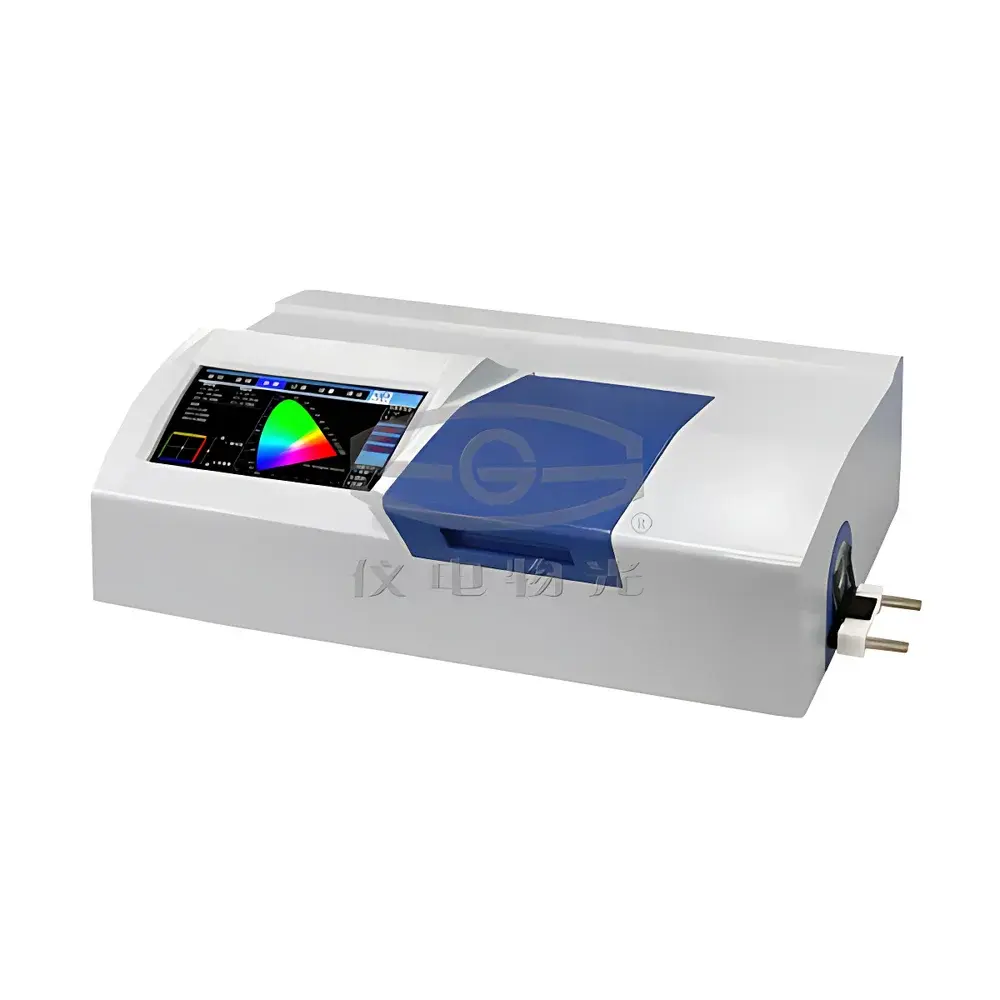
YDWG WSF-1S Benchtop Spectrophotometric Colorimeter
| Brand | YDWG |
|---|---|
| Origin | Shanghai, China |
| Model | WSF-1S |
| Product Type | Spectrophotometric Colorimeter |
| Instrument Type | Benchtop |
| Optical Geometry | d/8° Integrating Sphere |
| Light Source | Tungsten Halogen Lamp |
| Spectral Range | 400–700 nm |
| Repeatability | σu(Y) ≤ 0.5, σu(x), σu(y) ≤ 0.003 |
| Wavelength Accuracy | ±2 nm |
| Transmittance Accuracy | ±1.5% |
| Stability | ΔY ≤ 0.4 |
| Colorimetric Accuracy | ΔY ≤ 2, Δx/Δy ≤ 0.02 |
| Measurement Aperture | Φ20 mm |
| Display | 7-inch Touchscreen (Chinese UI) |
| Compliance | GBT 3978–2008 (equivalent to CIE No. 15:2004 under D65/A/C illuminants and 2°/10° standard observer) |
| Color Spaces | CIE XYZ, Yxy, CIELAB (L*a*b*), CIELUV (L*u*v*), CIELCH, Hunter Lab, Munsell, MI, CMYK, YI, Whiteness (Ganz, CIE, Blue Light, Taubel) |
| Color Difference Metrics | ΔE*ab, ΔEab, ΔE*uv |
| Communication | USB, RS232, USB Flash Drive Support |
| Power Supply | 220 V ± 22 V, 50 Hz ± 1 Hz, 70 W |
| Dimensions | 475 × 280 × 152 mm |
| Net Weight | 8 kg |
Overview
The YDWG WSF-1S Benchtop Spectrophotometric Colorimeter is an ISO-compliant, CIE-referenced spectrophotometer engineered for high-fidelity color measurement in industrial quality control and R&D laboratories. It operates on the CIE-standard d/8° geometry with a diffuse illumination and 8° viewing configuration, ensuring consistent, geometry-invariant reflectance and transmittance measurements across non-uniform, textured, or glossy surfaces. The instrument employs a tungsten halogen lamp as its stable broadband light source and integrates a grating-based optical path to resolve spectral reflectance/transmittance data at 10 nm intervals across the visible spectrum (400–700 nm). Its photometric response is calibrated to conform with GBT 3978–2008 — China’s national standard aligned with CIE Publication No. 15:2004 — enabling traceable tristimulus value computation under D65, A, and C illuminants and both 2° and 10° standard observer functions. Designed for routine color evaluation rather than research-grade hyperspectral analysis, the WSF-1S delivers robust repeatability (σu(Y) ≤ 0.5, σu(x/y) ≤ 0.003) and long-term photometric stability (ΔY ≤ 0.4 over 4 hours), making it suitable for pass/fail color matching, whiteness indexing, yellowing assessment, and multi-parameter color difference reporting in regulated production environments.
Key Features
- Benchtop form factor with integrated 7-inch capacitive touchscreen interface, supporting intuitive navigation without external PC dependency
- d/8° integrating sphere optics compliant with ISO 7724-1, ASTM E308, and GBT 3978–2008 for standardized colorimetric measurement
- Full-spectrum acquisition (400–700 nm) with ±2 nm wavelength accuracy and ±1.5% transmittance accuracy across the visible band
- Comprehensive color space support: CIE XYZ, Yxy, CIELAB (L*a*b*), CIELUV (L*u*v*), CIELCH, Hunter Lab, Munsell, MI, CMYK, and industry-specific whiteness indices (Ganz, CIE, Blue Light, Taubel)
- Multi-illuminant capability: D65, A, C, and F2 simulated via software-weighted tristimulus integration
- Real-time spectral curve visualization, color difference mapping (ΔE*ab, ΔEab, ΔE*uv), and directional color deviation indicators (e.g., +a*, −b*)
- Pass/fail judgment engine with configurable tolerance thresholds and visual color simulation overlay for rapid QC decision-making
Sample Compatibility & Compliance
The WSF-1S accommodates solid, liquid, and translucent samples via its fixed Φ20 mm measurement port. Reflectance mode supports opaque materials including textiles, paints, plastics, paper, ceramics, and food surfaces; transmittance mode enables quantification of colored liquids, films, and glass substrates using optional transmission cell fixtures. All optical calibrations are traceable to NIM (National Institute of Metrology, China) reference standards. The instrument satisfies functional requirements for GLP-aligned color testing workflows and supports audit-ready documentation when paired with external printers (e.g., CK NT-T24S dot-matrix printer, optional). While not natively 21 CFR Part 11 compliant, its data export capabilities (USB/RS232/U-disk) facilitate integration into validated LIMS or QMS platforms where electronic records and signature controls are implemented externally.
Software & Data Management
Embedded firmware provides full-color workflow management through a localized Chinese GUI — including spectral graphing, numerical colorimetric output (X/Y/Z, L*a*b*, etc.), ΔE calculation, whiteness/yellow index derivation, and batch comparison reports. Raw spectral data (31-point or interpolated 10-nm resolution) and metadata (sample ID, date/time, operator, illuminant/observer) are exportable in CSV format for downstream statistical process control (SPC) or multivariate analysis. Firmware updates are delivered via USB flash drive; no cloud connectivity or remote telemetry is implemented, preserving data sovereignty in air-gapped facilities. Print output includes calibrated spectral curves, numeric tables, and annotated color difference diagrams — essential for internal audits and supplier certification submissions.
Applications
- Textile & dye manufacturing: Shade matching consistency, batch-to-batch color deviation tracking, metamerism screening under multiple illuminants
- Paper & packaging: Whiteness grading (CIE, Ganz, Blue Light), brightness uniformity verification, ink coverage assessment
- Paints & coatings: Gloss-independent color verification, pigment dispersion homogeneity evaluation, weathering-induced chromatic shift monitoring
- Plastics & polymers: Additive migration detection, thermal degradation color analysis, regulatory compliance reporting (e.g., FDA colorant limits)
- Food & beverage: Surface color consistency of baked goods, fruit skins, dairy products; transparency grading of oils and syrups
- Printing & graphic arts: CMYK gamut validation, press run stability analysis, substrate-dependent color rendering verification
FAQ
What CIE illuminants and observers does the WSF-1S support?
The instrument computes tristimulus values under D65, A, and C illuminants, with selectable 2° and 10° standard observer functions per GBT 3978–2008.
Can the WSF-1S measure transparent or translucent samples?
Yes — transmittance mode is supported for liquids and thin films; a dedicated transmission accessory kit (sold separately) is required for optimal alignment and stray-light suppression.
Is spectral data export available in machine-readable format?
Yes — full 31-channel (or interpolated 10-nm) spectral reflectance/transmittance data, along with all calculated colorimetric values, are exportable as CSV files via USB flash drive or RS232 serial link.
Does the device meet international calibration traceability requirements?
Calibration is performed against NIM-traceable ceramic tile and liquid standards; certificate of conformance includes uncertainty budgets per ISO/IEC 17025 principles.
What maintenance is required to sustain measurement accuracy?
Annual recalibration is recommended; daily zero/white calibration using supplied standards is mandatory before each measurement session to compensate for lamp drift and detector aging.





