
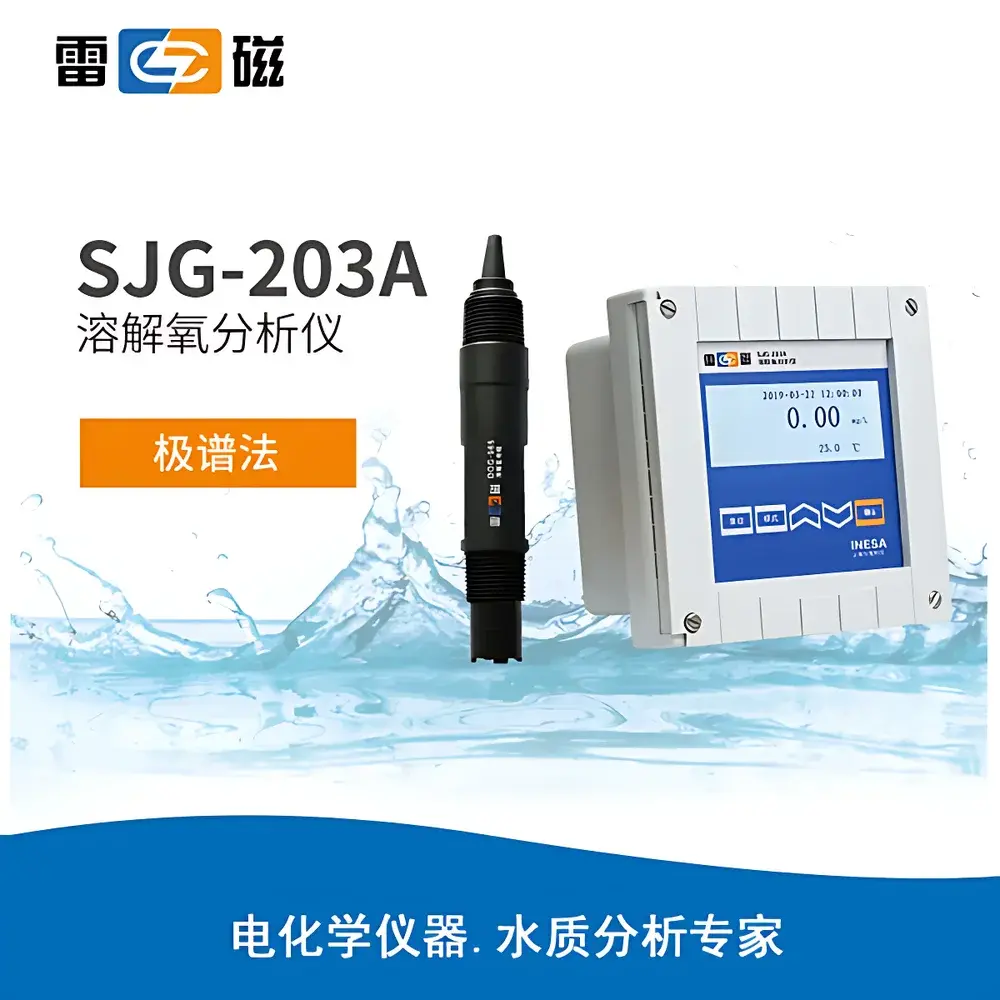
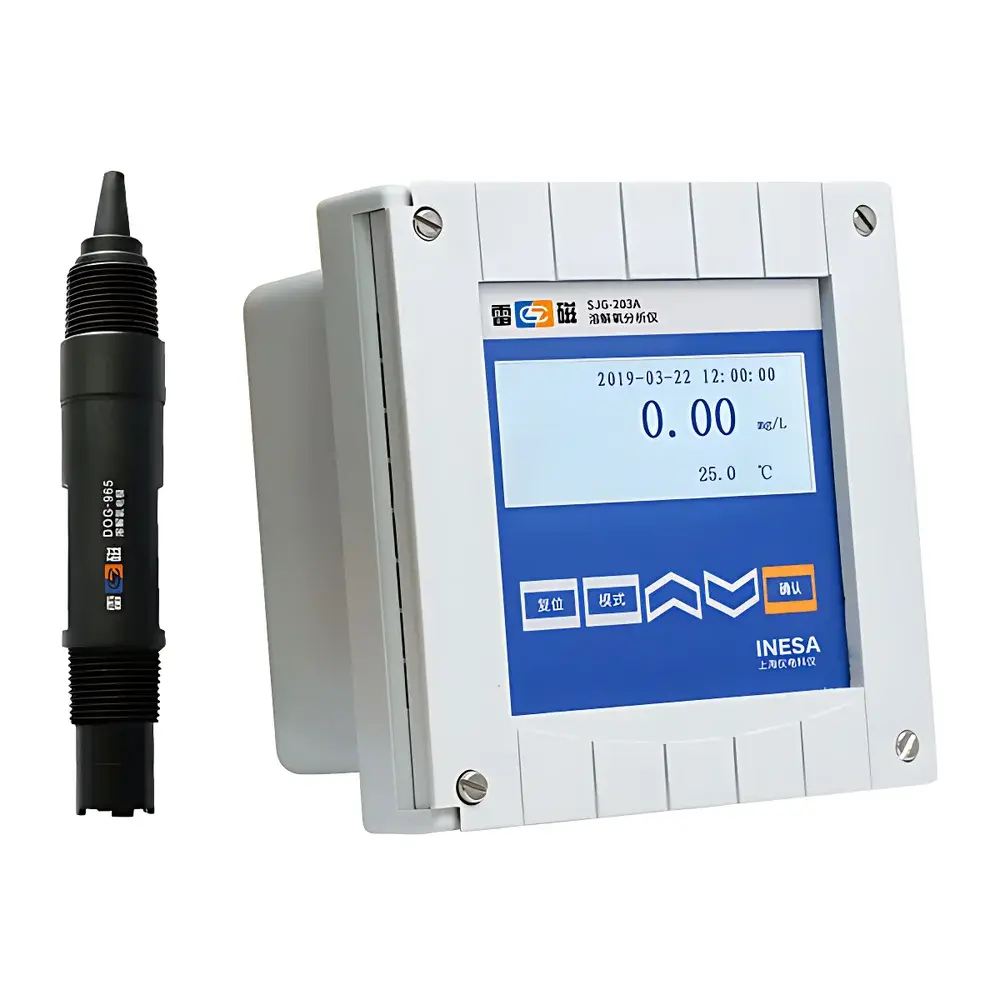
Leici SJG-203A Online Dissolved Oxygen Analyzer
| Brand | Leici |
|---|---|
| Origin | Shanghai, China |
| Model | SJG-203A |
| Instrument Type | Online |
| Measurement Range | (0.0–20.00) mg/L DO, (0.0–200.0)% saturation |
| Repeatability | ≤0.20 mg/L |
| Resolution | 0.01 mg/L (DO), 0.1% (saturation), 0.1°C (temperature) |
| Basic Error | ±0.5 mg/L (DO), ±10.0% (saturation), ±1.0°C (temperature) |
| Stability | (±0.30 mg/L)/24 h |
| Response Time (90%) | ≤45 s at 20°C |
| Temperature Range | −10.0–120.0°C |
| Salinity Compensation Range | (0.0–50.0) g/L |
| Salinity Compensation Error | ≤±3% |
| Output | (4–20) mA DC isolated, RS-232 digital interface |
| Power Supply | AC (220 ± 22) V, (50 ± 1) Hz |
| Enclosure Rating | IP65 |
| Dimensions & Weight | 160 × 160 × 110 mm, 1 kg |
| Data Storage | 200 groups with configurable logging interval |
Overview
The Leici SJG-203A Online Dissolved Oxygen Analyzer is an industrial-grade electrochemical sensor system engineered for continuous, real-time monitoring of dissolved oxygen (DO) concentration and saturation in aqueous environments. It operates on the principle of polarographic (Clark-type) amperometric detection, where molecular oxygen diffuses through a gas-permeable membrane and undergoes reduction at a cathode, generating a current proportional to the partial pressure of O2. This signal is converted into concentration (mg/L) and percent saturation values, with automatic temperature compensation applied per ISO 5814:2012 and ASTM D888–22 standards. Designed for fixed-installation applications, the SJG-203A integrates seamlessly into process control loops in municipal water supply systems, wastewater treatment plants, aquaculture facilities, and power generation units—particularly where low-level oxygen monitoring (e.g., boiler feedwater deaerator outlets) demands stable, drift-resistant performance under variable salinity and thermal conditions.
Key Features
- Simultaneous real-time display of DO concentration (mg/L), DO saturation (%), and temperature (°C) on a high-contrast dot-matrix LCD screen
- Dual-point calibration support: zero-oxygen (using sodium sulfite solution or nitrogen purge) and full-scale (air-saturated water or Winkler titration reference)
- Manual barometric pressure compensation and automatic temperature compensation (ATC) across −10.0 to 120.0°C, minimizing measurement drift due to environmental fluctuations
- Configurable data logging: stores up to 200 measurement records with user-defined time intervals; supports retrieval and export via RS-232 serial interface
- Programmable high/low alarm thresholds with relay output activation and audible/visual alert indicators
- Isolated 4–20 mA analog output with independently adjustable upper and lower range limits for integration into PLCs, SCADA, or DCS systems
- IP65-rated enclosure ensures reliable operation in humid, dusty, or splash-prone environments typical of pump stations, clarifiers, and outdoor monitoring kiosks
- Integrated power failure protection retains calibration settings and logged data during brief AC interruptions
Sample Compatibility & Compliance
The SJG-203A is optimized for use in freshwater, seawater (with salinity compensation up to 50.0 g/L), and low-conductivity boiler feedwater. Its Clark-type sensor design accommodates flow velocities from static immersion to moderate recirculation (≥10 cm/s recommended for response stability). The analyzer complies with key regulatory and methodological frameworks including ISO 5814:2012 (water quality — determination of dissolved oxygen — electrochemical probe method), ASTM D888–22 (standard test methods for dissolved oxygen in water), and Chinese national standard HJ 506–2009. While not inherently 21 CFR Part 11 compliant, its data logging architecture supports audit-ready traceability when deployed within GLP/GMP-aligned QA workflows—provided external validation protocols are implemented per laboratory SOPs.
Software & Data Management
Data acquisition and configuration are managed locally via front-panel keypad navigation; no proprietary PC software is required for routine operation. The RS-232 interface enables ASCII-based command-response communication using standard Modbus RTU or custom ASCII protocol, facilitating integration with third-party SCADA platforms (e.g., Ignition, Siemens Desigo, or Schneider EcoStruxure). Logged datasets include timestamp, DO value, saturation %, temperature, and sensor status flags (e.g., membrane integrity warning, calibration due flag). All stored entries persist through power cycles, and memory overwrite behavior follows FIFO (first-in, first-out) logic. For long-term trending, users may extract CSV-formatted logs via terminal emulation tools (e.g., PuTTY or Tera Term) for import into Excel, LabVIEW, or statistical analysis packages.
Applications
- Municipal Water Treatment: Continuous monitoring of raw intake, clarifier effluent, and distribution system endpoints to ensure regulatory compliance with WHO and EPA DO thresholds for potable water safety
- Wastewater Bioreactors: Control of aerobic digestion zones by maintaining optimal DO setpoints (typically 2–4 mg/L) to maximize nitrification efficiency and minimize energy consumption in blowers
- Aquaculture Operations: Real-time DO surveillance in recirculating aquaculture systems (RAS) and hatcheries, where sub-lethal hypoxia (< 5 mg/L for most finfish) must be preemptively mitigated
- Power Plant Chemistry Monitoring: Trace-level DO measurement (< 7 µg/L) at deaerator outlets and condensate return lines, supporting ASME PTC 19.11 and EPRI guidelines for corrosion prevention in steam cycles
- Environmental Field Stations: Fixed-site deployment in rivers, lakes, and estuaries for long-term ecological assessment, particularly in eutrophication and hypoxia zone studies
FAQ
What calibration standards are required for routine maintenance?
Zero-oxygen calibration uses freshly prepared 2% sodium sulfite solution or nitrogen-purged distilled water; full-scale calibration employs air-saturated water equilibrated at ambient pressure and temperature per ISO 5814 Annex B.
Can the sensor be used in high-turbidity or biofouling-prone water?
Yes—but requires periodic mechanical cleaning of the membrane surface and verification against a laboratory-grade Winkler titration every 7–14 days in such conditions.
Does the instrument support automatic salinity compensation without manual input?
No—salinity must be manually entered prior to measurement; the analyzer applies correction based on the entered value per the modified Stern–Volmer equation.
Is the 4–20 mA output intrinsically safe for hazardous area installation?
No—the output is non-isolated from internal power rails; external intrinsic safety barriers compliant with IEC 60079-11 must be installed if used in Zone 1/2 classified locations.
How often should the electrolyte and membrane be replaced?
Typical service life is 6 months under continuous operation; replacement frequency increases under high-temperature (>40°C), high-chloride, or abrasive particulate conditions.







