
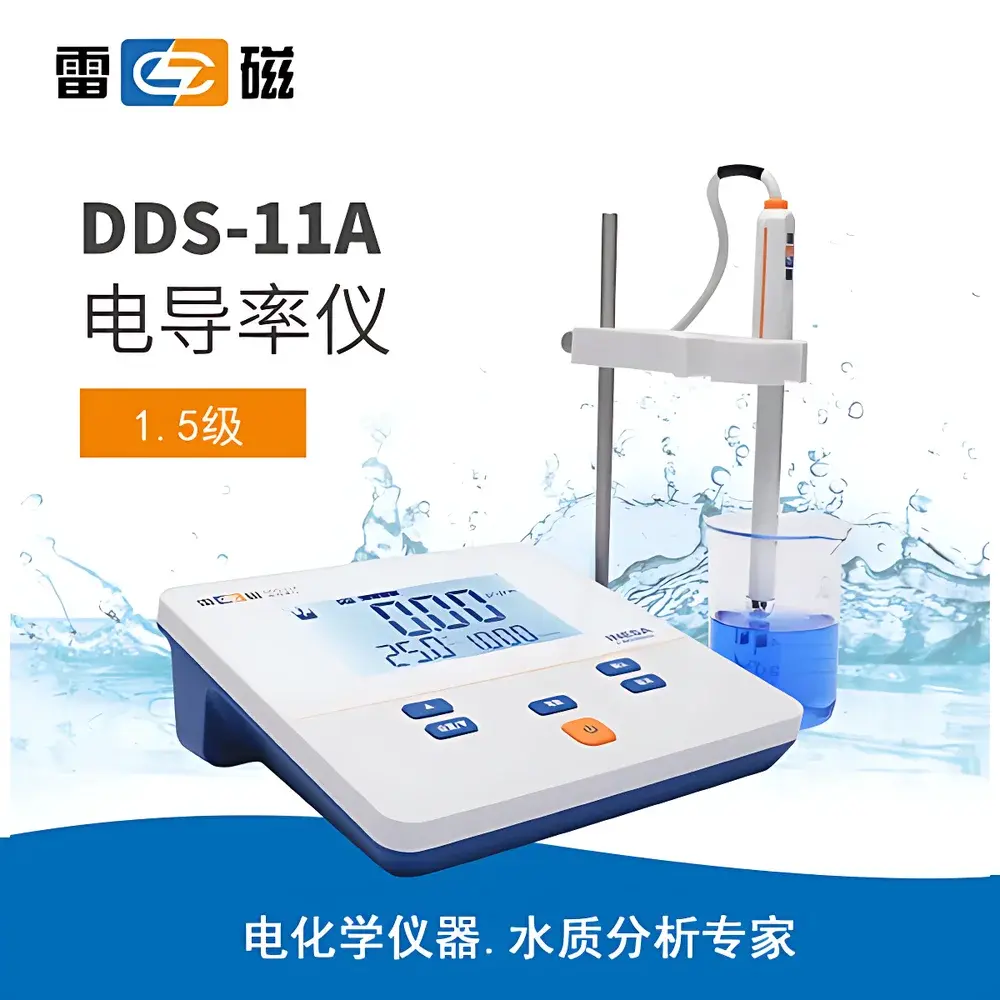
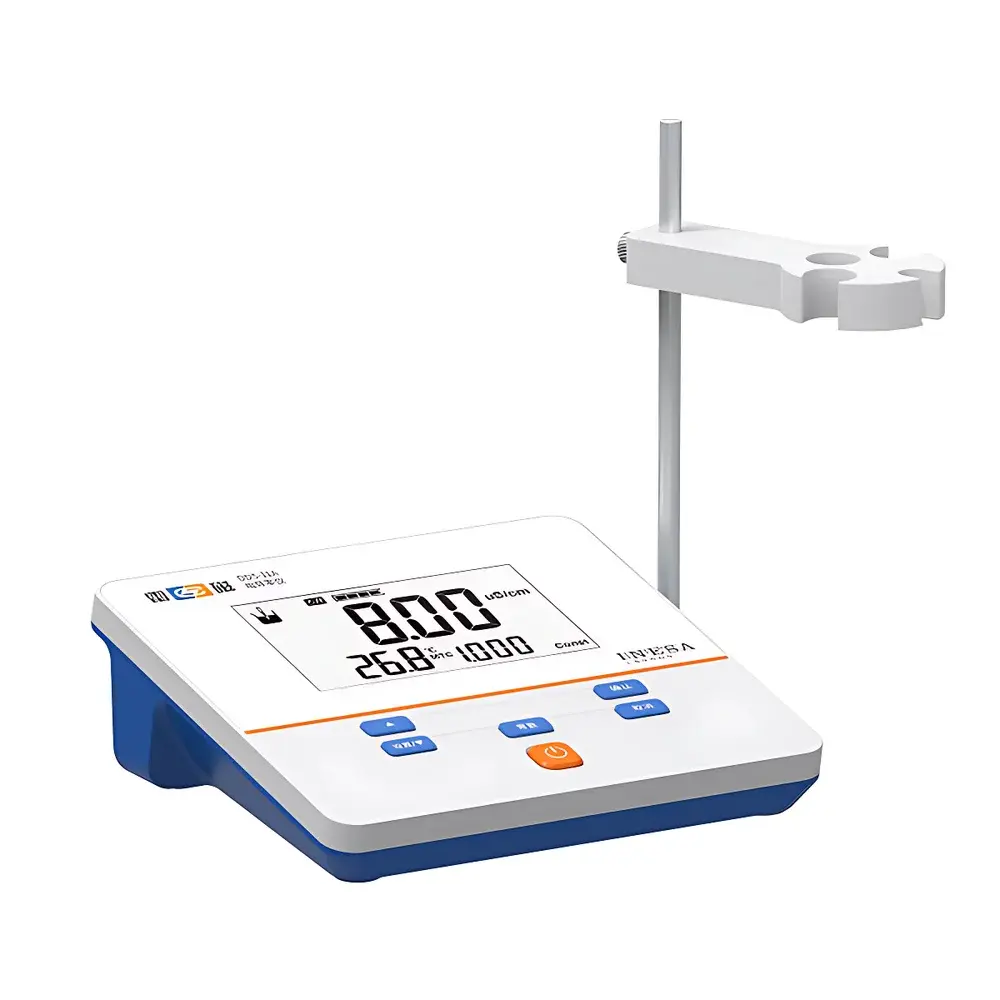
Leici DDS-11A Benchtop Conductivity Meter
| Brand | Leici |
|---|---|
| Origin | Shanghai, China |
| Instrument Type | Benchtop Laboratory Conductivity Meter |
| Measurement Parameter | Conductivity Only |
| Measurement Range | 0.00 μS/cm to 100.0 mS/cm |
| Accuracy | ±1.5% of Full Scale (FS) |
| Minimum Resolution | 0.01 μS/cm (auto-ranging) |
| Temperature Compensation | Manual |
| Electrode Constant Input | Adjustable (default 1.0 cm⁻¹) |
| Auto Frequency Switching | Yes |
| Display | LCD with Stability Indicator |
| Enclosure Rating | IP54 |
| Power Supply | DC 20 V / 1500 mA (AC 100–240 V input adapter) |
| Dimensions | 200 × 160 × 63 mm |
| Weight | 0.6 kg |
Overview
The Leici DDS-11A Benchtop Conductivity Meter is a precision-engineered electrochemical instrument designed for reliable, routine conductivity measurements in academic, industrial, and quality control laboratory environments. It operates on the principle of two-electrode AC conductometric measurement, applying a low-frequency alternating current across a pair of platinum electrodes immersed in the sample solution. The resulting conductance is converted into conductivity (σ), reported in siemens per centimeter (S/cm), with automatic range switching and frequency optimization to minimize polarization effects and electrode fouling. Engineered for stability and reproducibility, the DDS-11A delivers consistent performance across its full 0.00 μS/cm to 100.0 mS/cm dynamic range—covering ultrapure water analysis, saline solutions, process streams, and standard buffer verification. Its benchtop form factor, compact footprint (200 × 160 × 63 mm), and lightweight construction (0.6 kg) make it ideal for dedicated workstations in ISO/IEC 17025-accredited labs or GLP-compliant QC settings where space efficiency and operational simplicity are prioritized.
Key Features
- High-contrast LCD display with real-time stability indicator—provides visual confirmation when readings meet internal convergence criteria
- Auto-ranging architecture with intelligent frequency switching: automatically selects optimal excitation frequency (e.g., 1 kHz for low-conductivity samples; 10 kHz for high-salinity media) to ensure accurate measurement across all ranges
- Manual temperature compensation (MTC) with user-defined coefficient (α, typically 1.9–2.3 %/°C) aligned with ASTM D1125 and ISO 7888 standards
- Direct electrode constant entry (K = 0.01–10.00 cm⁻¹): supports interchangeable electrodes including standard K = 1.0 cm⁻¹ cells and specialized low-K sensors for ultrapure water applications
- IP54-rated enclosure: dust-protected and resistant to water splashes from any direction—suitable for humid lab environments and proximity to fume hoods
- Power management suite: configurable auto-off (10/30/60 min), power-loss memory retention, and factory reset function for calibration traceability and instrument recovery
Sample Compatibility & Compliance
The DDS-11A is validated for aqueous solutions only—including deionized water, buffer standards (e.g., KCl 0.01 mol/L, 0.1 mol/L), pharmaceutical rinse waters, boiler feedwater, and environmental surface water extracts. It is not intended for non-aqueous solvents, viscous suspensions, or highly oxidizing media. The instrument complies with basic electromagnetic compatibility (EMC) requirements per IEC 61326-1 and meets safety specifications under IEC 61010-1 for laboratory electrical equipment. While it does not include built-in audit trail or electronic signature functionality, its manual calibration protocol (using certified reference standards traceable to NIM or NIST) supports documentation workflows required under ISO/IEC 17025 Clause 6.4 and USP . All measurements adhere to the fundamental definition of conductivity as σ = G × K, where G is measured conductance and K is the cell constant—ensuring metrological consistency across laboratories.
Software & Data Management
The DDS-11A operates as a standalone instrument with no proprietary software dependency or USB/Bluetooth connectivity. All data acquisition, display, and storage occur locally via the embedded microcontroller. Readings are not logged internally; users must manually record values alongside timestamp, sample ID, temperature, and electrode constant for regulatory documentation. This design minimizes validation burden in regulated environments where software qualification (per FDA 21 CFR Part 11 or EU Annex 11) would otherwise be required. For laboratories requiring digital integration, third-party RS-232 interfaces (optional accessory) enable passive data capture using generic terminal emulators or LIMS-compatible scripts—provided the host system manages time-stamping, user authentication, and data integrity independently.
Applications
- Calibration verification of TDS meters and multi-parameter water quality analyzers
- Routine monitoring of purified water systems (PW) and water-for-injection (WFI) loops per pharmacopeial limits (e.g., EP 2.2.38, JP 2.05)
- Conductivity profiling during ion exchange resin regeneration cycles
- Quality release testing of raw materials (e.g., sodium chloride, potassium nitrate) per USP monographs
- Educational use in undergraduate chemistry and environmental science laboratories for teaching solution conductivity theory and Kohlrausch’s law
- Field-deployable lab support for wastewater treatment plants performing grab-sample analysis under EPA Method 120.1
FAQ
Does the DDS-11A support automatic temperature compensation (ATC)?
No—it provides manual temperature compensation only. Users must measure sample temperature separately (e.g., with a calibrated thermometer) and input the value to apply the selected temperature coefficient.
Can the DDS-11A be used for measuring conductivity in organic solvents?
No. The instrument is validated exclusively for aqueous electrolyte solutions. Non-aqueous media may damage the platinum electrodes or yield non-linear, uncalibratable responses.
Is the electrode included with the instrument certified for traceability?
The standard K = 1.0 cm⁻¹ electrode is supplied with a manufacturer’s certificate of conformance—not a NIST-traceable calibration certificate. For accredited applications, users must obtain separate certification from an ILAC-MRA signatory lab.
What is the recommended recalibration interval?
Leici recommends recalibration before each analytical session when used in regulated environments, or at minimum daily for continuous operation—using at least two certified conductivity standards bracketing the expected sample range.
Does the instrument meet GLP or GMP requirements?
The DDS-11A supports GLP/GMP practices through stable hardware design, manual documentation capability, and compliance with foundational metrological principles—but lacks electronic audit trail, user access control, or data export encryption required for full Part 11 compliance.






