
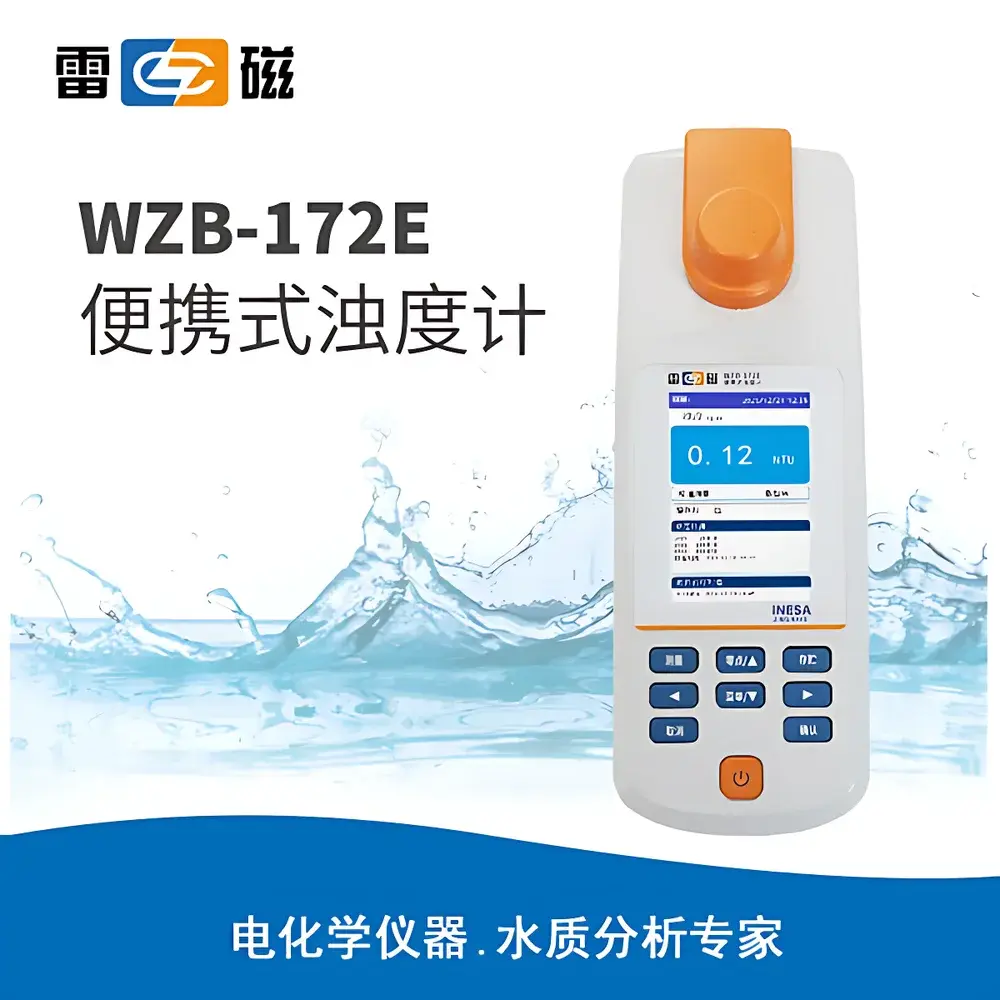
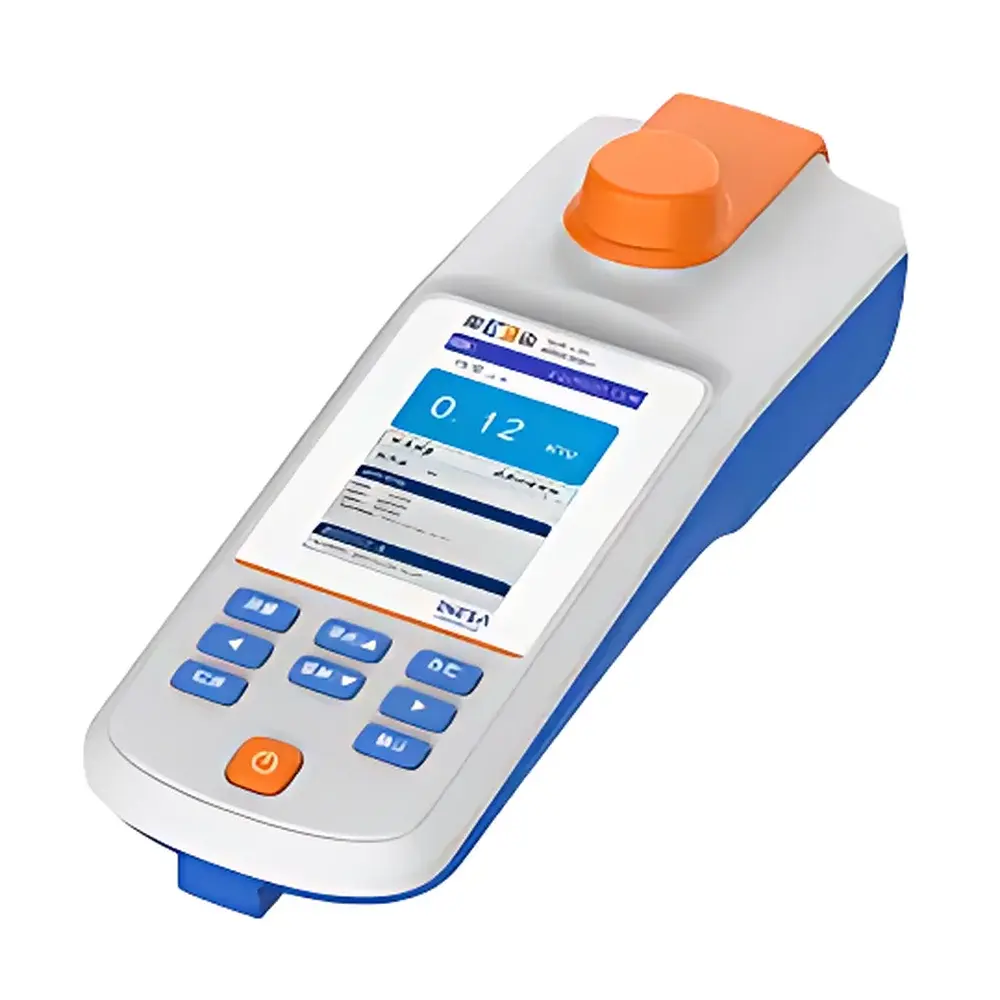
Leici WZB-172E Portable Turbidimeter
| Brand | Leici |
|---|---|
| Origin | Shanghai, China |
| Manufacturer Type | Authorized Distributor |
| Product Origin | Domestic (China) |
| Model | WZB-172E |
| Price | USD 590 (FOB Shanghai) |
| Type | Portable |
| Measurement Range | (0.00–9.99) NTU, (10.0–99.9) NTU, (100–500) NTU |
| Resolution | 0.01 NTU / 0.1 NTU / 1 NTU |
| Accuracy | ±6% FS |
| Repeatability | ≤0.5% |
| Zero Drift | ±0.5% FS/30 min |
| Stability | ±0.5% FS/30 min |
| Calibration Points | Up to 4-point (2, 20, 200, 500 NTU) |
| Data Storage | 1000 records |
| Display | 3.5-inch color LCD |
| Ingress Protection | IP65 |
| Operating Environment | 5–40 °C, ≤85% RH |
| Power | Rechargeable Li-ion battery |
| Dimensions & Weight | 90 × 250 × 90 mm, ~0.8 kg |
Overview
The Leici WZB-172E Portable Turbidimeter is an engineered field-deployable instrument designed for reliable, on-site turbidity measurement in compliance with internationally recognized environmental and regulatory standards—including U.S. Environmental Protection Agency Method 180.1 and China’s HJ 1075–2019. It operates on the principle of nephelometric detection (90° scattered light) and dual-mode scatter-transmission measurement, enabling accurate quantification of suspended particulate matter across three auto-ranging intervals: low (0.00–9.99 NTU), medium (10.0–99.9 NTU), and high (100–500 NTU). Its tungsten-halogen light source emits broadband visible radiation (400–600 nm), optimized for consistency with standard formazin-based calibration protocols and robust performance under variable ambient lighting conditions. The instrument is purpose-built for water quality professionals conducting routine monitoring in drinking water distribution systems, wastewater treatment plants, surface water surveillance, and environmental field studies where portability, ruggedness, and traceable data integrity are essential.
Key Features
- Auto-ranging optical detection system with seamless switching between 0.01 NTU (low-range), 0.1 NTU (mid-range), and 1 NTU (high-range) resolution modes
- Dual-measurement methodology: selectable nephelometric (ISO 7027-compliant scatter mode) and scatter-transmission hybrid mode for improved accuracy in colored or highly absorbing samples
- IP65-rated enclosure with integrated shock-absorbing housing—certified for dust-tight operation and resistance to low-pressure water jets, suitable for outdoor and industrial environments
- 3.5-inch full-color TFT LCD with adjustable brightness, intuitive icon-driven menu navigation, and real-time graphical display of measurement trends
- Integrated long-life tungsten-halogen lamp with stable spectral output and ≥10,000-hour operational lifetime; no warm-up delay required
- Built-in battery management system with low-voltage warning, charging status indicator, and support for simultaneous operation and charging via Micro-USB
- Onboard memory stores up to 1000 measurement records with timestamp, operator ID, unit selection, and measurement mode metadata
Sample Compatibility & Compliance
The WZB-172E accepts standard 25-mm round glass vials (included) and is compatible with ASTM D6508, ISO 7027:2016, USEPA 180.1, and HJ 1075–2019 test procedures. Its optical path geometry and detector alignment are factory-verified per GLP requirements, ensuring inter-instrument comparability. All calibration routines—including zero-point correction and multi-point (2, 20, 200, 500 NTU) formazin or StablCal® reference standardization—are logged with audit-trail timestamps. Instrument firmware supports user-defined calibration curves and restoration of factory-default settings, satisfying internal QA/QC and external regulatory review requirements for method validation and instrument qualification.
Software & Data Management
Data export and configuration management are enabled via Leici’s proprietary PC communication software (Windows-compatible), accessed through the Micro-USB interface. The software supports bidirectional data transfer—including batch download of stored measurements, firmware updates, and parameter reconfiguration (e.g., unit preference, averaging duration, auto-power-off delay). Exported datasets include CSV-formatted files with embedded metadata (date/time, operator code, calibration status, measurement mode), facilitating integration into LIMS or ELN platforms. RS-232 serial output (via optional adapter) enables direct printing to industry-standard thermal printers—ideal for field reporting and chain-of-custody documentation. All data operations comply with ALCOA+ principles (Attributable, Legible, Contemporaneous, Original, Accurate, Complete, Consistent, Enduring, Available) for regulated environments.
Applications
- Routine turbidity verification in municipal drinking water treatment and distribution networks
- Effluent monitoring at wastewater treatment facilities prior to discharge (compliance with NPDES or local discharge permits)
- Field assessment of sediment resuspension, stormwater runoff, and watershed health indicators
- Process control in membrane filtration, coagulation-flocculation, and disinfection unit operations
- Educational laboratory instruction for water chemistry and environmental science curricula
- Emergency response testing following natural disasters or infrastructure failures affecting water clarity
FAQ
What turbidity units does the WZB-172E support?
NTU (Nephelometric Turbidity Units), FNU (Formazin Nephelometric Units), and EBC (European Brewery Convention) — automatically converted based on selected calibration standard and measurement mode.
Does the instrument meet FDA or ISO 17025 requirements for accredited labs?
While not certified as a standalone ISO/IEC 17025 testing device, its design, calibration traceability, data audit trail, and GLP-compliant logging support use within ISO 17025-accredited laboratories when operated under documented SOPs and verified against NIST-traceable standards.
Can I perform multi-point calibration in the field without connecting to a PC?
Yes—up to four calibration points (2, 20, 200, and 500 NTU) can be executed directly on the device using supplied StablCal® or formazin standards; all calibration events are time-stamped and stored in non-volatile memory.
Is the battery replaceable by the end user?
The rechargeable lithium-ion battery is serviceable by authorized Leici technical centers; field replacement is not supported to maintain IP65 integrity and electrical safety certification.
How often should the optical window be cleaned, and what cleaning protocol is recommended?
The quartz measurement cell window should be wiped with lint-free lens tissue and deionized water after each sample series; isopropyl alcohol may be used for persistent residue—avoid abrasive cloths or solvents that degrade O-rings or optical coatings.





