
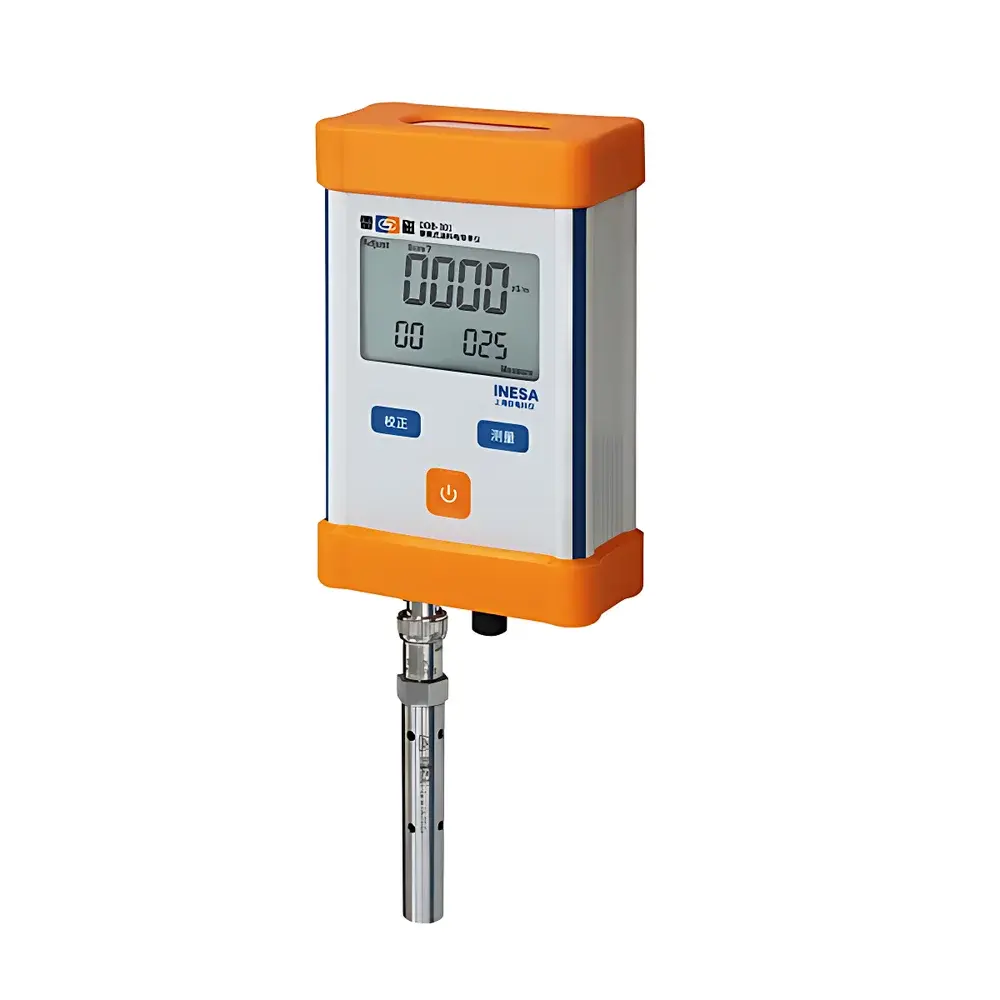
Leici DDB-301 Portable Fuel Conductivity Meter
| Brand | Leici |
|---|---|
| Origin | Shanghai, China |
| Model | DDB-301 |
| Portability | Portable |
| Application Environment | Laboratory & Field |
| Measurement Parameter | Electrical Conductivity (Single-Parameter) |
| Resolution | 1 pS/m |
| Measurement Range | 0–1999 pS/m |
| Display | LCD |
| Power Supply | Two 476A 6V Alkaline Batteries |
| Operating Temperature | 0–40 °C |
| Relative Humidity | ≤85% RH |
| Dimensions | 85 × 220 × 50 mm |
| Weight | ~350 g |
| Explosion Protection | Ex ia IIA T5 Ga (Certificate No.: GYB23.2384X) |
| Standard Electrode | DJSY-0.01 Fuel Conductivity Cell |
| Accessories | Silicone Protective Sleeve, Metal Measuring Beaker |
Overview
The Leici DDB-301 Portable Fuel Conductivity Meter is a purpose-engineered electrochemical instrument designed for rapid, on-site or laboratory-based measurement of electrical conductivity in hydrocarbon-based fuels—including aviation turbine fuel (Jet A-1, JP-5), diesel, gasoline, and kerosene. It operates on the principle of two-electrode AC conductometry, optimized to minimize polarization effects and electrode fouling common in low-conductivity non-aqueous media. With a measurement range of 0–1999 pS/m and a resolution of 1 pS/m, the DDB-301 meets the sensitivity requirements specified in ASTM D2624 (Standard Test Method for Electrical Conductivity of Aviation Fuels) and ISO 6297 (Petroleum products — Determination of electrical conductivity). Its compact, hand-held architecture enables direct insertion into fuel drums, tanker sumps, or sampling containers—supporting real-time verification of static charge dissipation capability critical for safe fuel handling, transfer, and storage.
Key Features
- High-resolution conductivity detection down to 1 pS/m, enabling precise quantification of trace ionic contamination and additive concentration in low-conductivity fuels.
- Integrated Ex ia IIA T5 Ga intrinsic safety certification (Certificate No.: GYB23.2384X), permitting safe operation in hazardous zones where flammable vapors may be present—fully compliant with IEC 60079-0 and GB 3836.1/4 standards.
- Dedicated DJSY-0.01 fuel-specific conductivity cell with optimized electrode geometry and temperature-compensated calibration, minimizing drift during repeated field use.
- Low-power LCD interface with three-button navigation—designed for intuitive operation under gloves and ambient lighting conditions typical of refinery, airport ramp, or marine environments.
- Intelligent power management including auto-shutdown after 10 minutes of inactivity and real-time battery voltage monitoring with audible and visual low-voltage alerts.
- Ruggedized housing with IP54-rated ingress protection, silicone protective sleeve, and impact-resistant metal measuring beaker included as standard accessories.
Sample Compatibility & Compliance
The DDB-301 is validated for use with non-aqueous, low-dielectric hydrocarbon liquids exhibiting conductivity values in the picosiemens-per-meter (pS/m) range. It is not intended for aqueous solutions, electrolytes, or high-conductivity solvents. The instrument complies with key industry standards governing fuel quality assurance and explosion safety, including ASTM D2624–22, ISO 6297:2021, DEF STAN 91-87, and MIL-DTL-83133E. Its intrinsic safety rating satisfies Zone 1/21 classification requirements per ATEX and CNEx frameworks. Calibration traceability is maintained through factory-certified reference standards traceable to NIM (National Institute of Metrology, China) and supports GLP-aligned documentation practices.
Software & Data Management
The DDB-301 operates as a standalone, embedded-system device without Bluetooth, USB, or PC connectivity. All measurements are displayed in real time on the monochrome LCD; no internal data logging or export functionality is provided. Users record results manually or integrate readings into external LIMS or QA/QC workflows via documented SOPs. Calibration status, date, and operator ID can be annotated alongside each reading in accordance with ISO/IEC 17025 clause 7.7 (result reporting) and FDA 21 CFR Part 11 principles when paired with controlled procedural documentation.
Applications
- Verification of fuel conductivity pre-transfer to ensure compliance with minimum static dissipation thresholds (e.g., ≥50 pS/m for Jet A-1 per IATA Guidance Material).
- Routine QC checks at fuel depots, blending facilities, and aircraft refueling units to detect contamination from water ingress, surfactant degradation, or additive depletion.
- Field audits during fuel receipt inspection or tank bottom sampling per API RP 1164 and EI JIG 1530 protocols.
- Supporting root-cause analysis in incidents involving electrostatic discharge (ESD)-related ignition risk during loading/unloading operations.
- Educational use in petroleum engineering labs for teaching fundamental concepts of fuel electrochemistry and static hazard mitigation.
FAQ
What is the recommended calibration frequency for the DDB-301 in routine fuel testing?
Calibration should be performed before each testing session using certified reference standards (e.g., 100 pS/m and 1000 pS/m fuel-mimicking solutions), especially after electrode cleaning or temperature shifts exceeding ±5 °C.
Can the DJSY-0.01 electrode be used with other conductivity meters?
No—the DJSY-0.01 is electrically and mechanically matched to the DDB-301’s excitation frequency and gain profile; interchanging with non-Leici instruments may yield non-linear or inaccurate results.
Is the DDB-301 suitable for measuring conductivity in biodiesel blends (e.g., B5, B20)?
Yes, provided the blend exhibits stable phase separation and the measurement is conducted at consistent temperature (20 ± 2 °C); however, elevated polarity may require more frequent electrode rinsing with dry isopropanol.
Does the instrument provide temperature compensation?
No—the DDB-301 reports raw conductivity at measured sample temperature; users must apply manual correction factors per ASTM D2624 Annex A3 if reporting to standardized 20 °C reference conditions.
How is intrinsic safety verified during field deployment?
The Ex ia IIA T5 Ga marking confirms that the entire system—including battery compartment, display circuitry, and electrode interface—has been independently tested and certified to limit energy release below the minimum ignition energy (MIE) threshold for propane-class atmospheres.







