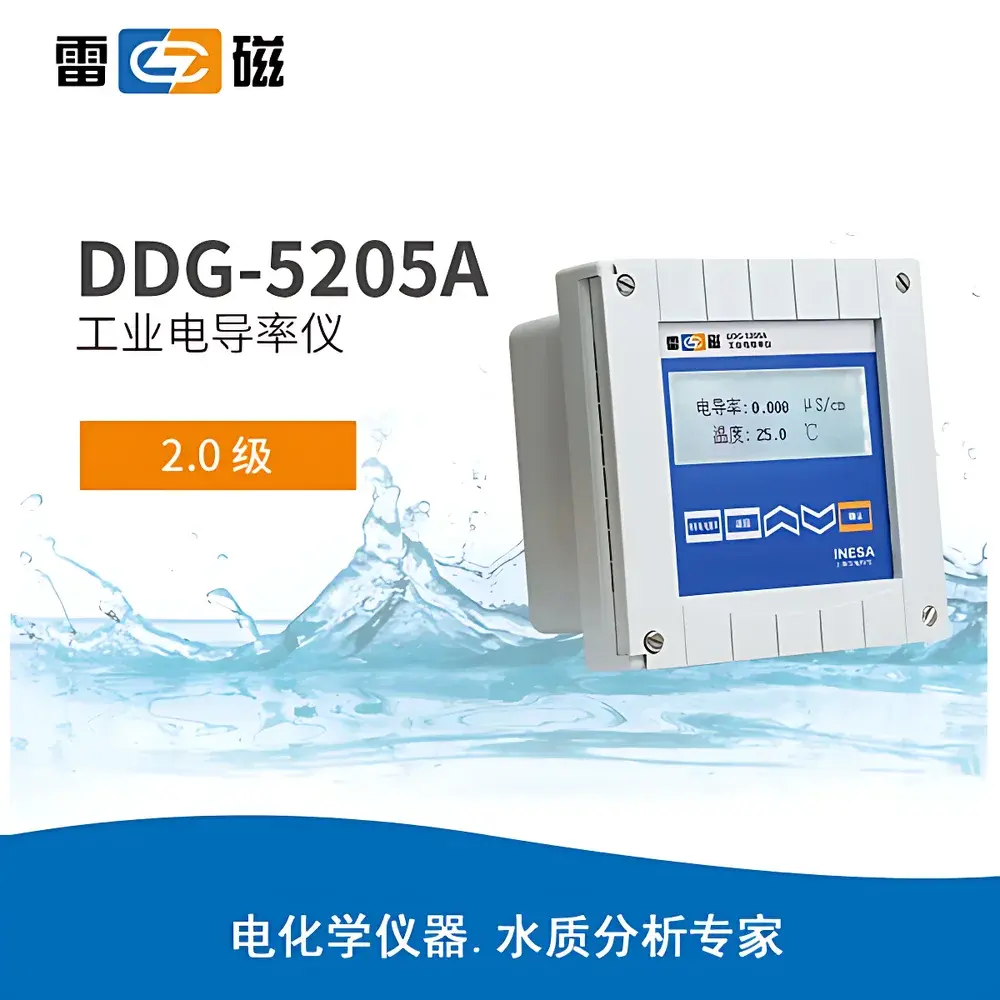
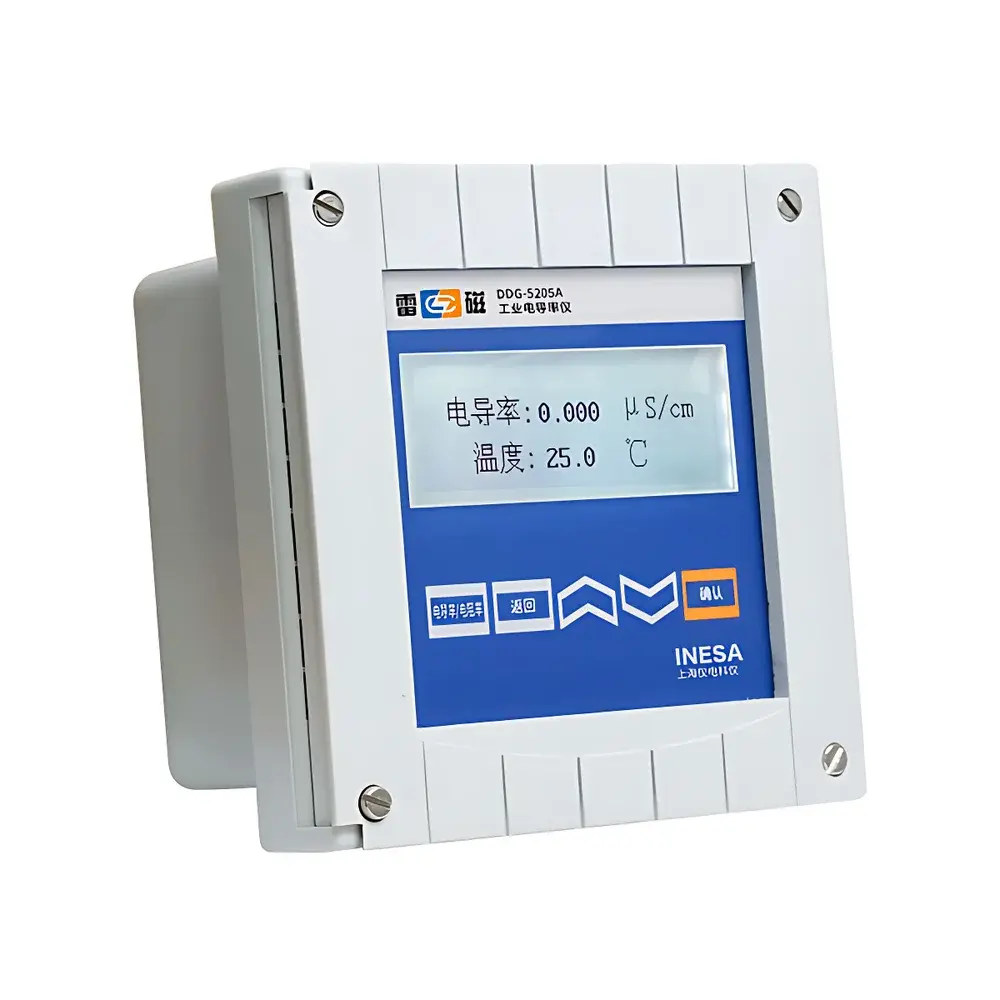
Leichi DDG-5205A Online Conductivity Analyzer
| Brand | Leichi |
|---|---|
| Model | DDG-5205A |
| Type | Online Conductivity Analyzer |
| Measurement Range (Conductivity) | 0.000 µS/cm to 10.0 mS/cm (dependent on cell constant) |
| Temperature Range | −10.0 °C to 120.0 °C |
| Basic Instrument Error (Conductivity) | ±2.0% FS |
| Resolution (Conductivity) | 0.001 µS/cm (lowest range) |
| Temperature Compensation Range | 5.0 °C to 60.0 °C (reference 25.0 °C) |
| Repeatability | 1.0% FS |
| Electronic Unit Accuracy (Conductivity) | ±1.0% FS |
| Stability | ±0.5% FS/24 h |
| Enclosure Rating | IP65 |
| Power Supply | AC 220 V ±10%, 50 Hz or DC 24 V |
| Dimensions | 166 × 166 × 110 mm |
| Weight | ~2 kg |
| Data Storage Capacity | 400 records with configurable logging interval |
| Output | Isolated 4–20 mA DC (user-definable upper/lower limits) |
| Communication Interface | RS-232 or RS-485 (selectable) |
| Optional Conductivity Cells | K = 0.01 cm⁻¹, 0.1 cm⁻¹, or 1.0 cm⁻¹ |
Overview
The Leichi DDG-5205A Online Conductivity Analyzer is an industrial-grade, microprocessor-controlled conductivity monitoring system engineered for continuous, real-time measurement of aqueous solution conductivity in demanding process environments. It operates on the principle of two-electrode or four-electrode conductometric measurement—depending on the selected sensor—and applies temperature-compensated calculation algorithms compliant with standard reference conditions (25.0 °C). Designed for integration into water treatment, power generation, pharmaceutical manufacturing, and chemical processing systems, the DDG-5205A delivers stable, traceable measurements across a wide dynamic range—from ultrapure water (sub-µS/cm) to high-conductivity brines (up to 10 mS/cm)—without manual range switching. Its robust architecture supports uninterrupted operation under fluctuating thermal and mechanical conditions, meeting the reliability requirements of ISO 9001-certified production lines and GLP-compliant utilities.
Key Features
- Large dot-matrix LCD display showing simultaneous conductivity and temperature readings with intuitive unit labeling and status indicators
- Embedded single-chip microcontroller enabling precise digital signal processing, automatic range selection, and linearized output scaling
- Automatic temperature compensation (ATC) using NTC thermistor input, configurable within 5.0–60.0 °C with user-selectable reference temperature (default 25.0 °C)
- Configurable data logging: stores up to 400 timestamped measurement records with programmable sampling intervals (1 min to 24 h)
- Dual-limit alarm functionality with relay outputs for high/low conductivity thresholds; alarm latching and reset options supported
- Power-fail protection preserving calibration parameters and configuration settings during brownout or shutdown events
- Optional automated electrode cleaning interface compatible with pneumatic or ultrasonic cleaning modules (requires external actuation control)
- Isolated 4–20 mA analog output with fully adjustable span and zero points—supports HART-compatible loop-powered configurations
- Standard serial communication via RS-232 or RS-485 (Modbus RTU protocol), enabling seamless integration with DCS, SCADA, or PLC-based control systems
- IP65-rated polycarbonate enclosure suitable for wall- or panel-mount installation in humid, dusty, or splash-prone industrial zones
Sample Compatibility & Compliance
The DDG-5205A is validated for use with low-to-medium ionic strength aqueous streams including deionized water, boiler feedwater, condensate return, seawater distillate, and municipal raw water. Sensor compatibility spans three standardized cell constants (K = 0.01, 0.1, and 1.0 cm⁻¹), allowing optimal resolution and linearity across application-specific ranges: 0–20 µS/cm (ultrapure water), 1–200 µS/cm (softened water), and 10–10,000 µS/cm (process brines or cooling tower blowdown). The instrument complies with IEC 61000-6-2 (EMC immunity) and IEC 61000-6-4 (EMC emission) standards. While not intrinsically safe, its non-hazardous location rating aligns with NEC Class 1, Division 2 and ATEX Zone 2 requirements when installed per manufacturer guidelines. Calibration traceability follows NIST-traceable standards per ASTM D1125 and ISO 7888 protocols.
Software & Data Management
Data acquisition and configuration are managed locally via front-panel keypad navigation or remotely through ASCII-command-based serial communication. The embedded firmware supports full parameterization—including sensor constant entry, temperature coefficient (β) adjustment, damping filter time constants, and alarm hysteresis settings. Logged datasets are retrievable in chronological order with date/time stamps and can be exported via terminal emulation software for trend analysis in Excel or LIMS platforms. Though the device does not include built-in FDA 21 CFR Part 11 compliance features (e.g., electronic signatures or audit trails), its deterministic behavior, non-volatile memory retention, and configuration lockout mode support GMP-aligned operational qualification (OQ) and routine calibration verification procedures.
Applications
- Continuous monitoring of steam condensate purity in thermal power plants to detect tube leakage and prevent turbine corrosion
- Real-time tracking of deionization efficiency in semiconductor fab UPW (ultrapure water) distribution loops
- Feedwater quality assurance in pharmaceutical water-for-injection (WFI) and purified water (PW) generation systems
- Process control of reverse osmosis (RO) and electrodeionization (EDI) unit performance in industrial desalination plants
- Early detection of contamination ingress in closed-loop cooling water circuits and HVAC chilled water systems
- Regulatory compliance reporting for EPA NPDES discharge permits requiring conductivity-based effluent characterization
FAQ
What conductivity cell constants are supported?
The DDG-5205A is compatible with three industry-standard cells: 2043-205B (K = 0.01 cm⁻¹), 2043-405B (K = 0.1 cm⁻¹), and 2043-605B (K = 1.0 cm⁻¹). Cell selection must match the expected sample conductivity range to maintain measurement accuracy and minimize polarization error.
Does the analyzer support automatic calibration?
No—the DDG-5205A requires manual calibration using certified standard solutions (e.g., 1413 µS/cm KCl at 25 °C). However, it retains calibration coefficients and supports multi-point verification routines.
Can the 4–20 mA output be scaled to a custom range?
Yes—users may define arbitrary lower and upper conductivity values corresponding to 4 mA and 20 mA respectively, enabling direct integration with legacy analog controllers.
Is the device suitable for high-pressure pipeline installations?
The analyzer itself is not rated for direct in-line pressure exposure. It must be used with a flow-through cell or bypass loop assembly rated for system pressure; sensor mounting hardware must comply with ASME B16.5 or DIN 11851 specifications.
How is temperature measured and compensated?
Temperature is acquired via integrated Pt1000 or NTC thermistor embedded in the conductivity cell. Compensation follows the linearized equation σT = σmeas / [1 + β(T − Tref)], where β defaults to 2.0 %/°C but is adjustable per IAPWS guidelines.
Related Products