
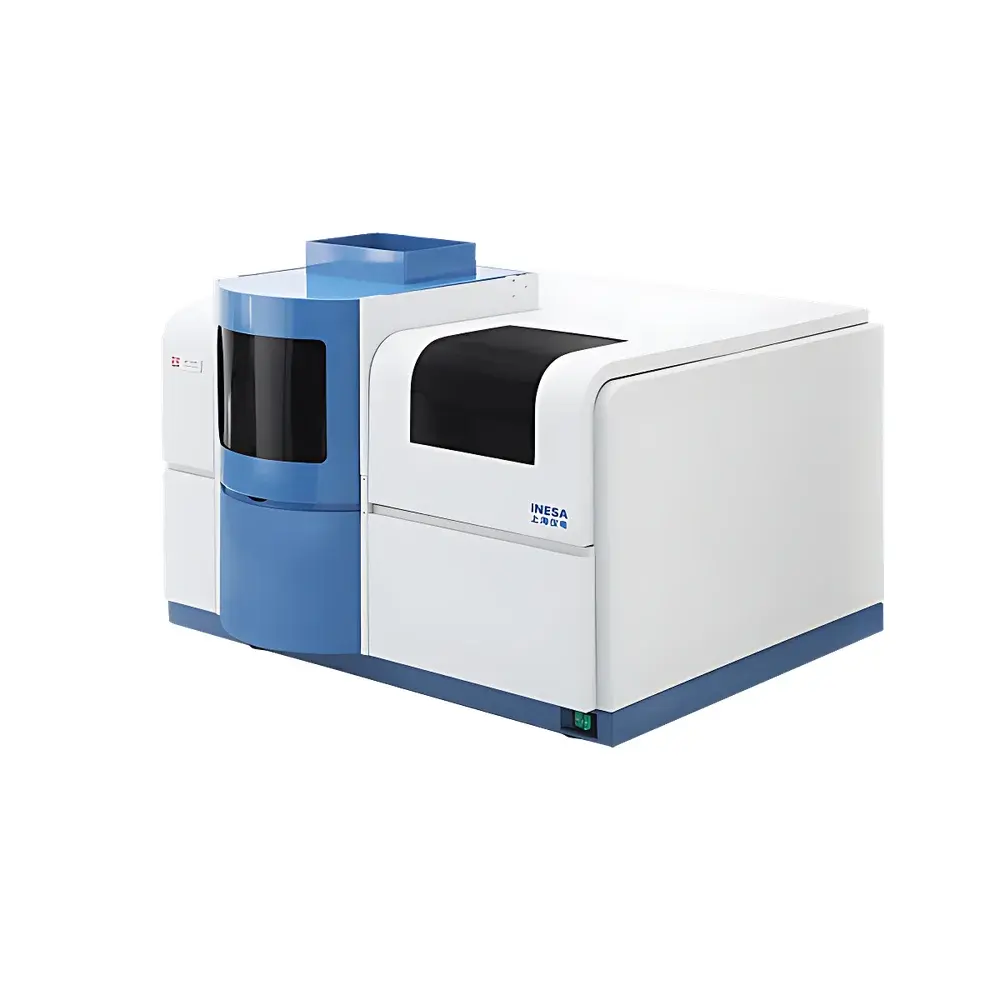
INESA AA320N Plus Atomic Absorption Spectrophotometer with Graphite Furnace Options
| Brand | INESA |
|---|---|
| Origin | Shanghai, China |
| Instrument Type | Flame and Graphite Furnace Atomic Absorption Spectrophotometer |
| Compliance | Meets ISO 11171, ASTM D5185, USP <731>, and GB/T 21187–2007 for AAS methodology |
| Detection Limits | Sub-pptr range for most elements (e.g., Cd: 0.002 µg/L, Pb: 0.02 µg/L in flame mode |
| Cd | 0.1 pg, Pb: 0.5 pg in GF mode) |
| Wavelength Range | 190–900 nm |
| Spectral Bandwidth | 0.1, 0.2, 0.4, 1.0, 2.0 nm selectable |
| Light Source | Hollow Cathode Lamps (HCLs) and Electrodeless Discharge Lamps (EDLs) |
| Detector | High-sensitivity photomultiplier tube (PMT) |
| Data Output | USB 2.0, RS-232, optional Ethernet interface |
| Software | AAWinLab v3.2 with audit trail, user permission levels, and 21 CFR Part 11 compliance modules |
Overview
The INESA AA320N Plus Atomic Absorption Spectrophotometer is a dual-mode analytical instrument engineered for quantitative elemental analysis at trace and ultra-trace concentration levels. Based on the fundamental principle of atomic absorption spectroscopy—where ground-state free atoms in a graphite furnace or flame atomizer absorb characteristic radiation emitted by element-specific hollow cathode lamps—the system delivers high specificity, low detection limits, and robust reproducibility. Designed for routine laboratory environments in environmental monitoring, pharmaceutical quality control, clinical toxicology, and metallurgical R&D, the AA320N Plus supports both flame (FAAS) and electrothermal (GFAAS) atomization configurations. Its optical architecture features a double-beam, monochromator-based design with automatic wavelength scanning and spectral bandwidth selection, minimizing baseline drift and enhancing long-term measurement stability. The system’s modular construction allows seamless integration of optional accessories—including the AS4020 graphite furnace autosampler, AS800 recirculating chiller, and AAH-1 hydride generation unit—to extend analytical capability to volatile species (As, Se, Sb, Bi, Hg, Te) via cold vapor or hydride-forming protocols.
Key Features
- Simultaneous flame and graphite furnace operation via interchangeable atomizers, enabling method flexibility without hardware reconfiguration
- Automatic lamp alignment and intensity optimization using servo-controlled positioning and real-time energy feedback
- Integrated background correction using deuterium arc (D₂) and Zeeman-effect modes, ensuring accurate compensation for non-specific absorption and scattering interference
- Graphite furnace temperature programming with up to 30-step ramping, hold, and cooling profiles, controllable to ±1°C accuracy across 20–3000°C range
- Flame system with air-acetylene and nitrous oxide-acetylene gas mixing capability, supporting >70 elements including refractory metals (V, Mo, Ti)
- Robust mechanical design compliant with IEC 61010-1 safety standards; CE-marked and certified for electromagnetic compatibility (EMC)
Sample Compatibility & Compliance
The AA320N Plus accommodates liquid samples (aqueous, acidic digests, organic extracts), slurries (up to 15% solids), and solid micro-samples via direct insertion into the graphite tube. Sample introduction supports manual pipetting, programmable autosampling (AS4020), and hydride/vapor generation (AAH-1). All operational parameters—including lamp current, slit width, integration time, and calibration curve fitting algorithms—are configurable to align with ISO/IEC 17025–accredited workflows. The instrument meets regulatory requirements for GLP and GMP environments: AAWinLab software includes full 21 CFR Part 11 compliance features—electronic signatures, audit trail logging, role-based access control, and data integrity safeguards. Routine performance verification follows ASTM D5185 (petroleum products), USP (heavy metals in pharmaceuticals), and EPA Method 7000B (wastewater metals).
Software & Data Management
AAWinLab v3.2 provides a validated, Windows-based platform for instrument control, method development, and quantitative reporting. The software supports multi-point calibration (linear, quadratic, weighted least squares), standard addition, and internal standard correction. Raw absorbance/time and absorbance/wavelength data are stored in vendor-neutral ASCII and CSV formats. Audit trails record all user actions—including parameter changes, calibration events, and result modifications—with timestamps and operator IDs. Data export options include PDF reports with embedded spectra, Excel-compatible spreadsheets, and LIMS-ready XML output. Optional network deployment enables centralized method libraries and remote diagnostics across multi-instrument laboratories.
Applications
- Environmental: Quantification of Pb, Cd, Cr, Ni, and As in soil leachates, drinking water, and industrial effluents per ISO 17294-2
- Pharmaceutical: Heavy metal testing in active pharmaceutical ingredients (APIs) and excipients per ICH Q3D guidelines
- Clinical: Trace element profiling (Zn, Cu, Fe, Mn) in serum and whole blood for nutritional assessment
- Food Safety: Monitoring of toxic elements (Hg, As, Cd) in seafood, rice, and infant formula per EU Commission Regulation (EU) No 1881/2006
- Materials Science: Impurity analysis in high-purity metals, catalysts, and battery-grade lithium compounds
FAQ
Does the AA320N Plus support automated sample dilution and standard preparation?
No—dilution and standard preparation must be performed manually or using external liquid handlers; however, the AS4020 autosampler supports programmable rinse cycles and matrix-matched calibration bracketing.
Is Zeeman background correction available as a factory-installed option?
Yes—Zeeman correction is integrated as a standard feature in all graphite furnace configurations and may be enabled via software license activation.
What validation documentation is supplied with the instrument?
Each unit ships with Factory Acceptance Test (FAT) report, IQ/OQ protocol templates, and a Certificate of Conformance to GB/T 21187–2007 and ISO/IEC 17025 Annex A.5 requirements.
Can the system operate under nitrogen purge for UV-sensitive elements?
Yes—the optical bench includes a dedicated N₂ purge port compatible with external gas manifolds for extended UV performance below 200 nm.
Is remote firmware update supported over LAN?
Firmware updates require local USB connection and administrator-level credentials; remote updates are disabled by default to maintain data integrity and regulatory compliance.






