
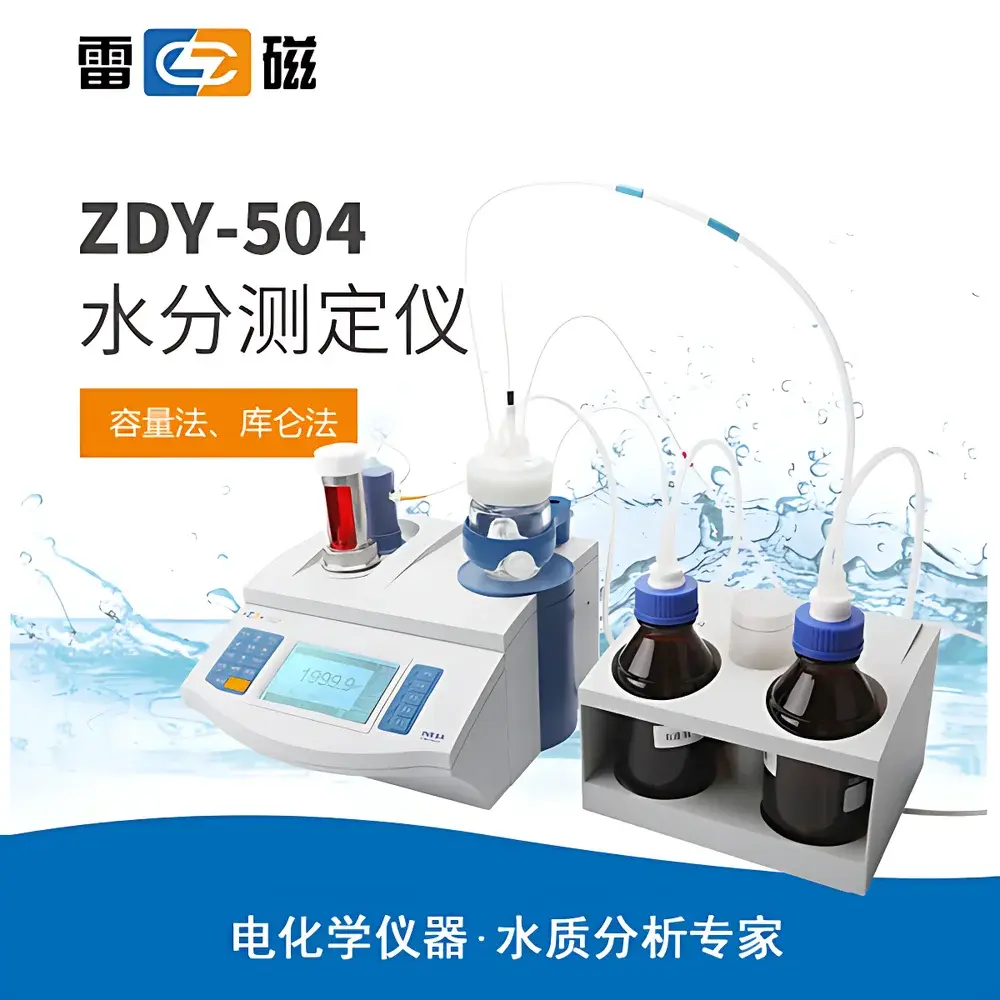
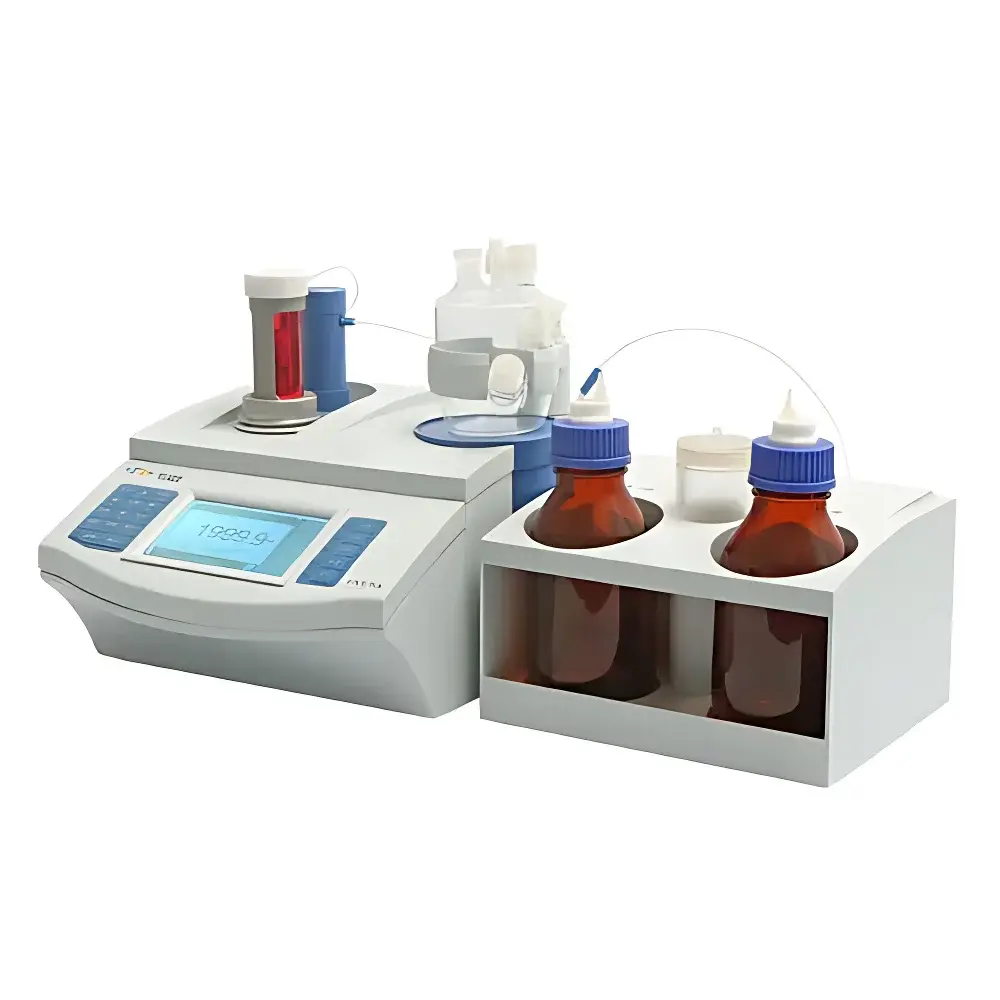
Leici ZDY-504 Karl Fischer Moisture Titrator
| Brand | Leici |
|---|---|
| Origin | Shanghai, China |
| Model | ZDY-504 |
| Titration Method | Fully Automatic |
| Instrument Type | Volumetric & Coulometric Karl Fischer Moisture Analyzer |
| Moisture Range | Volumetric: 0.1–250.0 mg H₂O |
| Coulometric | 10 μg–20 mg H₂O |
| Resolution | 0.1 mg |
| Accuracy | Volumetric: ≤0.5% RSD |
| Coulometric | RSD ≤3% at 100 μg H₂O |
| Minimum Dispensing Volume | 0.005 mL |
| Titration Control Precision | 1/12000 |
| Polarization Current | 1 μA ± 0.2 μA |
| Electrolysis Current Options (Coulometric) | 10, 20, 50, 100 mA |
| Water Equivalence Factors (Coulometric) | 1, 1.86, 5, 10 μg H₂O/s |
| Measurement Error (Coulometric) | ±(5% of reading + 3) μg |
| Dimensions (L×W×H) | 340 × 400 × 400 mm |
| Weight | ~10 kg |
Overview
The Leici ZDY-504 Karl Fischer Moisture Titrator is a dual-mode analytical instrument engineered for precise and trace-level quantification of water content in solid, liquid, and gaseous samples using both volumetric and coulometric Karl Fischer titration principles. Volumetric mode employs standardized KF reagent delivery via high-precision syringe dosing to determine water mass based on stoichiometric reaction with iodine, suitable for samples containing >0.1 mg H₂O. Coulometric mode generates iodine electrochemically at the anode in real time, enabling sub-microgram detection (down to 10 μg H₂O) with inherent reagent stability and minimal consumable dependency—ideal for pharmaceutical excipients, lithium battery electrolytes, polymer resins, and hygroscopic APIs. The system complies with fundamental metrological requirements defined in ASTM E203, ISO 760, and USP , supporting method validation under GLP and GMP-aligned workflows.
Key Features
- Dual-mode architecture: Seamless switching between volumetric and coulometric titration without hardware modification—enabling laboratory-wide coverage from routine QC (e.g., solvents, oils) to ultra-trace analysis (e.g., silicone oils, catalysts).
- High-fidelity fluid handling: Syringe-driven reagent delivery with 0.005 mL minimum dispensing volume and 1/12000 volumetric control precision ensures reproducible reagent metering and minimizes endpoint overshoot.
- Integrated safety engineering: Leak-proof reagent delivery path, anti-siphon waste bottle design, automatic electrode rinsing, and overflow protection prevent KF reagent exposure and cross-contamination—critical for compliance with OSHA and CLP hazard communication standards.
- Multi-parameter endpoint detection: Adaptive polarization current monitoring (1 μA and 50 μA ranges) coupled with real-time current stabilization enables robust endpoint recognition across diverse sample matrices, including viscous, acidic, or redox-active substances.
- Modular operation modes: Supports automatic titration, constant-dose titration, and KF titer calibration—allowing method customization for non-aqueous solvents (e.g., chloroform/methanol blends), heterogeneous solids (via oven coupling), or volatile samples.
- GLP-compliant data integrity: Built-in audit trail for method parameters, operator ID, date/time stamps, and raw titration curves; supports storage of up to 200 volumetric and 200 coulometric measurement records with full traceability.
Sample Compatibility & Compliance
The ZDY-504 accommodates samples ranging from low-viscosity liquids (e.g., acetone, THF) to semi-solids (greases, adhesives) and powdered solids (APIs, metal oxides) when used with optional sample heaters or homogenizers. Its sealed titration cell design mitigates atmospheric moisture ingress during analysis—essential for accurate results per ISO 15512 and ASTM D6304. All measurement units (mg, %, ppm, mg/L, μg/mL) are programmable and auto-converted based on sample weight and dilution factor. Data export conforms to CSV and PDF formats compatible with LIMS integration. The instrument meets electromagnetic compatibility (EMC) requirements per IEC 61326-1 and electrical safety standards per IEC 61010-1.
Software & Data Management
The embedded Chinese-language interface operates alongside optional PC-based software for remote control, method development, and advanced reporting. Software features include customizable report templates compliant with 21 CFR Part 11 requirements (user authentication, electronic signatures, change history logging), trend analysis across batches, and statistical evaluation (mean, SD, RSD, confidence intervals). Data backup is supported via USB storage; firmware and application updates are delivered via secure USB flash drive—ensuring long-term regulatory adaptability without network connectivity.
Applications
- Pharmaceuticals: Water content verification of lyophilized powders, tablet granules, and packaging headspace per USP and EP 2.5.12.
- Chemicals: Purity assessment of solvents (e.g., DMF, acetonitrile), monomers, and catalysts where residual moisture impacts polymerization kinetics.
- Energy materials: Quantification of trace water in lithium hexafluorophosphate (LiPF₆) electrolytes—critical for SEI layer formation and cell cycle life.
- Food & agriculture: Determination of moisture in dairy powders, spices, and feed additives where water activity correlates with microbial stability.
- Polymers & coatings: Monitoring hydroxyl group reactivity in polyols and isocyanates during polyurethane synthesis.
FAQ
Does the ZDY-504 support ASTM D6304-compliant oven coupling?
Yes—when paired with a certified external heating module and dry gas purge, the instrument supports automated moisture release from thermally labile or insoluble samples.
Can measurement data be exported directly to Excel or LIMS?
Yes—CSV-formatted raw data and PDF reports are exportable via USB port; structured data fields align with ASTM E1482 and ISO/IEC 17025 digital record requirements.
Is the coulometric cell reusable, and what is its typical service life?
The platinum generator and indicator electrodes are designed for >5,000 analyses with proper maintenance; electrolyte replacement is recommended after 200–300 coulometric runs or visible contamination.
How does the instrument handle samples that react with iodine or generate interfering side reactions?
Method optimization options include solvent selection (e.g., imidazole-based reagents), current range adjustment, and pre-titration blank subtraction—documented in the included application note library.
What documentation is provided for IQ/OQ/PQ validation?
Factory-issued performance qualification reports, calibration certificates traceable to NIM (China), and a comprehensive user manual with SOP templates for installation, operational, and performance qualification are supplied.






