
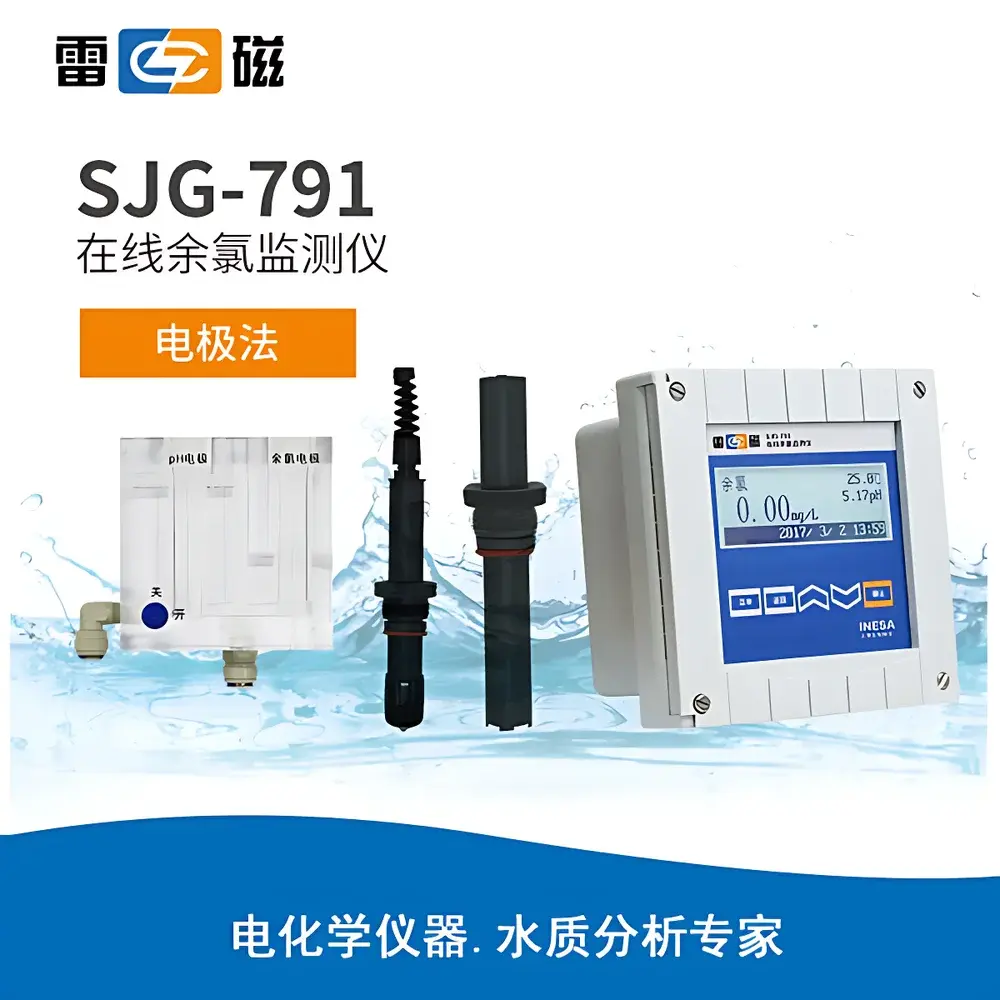
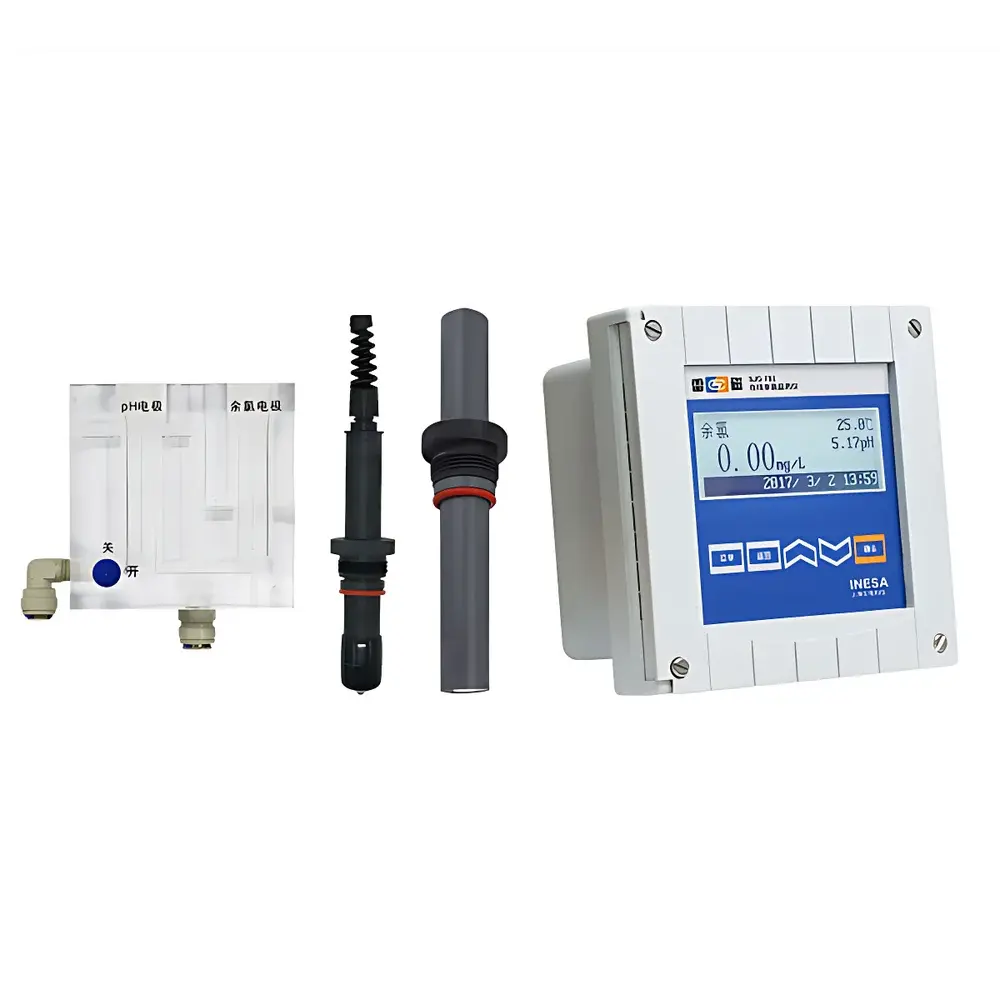
Leichi SJG-791 Online Residual Chlorine Monitor
| Brand | Leichi |
|---|---|
| Origin | Shanghai, China |
| Model | SJG-791 |
| Instrument Type | Online Analyzer |
| Measurement Principle | Electrochemical Amperometric Sensor |
| Measured Parameter | Free Residual Chlorine |
| Range | 0.00–20.00 mg/L |
| Accuracy | ±10% (≥0.5 mg/L) or ±0.05 mg/L (<0.5 mg/L) |
| Resolution | 0.01 mg/L (Cl₂), 0.01 pH, 0.1 °C |
| pH Range | 0.00–14.00 pH |
| Temperature Range | 0.0–60.0 °C |
| pH Accuracy | ±0.05 pH |
| Temp Accuracy | ±0.5 °C |
| Linear Error | ±3.0% FS (Cl₂) |
| Electronic Unit Stability | ±1% FS/24 h |
| 90% Response Time | 2 min |
| Enclosure Rating | IP65 |
| Power Supply | AC 220 V ±10%, 50 Hz |
| Dimensions | 166 × 166 × 110 mm |
| Weight | 2 kg |
| Output | Dual isolated 4–20 mA DC (configurable for Cl₂ or pH), RS-232/RS-485 (Modbus RTU) |
| Data Storage | 2000 records |
| Auto Compensation | pH and temperature compensated for residual chlorine measurement |
| Alarm | Configurable upper/lower limits with hysteresis |
| Power Failure Protection | Yes |
Overview
The Leichi SJG-791 Online Residual Chlorine Monitor is an industrial-grade electrochemical analyzer engineered for continuous, real-time monitoring of free residual chlorine in potable water, municipal drinking water distribution systems, wastewater effluent, swimming pool circulation loops, and pharmaceutical process water. It employs a stable amperometric chlorine sensor that operates via selective oxidation of hypochlorous acid (HOCl) at a catalytic working electrode under controlled polarization potential. This principle ensures high specificity for free chlorine over interfering oxidants such as chlorine dioxide or ozone—provided appropriate sensor selection and calibration protocols are followed. The instrument integrates simultaneous pH and temperature measurement to enable dynamic compensation algorithms, correcting for the pH-dependent speciation of HOCl/OCl⁻ and thermal drift in sensor response. Designed for unattended operation in demanding environments, the SJG-791 complies with core functional requirements outlined in ISO 7888 (water quality — determination of free and total chlorine), ASTM D1253 (standard test method for residual chlorine in water), and supports data integrity practices aligned with GLP and basic GMP documentation needs.
Key Features
- Integrated triple-parameter measurement: real-time free chlorine (0.00–20.00 mg/L), pH (0.00–14.00), and temperature (0.0–60.0 °C) on a single 128×64 dot-matrix LCD display
- Automatic pH and temperature compensation for residual chlorine readings—applies Nernst-based correction to maintain accuracy across variable water chemistry conditions
- Dual isolated 4–20 mA analog outputs, each independently configurable for chlorine concentration, pH value, or temperature; output scaling fully user-definable
- Standard digital communication interface: selectable RS-232 or RS-485 port supporting Modbus RTU protocol for seamless integration into SCADA, DCS, or PLC-based control systems
- Non-volatile internal memory stores up to 2,000 timestamped measurement records with automatic overwrite policy; data retention persists through power interruption
- Configurable dual-limit alarm system with adjustable hysteresis to prevent relay chatter during transient fluctuations near setpoints
- Robust IP65-rated enclosure suitable for wall-mount or panel-mount installation in humid or splash-prone environments (e.g., pump rooms, filter galleries, pool equipment enclosures)
- Built-in power failure protection: retains calibration coefficients, configuration settings, and buffered measurement history during mains outage
Sample Compatibility & Compliance
The SJG-791 is validated for use with clear, low-turbidity aqueous samples typical of treated drinking water, recirculated pool water, and purified process streams. It is not intended for raw surface water, seawater, or highly contaminated industrial effluents without pre-filtration and flow conditioning. Sensor performance assumes stable flow velocity (>0.3 m/s) and absence of suspended solids >5 µm or oil/fat films that may foul the membrane. While not certified to EN 14181 (QAL3) or EPA Method 334.0, the instrument meets functional specifications referenced in national regulatory guidance for continuous disinfectant monitoring—including China’s CJ/T 3077 (Online Monitoring Equipment for Residual Chlorine in Drinking Water) and U.S. EPA Guidance for Public Water Systems (2012). Its analog and digital outputs support traceability when paired with calibrated data loggers compliant with FDA 21 CFR Part 11 audit trail requirements.
Software & Data Management
The SJG-791 operates autonomously without proprietary software dependency. Configuration, calibration, and alarm setup are performed locally via front-panel keypad navigation. All operational parameters—including sensor zero/span values, compensation coefficients, output scaling, and alarm thresholds—are stored in EEPROM with write-protection logic. For centralized data aggregation, the Modbus RTU interface enables polling of live measurements, status flags (e.g., sensor fault, calibration due), and historical records via standard industrial gateways. When interfaced with third-party historian platforms (e.g., Ignition, Siemens Desigo CC, or custom Python-based OPC UA clients), the device supports time-synchronized data ingestion with UTC timestamps embedded in each register read. No cloud connectivity or firmware-over-the-air capability is provided—ensuring air-gapped deployment where cybersecurity policies prohibit network exposure.
Applications
- Municipal water treatment plants: monitoring chlorine residual at clearwell outlets and distribution system entry points to verify CT compliance per regulatory disinfection benchmarks
- Drinking water booster stations: maintaining consistent disinfectant levels across extended pipeline networks with variable residence times
- Commercial and public swimming pools: enforcing WHO-recommended free chlorine ranges (1–3 mg/L) while minimizing chloramine formation through precise dosing feedback
- Hospital central sterile supply departments (CSSD): verifying residual chlorine in rinse water used for endoscope reprocessing per ISO 15883-5 and AAMI ST91
- Pharmaceutical purified water (PW) and water-for-injection (WFI) loop monitoring: supporting periodic verification of sanitization efficacy during hot or chemical sanitization cycles
- Food & beverage production lines: ensuring chlorine-based sanitizing solutions meet target concentrations prior to contact with processing equipment surfaces
FAQ
What type of electrochemical sensor does the SJG-791 use?
It uses a membrane-covered amperometric sensor with a three-electrode configuration (working, counter, and reference), optimized for selective detection of hypochlorous acid in neutral-to-weakly-alkaline aqueous matrices.
Can the instrument measure total chlorine or only free chlorine?
The SJG-791 is configured exclusively for free residual chlorine. Total chlorine measurement requires either a separate DPD-based photometric analyzer or a dual-sensor configuration not supported by this model.
Is field calibration required, and how often?
Yes—zero and span calibration using certified chlorine standards (e.g., potassium iodide/starch titration reference or NIST-traceable DPD solution) is recommended before initial deployment and at intervals no greater than 7 days under continuous operation.
Does the device support automatic temperature compensation for pH as well as chlorine?
Yes—the integrated Pt1000 temperature sensor feeds real-time values to both the pH measurement circuit and the chlorine compensation algorithm, ensuring thermally corrected outputs for both parameters.
What maintenance is required for long-term reliability?
Routine maintenance includes quarterly electrolyte replenishment (for gel-filled reference electrode), semi-annual membrane replacement, and bi-weekly cleaning of the sensor tip with mild detergent and deionized water to prevent biofilm accumulation.







