
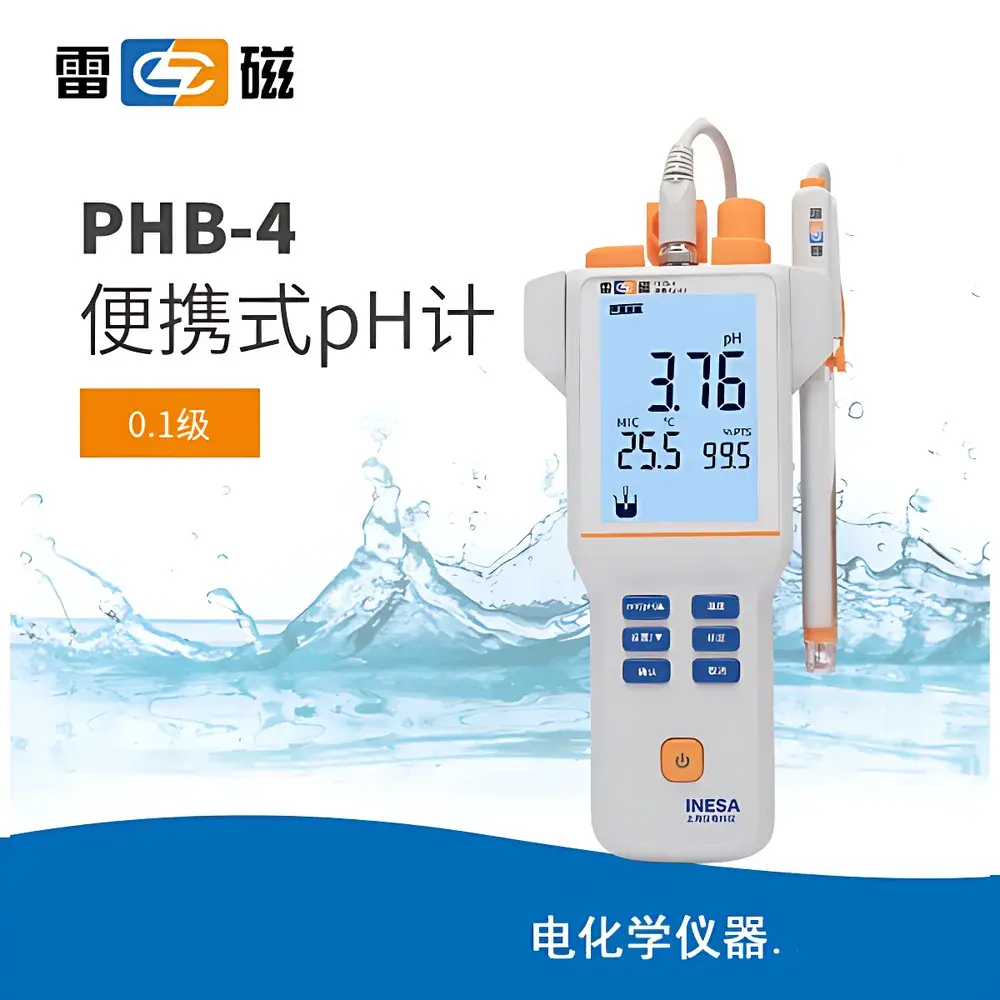
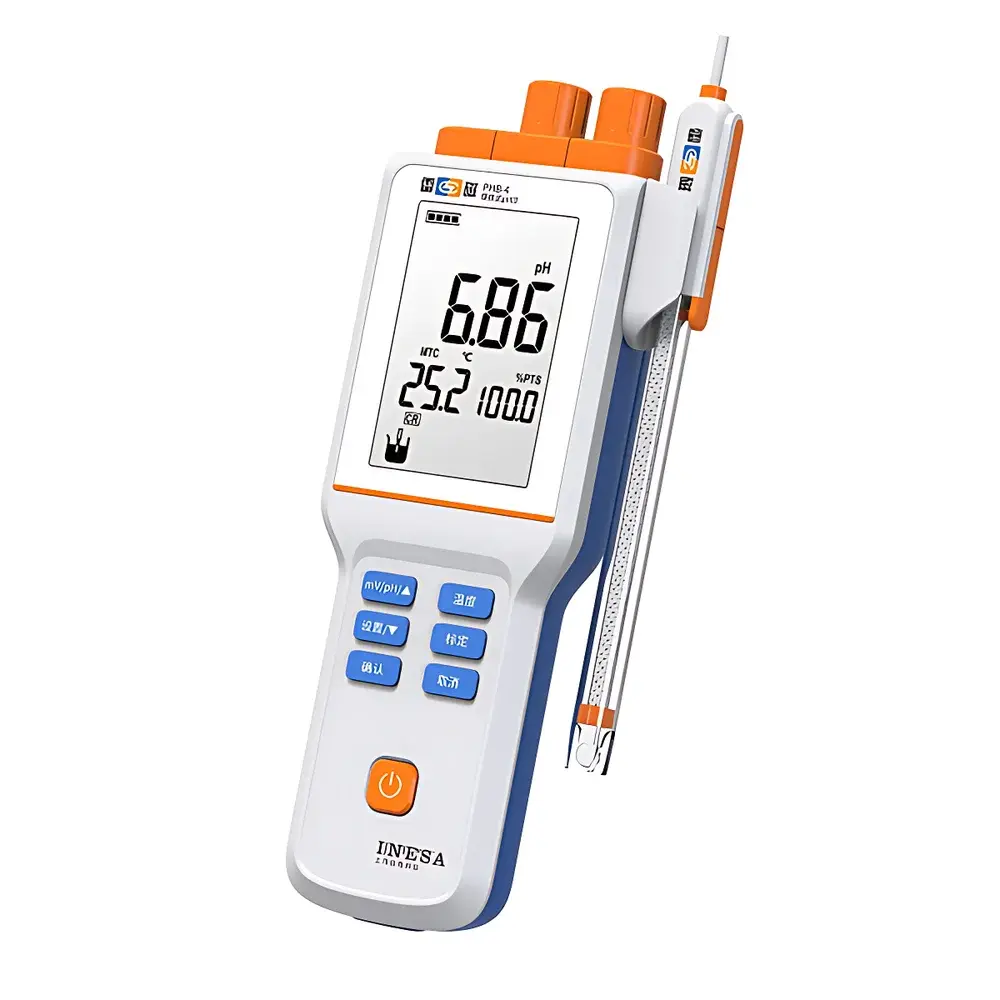
Leici PHB-4 Portable pH Meter
| Brand | Leici |
|---|---|
| Origin | Shanghai, China |
| Model | PHB-4 |
| Instrument Type | Portable |
| Parameter Types | Multi-parameter |
| pH Range | (0.00–14.00) pH |
| Resolution | 0.01 pH |
| Accuracy | ±0.03 pH |
| Calibration Standards | GB buffer solutions at pH 4.00, 6.86, and 9.18 |
| mV Range | (−1400–1400) mV |
| mV Resolution | 1 mV |
| mV Accuracy | ±0.2% FS |
| Temperature Compensation | Manual |
| IP Rating | IP65 |
| Dimensions | 80 × 225 × 35 mm |
| Weight | 0.4 kg |
| Power | Rechargeable Li-ion battery |
Overview
The Leici PHB-4 Portable pH Meter is a field-deployable electrochemical instrument engineered for reliable, high-fidelity pH and mV measurements in diverse environmental, educational, industrial, and quality control settings. Operating on the principle of potentiometric measurement via a glass-membrane pH electrode, the PHB-4 detects the hydrogen ion activity difference between the sample and an internal reference system, converting it into a stable millivolt signal linearly correlated to pH according to the Nernst equation. Its 0.01 pH resolution and ±0.03 pH accuracy meet the performance requirements of ISO 7888 and ASTM D1293 for routine water quality analysis, while its dual capability to measure both pH and redox potential (mV) supports broader electrochemical characterization—such as corrosion monitoring or disinfection efficacy verification—without requiring separate instrumentation.
Key Features
- High-contrast LCD display with adjustable backlight for legibility under variable ambient lighting conditions—including direct sunlight and low-light field environments.
- Robust IP65-rated enclosure ensures dust-tight operation and protection against low-pressure water jets, enabling safe use in outdoor sampling, wastewater treatment plants, aquaculture sites, and food processing floors.
- Intelligent calibration workflow: automatic recognition of three standard GB-certified pH buffers (pH 4.00, 6.86, 9.18); support for 1- or 2-point calibration with real-time slope and offset diagnostics displayed post-calibration.
- Integrated power management system featuring rechargeable lithium-ion battery (typical runtime >100 hours per charge), low-battery warning, charging status indicator, and compatibility with universal USB power sources—including portable power banks and laboratory DC adapters.
- Onboard functionality includes auto-diagnostic startup sequence, auto-power-off after 10 minutes of inactivity, data retention during power loss, and factory reset capability for procedural consistency across multi-user deployments.
- Ergonomic accessories included: protective silicone sleeve, wrist strap, electrode holder mount, and pre-measured buffer powder sachets with QR-coded lot traceability for GLP-compliant recordkeeping.
Sample Compatibility & Compliance
The PHB-4 accommodates aqueous samples across the full pH spectrum (0.00–14.00), including freshwater, seawater, process streams, soil extracts, and beverage formulations. It interfaces seamlessly with standard BNC-compatible combination pH electrodes (e.g., Leici E-201-C or equivalent), supporting manual temperature compensation via user-input value (0–100 °C). While not equipped with built-in temperature sensing, its manual TC mode aligns with ISO 10523 and USP guidelines for pH measurement where ambient or sample temperature is known and stable. The device complies with CE electromagnetic compatibility (EMC) directives and meets RoHS material restrictions. Its firmware architecture supports future validation protocols required under ISO/IEC 17025-accredited laboratories when used within documented SOPs.
Software & Data Management
The PHB-4 operates as a standalone instrument with no embedded data logging; however, its USB interface enables connection to Windows/macOS systems for real-time data streaming using Leici’s optional PC software suite (v2.1+). This software provides timestamped measurement export in CSV format, calibration history archiving, audit trail generation (including operator ID, date/time, buffer IDs, slope/offset values), and alignment with FDA 21 CFR Part 11 requirements when deployed with electronic signature modules and role-based access controls. All firmware updates are delivered via signed binary packages verified through SHA-256 checksums, ensuring integrity during field upgrades.
Applications
- Environmental monitoring: On-site pH assessment of rivers, lakes, groundwater wells, and stormwater runoff per EPA Method 150.1.
- Education and teaching labs: Student-led titration endpoint verification, buffer preparation validation, and introductory electrochemistry experiments.
- Food & beverage QA/QC: Batch testing of dairy products, fruit juices, brewing wort, and cleaning-in-place (CIP) rinse solutions.
- Aquaculture and hydroponics: Daily tracking of pond or reservoir pH to maintain optimal species-specific ranges (e.g., trout: pH 6.5–8.0; tilapia: pH 6.8–8.5).
- Facility maintenance: Verification of neutralization efficiency in industrial effluent treatment systems prior to discharge.
FAQ
Does the PHB-4 support automatic temperature compensation (ATC)?
No—it requires manual temperature entry prior to measurement. For ATC functionality, consider the Leici PHS-3C or PHBJ-260 models equipped with integrated Pt1000 sensors.
Can I use non-GB buffer solutions for calibration?
Yes—the instrument allows custom buffer definition with user-specified pH values and tolerances, though traceability to national standards is recommended for regulatory submissions.
Is the included electrode suitable for measuring high-ionic-strength or viscous samples?
The standard E-201-C composite electrode is optimized for general-purpose aqueous use. For brines, slurries, or organic solvents, a double-junction or gel-filled electrode with reinforced junction is advised.
How often should I recalibrate during continuous field use?
Calibration is recommended before each sampling session and repeated every 2–4 hours during extended deployment, especially when ambient temperature fluctuates by >5 °C or when switching between acidic and alkaline matrices.
What is the expected service life of the rechargeable battery?
Under typical usage (2–3 hours/day), the Li-ion cell maintains ≥80% capacity for ≥500 charge cycles, corresponding to approximately 2–3 years of field service before replacement.





