
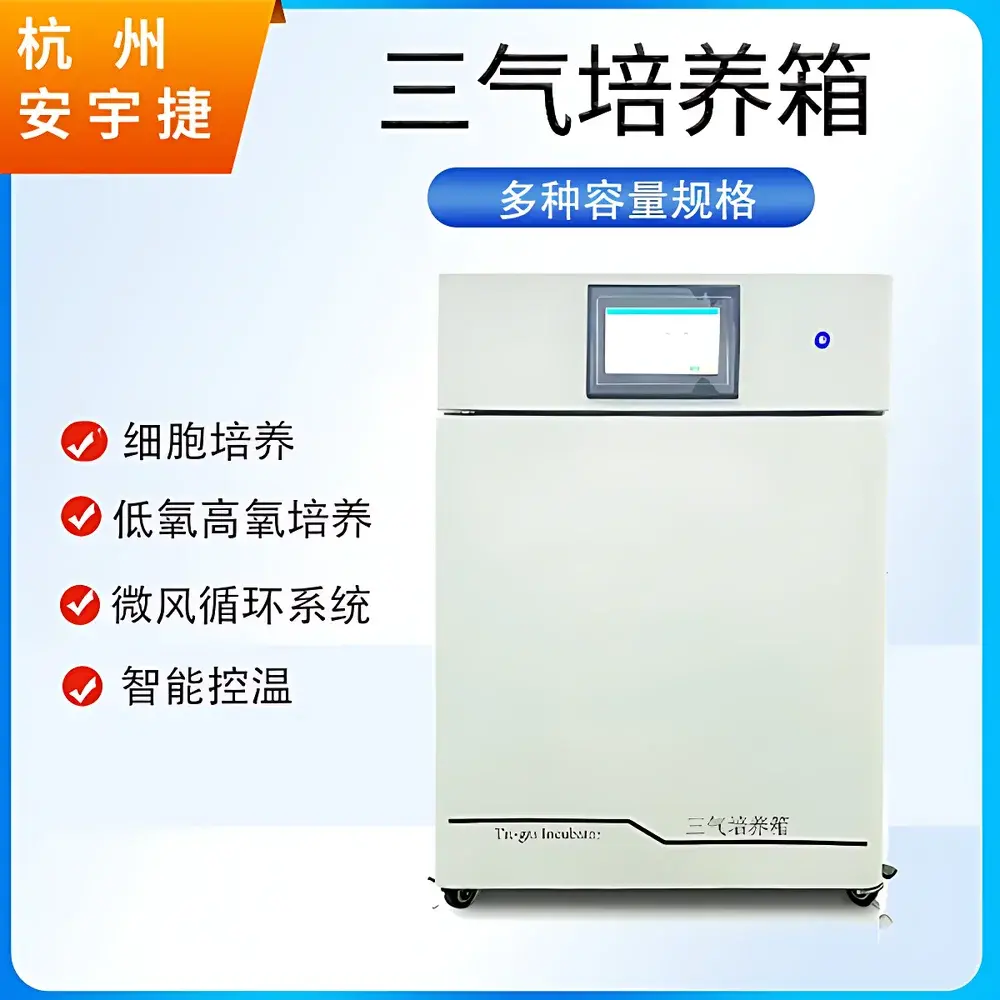
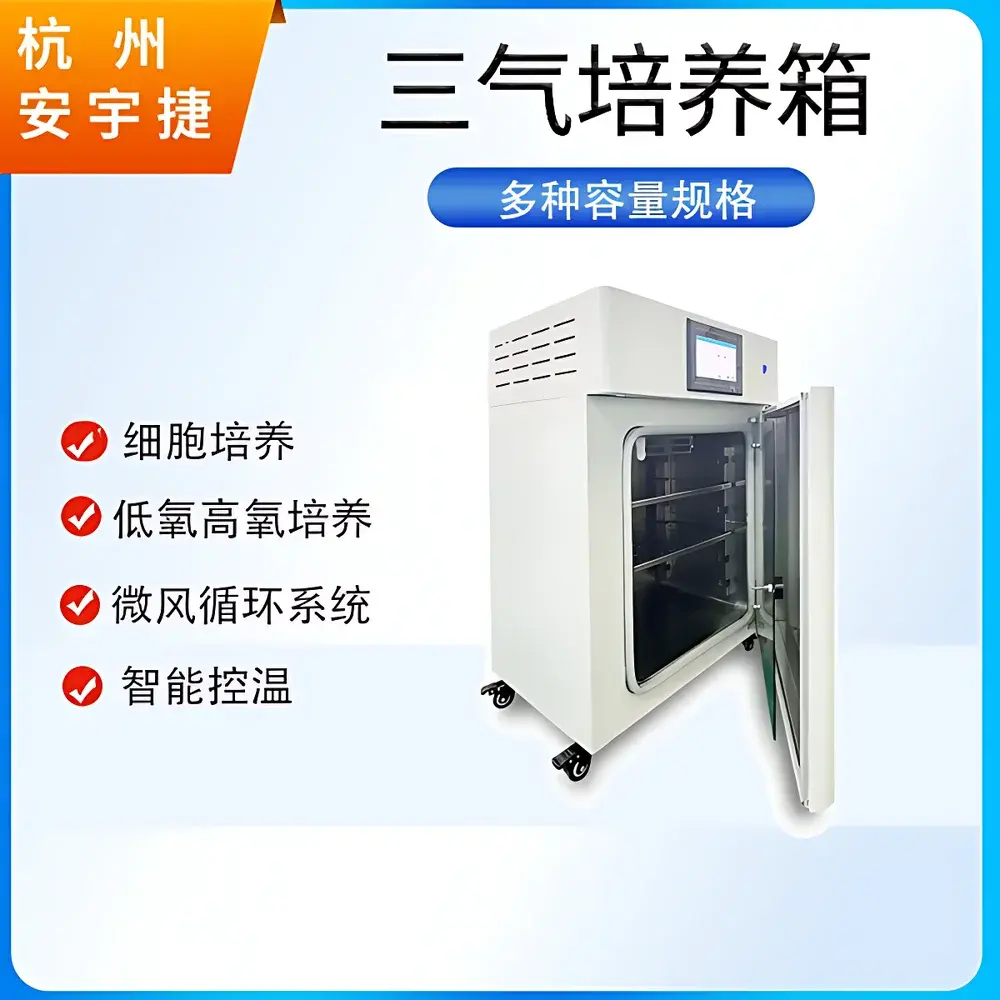
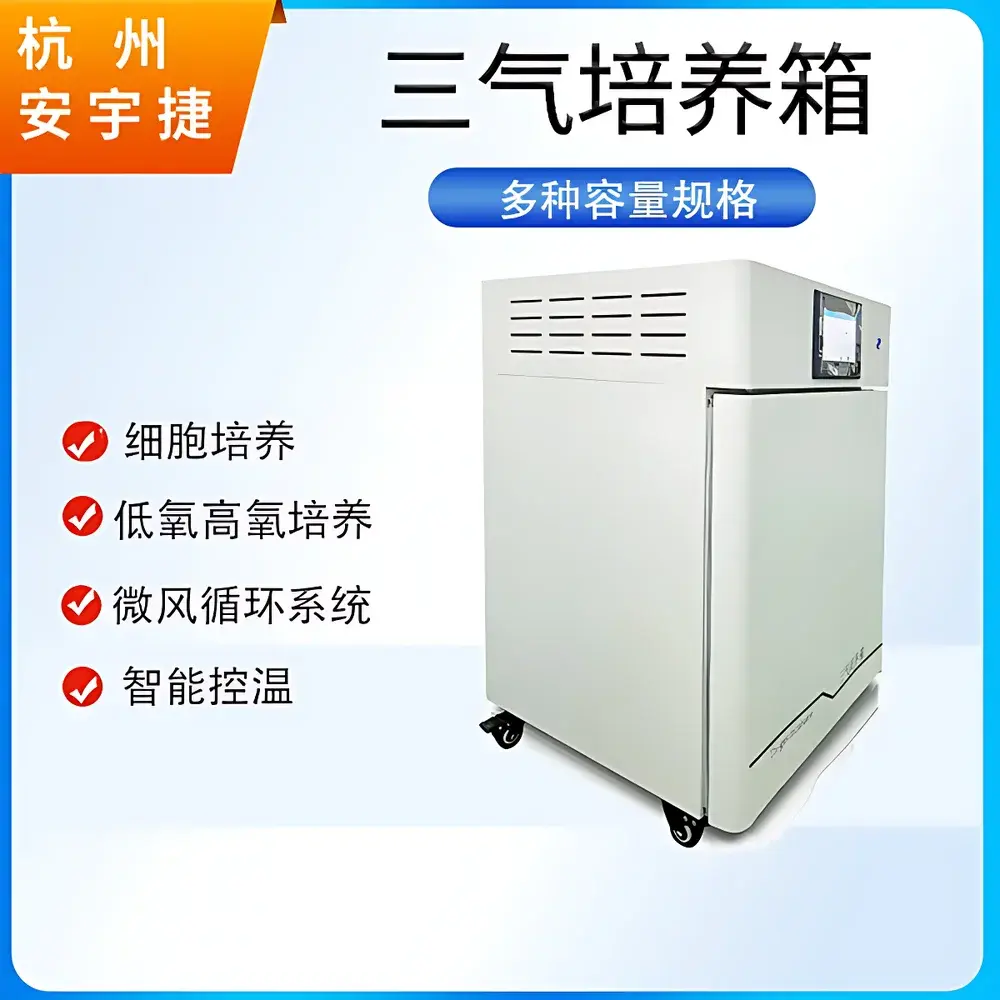
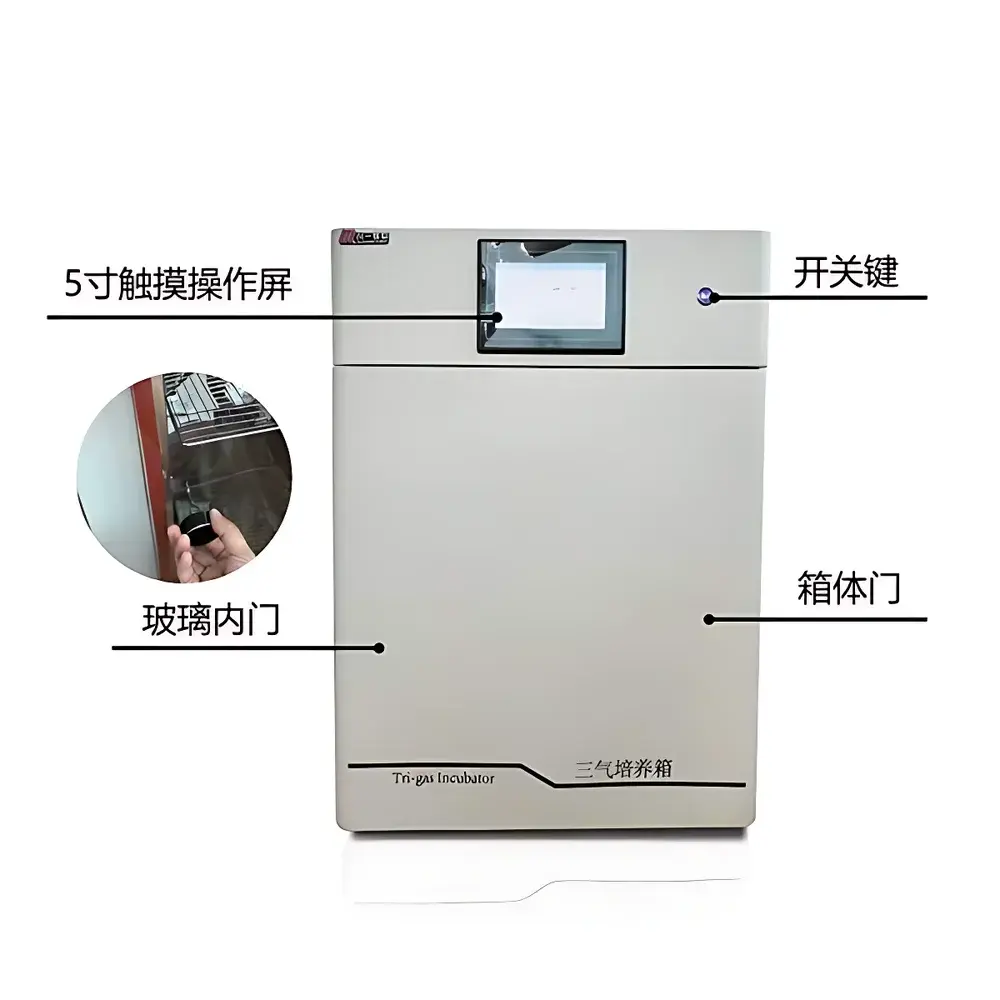
AnYuJie AYJ-KB50B Tri-Gas Incubator (O₂/N₂/CO₂) with Water-Jacketed Temperature Control
| Brand | AnYuJie |
|---|---|
| Origin | Zhejiang, China |
| Model | AYJ-KB50B |
| Type | Water-Jacketed Tri-Gas Incubator |
| Chamber Capacity | 50 L |
| Dimensions (W×D×H) | 430 × 460 × 650 mm |
| Temperature Range & Accuracy | RT+3°C to 60°C |
| Temperature Uniformity | ±0.3°C @ 37°C |
| CO₂ Control Range & Accuracy | 0–20% ±0.1% |
| O₂ Control Range & Accuracy | 1–95% ±0.3% |
| Humidity Control | ≥90% RH (natural evaporation from stainless steel water pan) |
| Gas Sensors | IR-based CO₂ sensor |
| Display | Touchscreen interface |
| Sterilization | UV lamp |
| Construction | 304 stainless steel interior with rounded corners |
Overview
The AnYuJie AYJ-KB50B is a precision-engineered water-jacketed tri-gas incubator designed for rigorous hypoxic, normoxic, and hyperoxic cell culture applications. It enables independent, real-time regulation of three critical atmospheric parameters—oxygen (O₂), carbon dioxide (CO₂), and nitrogen (N₂)—within a sealed 50 L chamber. Unlike standard CO₂ incubators, the AYJ-KB50B implements dual-gas mixing logic: by precisely metering two gases (e.g., high-purity N₂ and CO₂ for low-O₂ conditions, or O₂ and CO₂ for high-O₂ environments), it dynamically maintains stoichiometric gas balance across the full 100% volume, ensuring traceable, repeatable gas composition without residual ambient air contamination. Its water-jacketed thermal architecture provides superior thermal inertia and stability—critical for long-term cultures sensitive to transient fluctuations in temperature or gas partial pressure. The system operates on the principle of feedback-controlled gas blending via solenoid valves, with continuous monitoring via industrial-grade infrared (CO₂) and electrochemical (O₂) sensors, delivering robust environmental control aligned with ISO 13485–informed laboratory practice.
Key Features
- Water-jacketed thermal design ensures exceptional temperature stability (±0.3°C at 37°C) and minimizes external ambient influence—even during frequent door openings.
- Dual independent gas control: O₂ range 1–95% ±0.3%; CO₂ range 0–20% ±0.1%, both regulated via closed-loop PID algorithms with real-time sensor feedback.
- Five-sided chamber wall heating + dedicated door-heating circuit eliminates cold spots and prevents condensation at the viewing window.
- Micro-fan-assisted laminar airflow mimics natural convection—accelerating recovery time for temperature, humidity, O₂, and CO₂ after door access (typical <5 min stabilization post-opening).
- UV sterilization module with programmable cycle timing supports routine decontamination without chemical agents—compatible with GLP-aligned maintenance logs.
- 304 stainless steel interior with seamless, radius-corner construction facilitates cleaning, reduces microbial adhesion, and complies with ISO 14644-1 Class 7 cleanroom-compatible surface standards.
- Touchscreen HMI displays all setpoints and real-time readings (temperature, O₂ %, CO₂ %, RH %) with configurable alarm thresholds and event-triggered data logging.
- Comprehensive safety architecture includes dual independent overtemperature cutoffs (solid-state relay + mechanical thermostat), automatic gas valve shutoff upon door opening, and fault-diagnostic LED indicators.
Sample Compatibility & Compliance
The AYJ-KB50B supports primary cell lines, stem cells, organoids, anaerobic/microaerophilic bacteria, and oxygen-sensitive biosensors requiring tightly defined partial pressures of O₂ (e.g., 1–5% for tumor hypoxia modeling or 40–95% for hyperoxic injury studies). Its gas-tight chamber (tested per ASTM E2877-13 leakage specifications) and validated recovery profiles meet requirements for ISO/IEC 17025-accredited labs performing method validation under USP . While not FDA 510(k)-cleared as a medical device, its hardware and firmware architecture—including non-volatile parameter storage, password-protected configuration access, and timestamped operational logs—supports alignment with 21 CFR Part 11 Annex 11 principles for audit-ready data integrity in regulated QC/QA workflows.
Software & Data Management
The embedded controller stores up to 30 days of minute-interval environmental data (temperature, O₂, CO₂, RH) internally. Optional RS-485 Modbus RTU or USB-C serial export enables integration with LabArchives, ELN platforms, or custom SCADA systems. All parameter changes are logged with user ID (if enabled), timestamp, and pre-/post-value—supporting ALCOA+ data governance criteria (Attributable, Legible, Contemporaneous, Original, Accurate). No cloud connectivity or remote firmware updates are implemented, preserving local data sovereignty and minimizing cybersecurity attack surface—a design priority for institutional IT policies.
Applications
- Hypoxia research: Modeling ischemic stroke, solid tumor microenvironments (e.g., 1–3% O₂), and HIF-1α pathway activation.
- Stem cell expansion: Maintaining pluripotency in human embryonic or induced pluripotent stem cells under physiological O₂ (2–5%).
- Microaerophilic pathogen culture: Growing Helicobacter pylori, Campylobacter jejuni, or Neisseria gonorrhoeae without specialized anaerobic jars.
- Regenerative medicine: Optimizing chondrocyte or osteoblast differentiation under graded O₂ tensions.
- Bioprocess development: Screening oxygen-transfer effects on monoclonal antibody production in suspension CHO cultures.
- Toxicology: Assessing oxidative stress responses under controlled hyperoxia (≥40% O₂) or reoxygenation injury protocols.
FAQ
What gas purity is required for optimal performance?
High-purity gases are essential: ≥99.998% N₂, ≥99.995% O₂, and ≥99.99% CO₂. Impurities (e.g., hydrocarbons, moisture, NOₓ) degrade sensor accuracy and accelerate catalytic converter fouling in CO₂ subsystems.
Can the incubator operate without water in the jacket?
No. The water jacket is integral to thermal mass and uniformity. Operating dry risks heater element damage and invalidates temperature uniformity specifications.
Is humidity actively controlled or passively maintained?
Humidity is passively sustained via natural evaporation from a 304 stainless steel water pan (≥90% RH at 37°C). Active humidification is not provided, avoiding condensate-related contamination pathways.
How often should the O₂ and CO₂ sensors be calibrated?
IR CO₂ sensors require zero-point calibration every 6 months using certified N₂ gas; electrochemical O₂ sensors are factory-calibrated with typical drift <0.1%/month—verification recommended quarterly using traceable gas standards.
Does the system support GLP-compliant electronic signatures?
The standalone unit does not implement electronic signature functionality per 21 CFR Part 11 §11.200; however, exported log files retain immutable timestamps and can be archived in validated third-party ELN systems supporting digital sign-off.





