
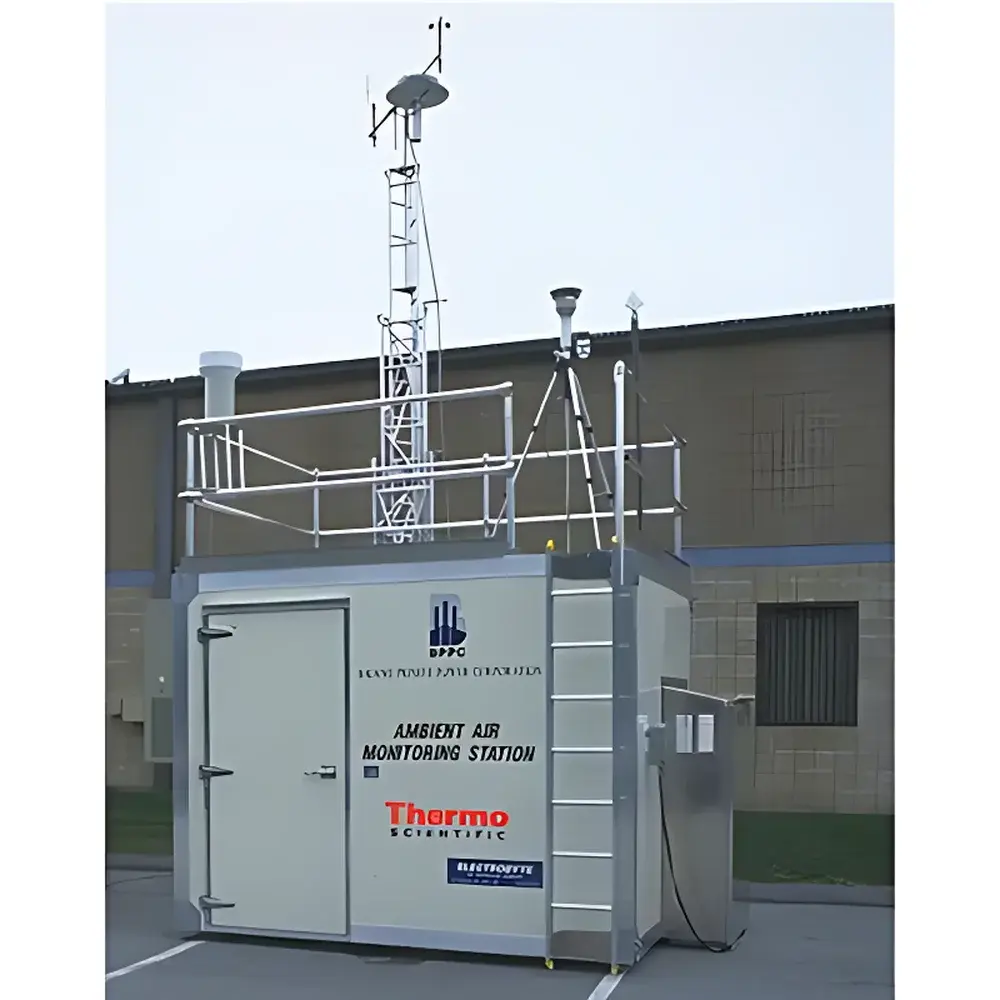
Thermo Fisher Scientific Ambient Air Quality Monitoring System – Ambient Gas MS
| Brand | Thermo Fisher |
|---|---|
| Origin | USA |
| Model | Ambient Gas MS |
| Type | Fully Automated Ambient Air Quality Monitoring System |
| Compliance | EPA Reference/Equivalent Methods, CNAS-ISO/IEC 17025 Accredited Deployment, Meets China HJ 653–2013 & HJ 654–2013 Standards |
| Data Capture Rate | >90% (7-day rolling average) |
| Measurement Uncertainty | ≤1% deviation between acquired and true reference values |
| Output Interfaces | 0–10 V analog, RS-232/RS-485 bidirectional digital communication |
| Software Platform | ENVIDATA v5.x (Windows-based, 21 CFR Part 11 compliant audit trail option available) |
| Configuration | Central Station + Remote Substations + QA/QC Laboratory |
Overview
The Thermo Fisher Scientific Ambient Air Quality Monitoring System (Model: Ambient Gas MS) is a fully integrated, EPA-equivalent reference-grade continuous emission monitoring platform engineered for regulatory-grade compliance, long-term network deployment, and scientific-grade data integrity. Built upon standardized physical measurement principles—including pulsed ultraviolet fluorescence (SO₂), chemiluminescence (NO/NO₂/NOₓ), gas filter correlation infrared absorption (CO), UV photometry (O₃), beta attenuation (PM₁₀/PM₂.₅), and tapered element oscillating microbalance (TEOM™ PM₂.₅)—the system delivers traceable, metrologically sound concentration data across gaseous and particulate pollutants. Designed for unattended operation over extended cycles (≥30 days between manual intervention), it conforms to U.S. EPA Federal Reference Methods (FRMs) and Federal Equivalent Methods (FEMs), while also satisfying China’s HJ 653–2013 (for gaseous analyzers) and HJ 654–2013 (for PM monitors) technical specifications. Its architecture supports multi-substation telemetry, centralized real-time validation, and GLP/GMP-aligned data governance protocols.
Key Features
- Fully automated, 24/7 continuous sampling and analysis with scheduled zero/span calibration using certified standard gases and zero-air generators
- Modular substation design: integrated sampling manifold with solenoid-controlled inlet routing, environmental-conditioned sample lines, and heated/filtered transport paths to prevent condensation and adsorption artifacts
- Redundant meteorological sensor suite: ultrasonic wind speed/direction, capacitive humidity/temperature, and piezoresistive barometric pressure sensors—calibrated per ISO 9001 traceable procedures
- Substation-level data acquisition unit (DAU) featuring dual SD card logging, internal UPS support, and watchdog-timed reset logic for field resilience
- ENVIDATA v5.x central software with configurable alarm thresholds, automatic flagging of out-of-spec events (e.g., flow deviation >±5%, calibration drift >±2%), and built-in uncertainty propagation modeling
- Analog output channels (0–10 V) compatible with SCADA integration; RS-232/RS-485 interfaces support Modbus RTU and custom ASCII protocol for third-party interoperability
- Comprehensive diagnostic reporting: real-time instrument health status, calibration history, maintenance logs, and electronic signature-enabled audit trails (optional 21 CFR Part 11 module)
Sample Compatibility & Compliance
The Ambient Gas MS accommodates ambient air matrices across diverse climatic and urban/industrial settings—from coastal high-humidity zones to arid, dust-laden environments. All gaseous analyzers operate within defined linear dynamic ranges (e.g., SO₂: 0–100 ppb; CO: 0–50 ppm; O₃: 0–500 ppb) and meet interference rejection criteria specified in EPA 40 CFR Part 53. PM monitors are validated per ISO 10473 and EN 12341 for size-selective inlet efficiency and mass loading effects. The system has undergone third-party verification by CNAS-accredited laboratories under ISO/IEC 17025:2017, confirming metrological traceability to NIST SRMs and NMIs. It supports full compliance with national ambient air quality standards (CAAQS), WHO Air Quality Guidelines, and EU Directive 2008/50/EC requirements.
Software & Data Management
ENVIDATA v5.x serves as the central data management engine, providing role-based access control, time-synchronized multi-substation visualization, and automated generation of EPA Form 10 reports. Raw second-level data are stored in encrypted binary archives with SHA-256 checksums; processed hourly/daily averages comply with ISO 14064-1 and GHG Protocol calculation rules. The software supports configurable metadata tagging (e.g., instrument ID, calibration certificate number, QA event codes), batch export in CSV/NetCDF formats, and API-driven integration with national air quality platforms (e.g., China’s CNEMC AQS Portal). Optional modules include remote firmware update scheduling, predictive maintenance alerts based on component duty-cycle analytics, and GLP-compliant electronic lab notebook (ELN) linkage.
Applications
- National and municipal ambient air quality monitoring networks (AQN) requiring regulatory-grade data submission to environmental authorities
- Long-term trend analysis for PM₂.₅/PM₁₀ source apportionment studies using co-located speciation instruments
- Industrial fence-line monitoring and compliance verification against permit limits (e.g., Title V, China’s Pollutant Discharge Permit System)
- Research-grade exposure assessment in epidemiological cohort studies, requiring high-temporal-resolution pollutant time-series
- Validation of satellite-derived aerosol optical depth (AOD) products and regional chemical transport model (CTM) outputs
- Emergency response deployments during wildfire smoke episodes or industrial accidents, leveraging rapid setup and telemetry-ready configuration
FAQ
What regulatory standards does the Ambient Gas MS meet?
It satisfies U.S. EPA FRM/FEM equivalency criteria, China’s HJ 653–2013 and HJ 654–2013 technical specifications, and ISO 14064-1 for greenhouse gas inventory applications.
Can the system operate without on-site personnel?
Yes—designed for unattended operation up to 30 days, with automated calibration, fault diagnostics, and remote command execution via secure TLS-encrypted channels.
Is raw data accessible for third-party analysis?
All second-level raw signals and processed concentrations are exportable in open-format files (CSV, NetCDF) with full metadata headers and traceable calibration coefficients.
How is data integrity ensured during transmission?
End-to-end CRC-32 validation, timestamped packet sequencing, and automatic retransmission of corrupted frames ensure lossless telemetry—even over low-bandwidth GPRS/3G links.
Does the system support audit-ready documentation?
ENVIDATA’s optional 21 CFR Part 11 module provides electronic signatures, immutable audit logs, and user activity tracking aligned with FDA and NMPA data integrity expectations.
Related Products







