
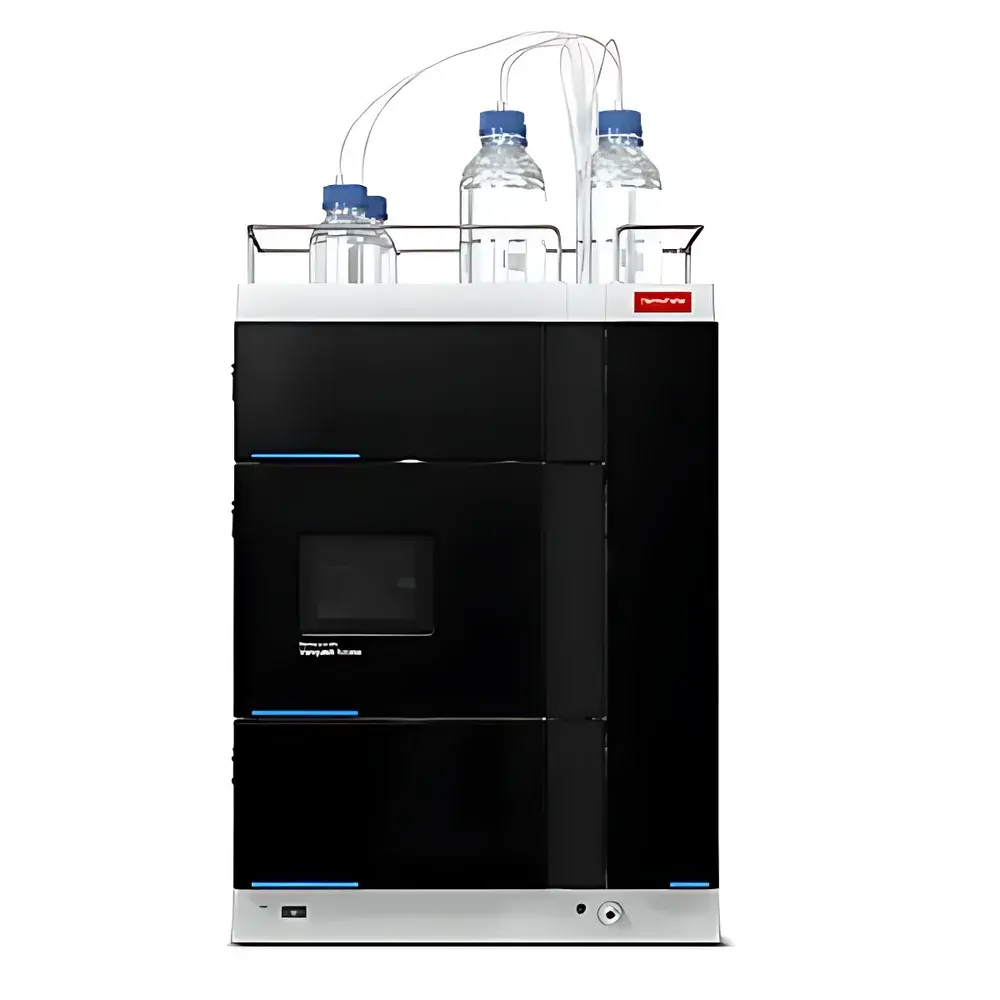
Thermo Fisher Vanquish Access HPLC System
| Brand | Thermo Fisher |
|---|---|
| Origin | Shanghai, China |
| Manufacturer Type | Authorized Distributor |
| Origin Category | Domestic (China-manufactured) |
| Model | Vanquish Access HPLC System |
| Price | Upon Request |
| Flow Rate Range | 0–10 mL/min |
| Maximum Pressure | 500 bar |
| Injection Volume Range | Standard: 0.01–100 µL |
| Optional | 0.01–1000 µL |
| Column Oven Temperature Range | 5–85°C |
Overview
The Thermo Fisher Vanquish Access HPLC System is a robust, entry-level high-performance liquid chromatography platform engineered for routine analytical laboratories requiring regulatory compliance, method reproducibility, and operational efficiency. Built on Thermo Fisher’s proven Vanquish architecture, it employs dual-piston, parallel-flow SmartFlow pump technology to deliver exceptional flow rate accuracy (<0.05% RSD) and gradient precision—critical for retention time stability across batches and instruments. The system operates under isocratic or gradient elution modes and supports standard reversed-phase, HILIC, ion-exchange, and size-exclusion separations. Its integrated modular design—comprising quaternary solvent manager, auto-sampler with temperature-controlled tray, column oven, and variable wavelength detector (VWD)—ensures minimal dwell volume variability and low system dispersion, enabling seamless method transfer from research-grade systems without hardware reconfiguration.
Key Features
- SmartFlow Pump Technology: Dual-piston, parallel-flow architecture ensures <0.1% flow rate RSD and <0.15% gradient composition RSD across the full 0–10 mL/min range, even at low flow rates (e.g., 0.05 mL/min).
- Viper Hand-Tight Fittings: Tool-free, zero-dead-volume connections eliminate leakage risk and reduce column installation time—validated for >10,000 pressure cycles at 500 bar.
- Method Transfer Optimization: Adjustable gradient delay volume (via configurable auto-sampler metering device and method transfer kit) allows precise compensation for dwell volume differences between systems—no tubing replacement or revalidation required.
- Real-Time Health Monitoring: Embedded diagnostics continuously assess pump seal wear, valve actuation, detector lamp intensity, and solvent degassing status—triggering proactive maintenance alerts via Chromeleon CDS.
- Column Oven with Passive Pre-Heater: Maintains stable 5–85°C operation using static air heating; includes passive pre-heater to minimize thermal band broadening prior to column inlet.
Sample Compatibility & Compliance
The Vanquish Access supports standard 12 mm OD vials (≤1.5 mL) across four 54-position trays (216 total), plus 12 positions for 22.5 mm OD vials (≤10 mL). Sample cooling (4–40°C) prevents analyte degradation during extended sequences. The system complies with key regulatory frameworks: data integrity is enforced via audit-trail-enabled Chromeleon CDS meeting FDA 21 CFR Part 11 requirements; electronic signatures, user role-based access control, and immutable event logging are natively supported. All fluidic components are chemically resistant within pH 1–13 and tolerate ≤0.1 mol/L chloride—suitable for most small-molecule pharmaceutical QC, environmental testing, and food safety applications per ISO/IEC 17025 and USP guidelines.
Software & Data Management
Fully integrated with Thermo Scientific Chromeleon Chromatography Data System (CDS) 7.3 or later, the Vanquish Access enables centralized instrument control, sequence scheduling, peak integration, report generation, and electronic lab notebook (ELN) export. Chromeleon provides full GLP/GMP traceability—including instrument method versioning, raw data archiving with hash verification, and automated backup to network storage. Remote monitoring via web browser is supported; all audit trails are timestamped, user-attributed, and non-erasable. Batch processing workflows support IQ/OQ/PQ documentation templates aligned with ASTM E2500 and Annex 11 validation principles.
Applications
This system is routinely deployed in quality control laboratories for assay quantitation of active pharmaceutical ingredients (APIs), impurity profiling per ICH Q2(R2), residual solvent analysis (USP ), and stability-indicating methods. It also serves environmental labs performing EPA Method 8081B (PCBs) and 8330B (PAHs), as well as food testing labs executing AOAC 2012.01 (mycotoxins) and EN 15662:2018 (pesticide residues). Its 500 bar pressure limit and wide injection range (0.01–1000 µL) accommodate both narrow-bore UHPLC columns and conventional 4.6 mm ID HPLC columns—enabling method scalability without platform replacement.
FAQ
Is the Vanquish Access HPLC system manufactured in China compliant with international regulatory standards?
Yes—units produced in Thermo Fisher’s Shanghai facility adhere to the same design controls, material specifications, and factory acceptance testing (FAT) protocols as globally manufactured Vanquish systems. CE marking, UL certification, and ISO 9001:2015 manufacturing accreditation apply.
Can the system be upgraded to include a photodiode array detector (PDA) or mass spectrometer interface?
No—the Vanquish Access is a fixed-configuration platform with integrated VWD only. For PDA or MS coupling, Thermo Fisher recommends the Vanquish Flex or Vanquish Horizon platforms.
What is the typical maintenance interval for pump seals and injection valve rotors?
Under normal use (≤2000 injections/month, aqueous/organic mobile phases), pump seals require replacement every 12–18 months; injection valve rotors every 24 months—both intervals are tracked automatically in Chromeleon’s maintenance scheduler.
Does the column oven support active cooling below ambient temperature?
No—it operates in static air heating mode only (5–85°C). Active cooling requires the Vanquish Flex or Horizon column compartments with Peltier elements.
Is method validation support included with the system purchase?
Thermo Fisher provides IQ/OQ documentation templates and on-site installation qualification (IQ) services. Full method validation (including specificity, linearity, LOD/LOQ) remains the responsibility of the end-user laboratory per their internal SOPs and regulatory jurisdiction.






