
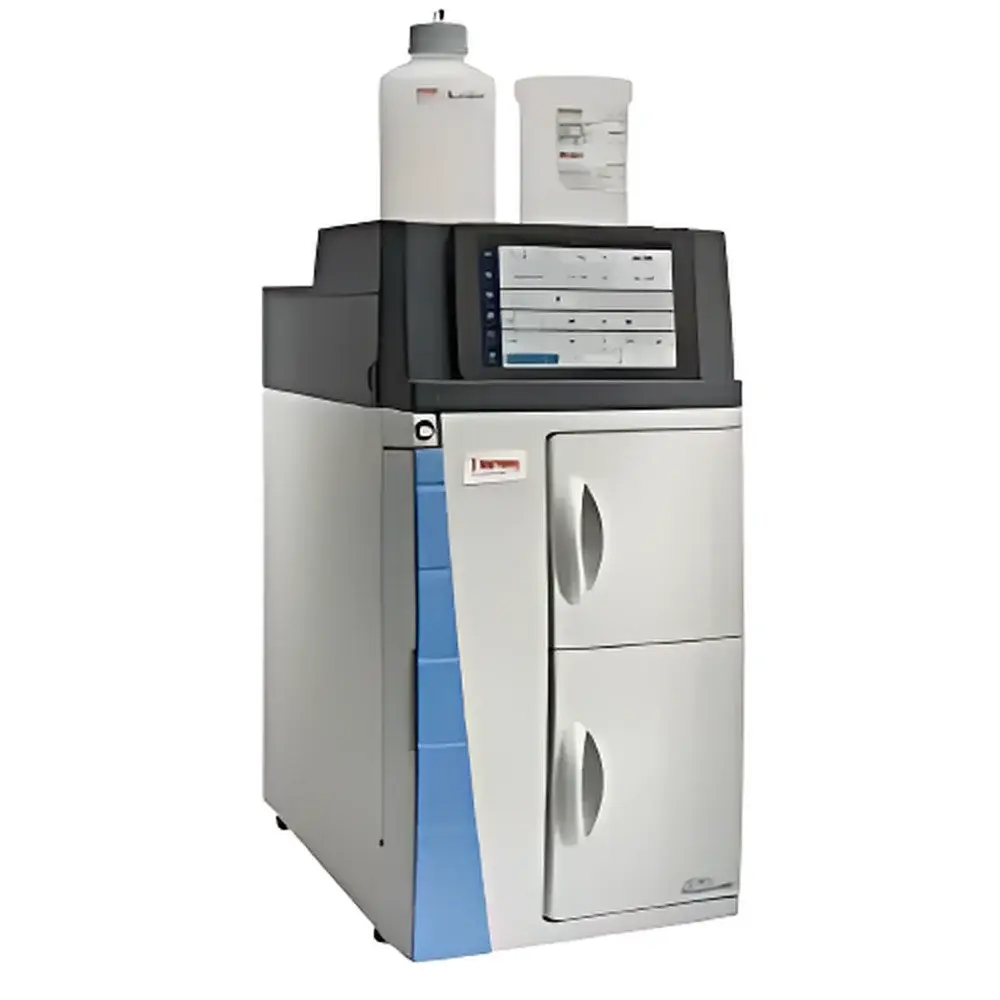
Thermo Scientific Integrion High-Pressure Ion Chromatograph
| Brand | Thermo Scientific |
|---|---|
| Origin | USA |
| Manufacturer Type | Original Equipment Manufacturer (OEM) |
| Product Origin | Imported |
| Model | Integrion |
| Instrument Type | Laboratory Benchtop System |
| Maximum Pump Pressure | 6000 psi |
| Flow Rate Range | 0–22.4 mL/min |
| Eluent Generation Concentration Range | 0.1–100 mM (dependent on eluent chemistry) |
| Maximum Operating Pressure | 5000 psi |
| Temperature Reproducibility | ±0.2 °C |
Overview
The Thermo Scientific Integrion High-Pressure Ion Chromatograph (HPIC) is a fully integrated, benchtop ion chromatography system engineered for high-resolution, high-sensitivity anion and cation analysis in demanding laboratory environments. Built upon the proven Dionex platform architecture, the Integrion system leverages high-pressure fluidics (up to 6000 psi pump capability) and advanced electrochemical suppression to deliver robust separation performance across complex matrices — including environmental water samples, pharmaceutical excipients, battery electrolytes, food additives, and semiconductor process chemicals. Its core measurement principle relies on ion-exchange chromatography coupled with suppressed conductivity detection, where analyte ions are separated on high-efficiency, low-capacity ion-exchange columns and quantified via post-column chemical suppression and conductivity measurement. The system supports both conventional chemical eluents and on-demand, high-purity eluent generation via the optional RFIC-EG (Reagent-Free Ion Chromatography – Electrolytic Generation) module, eliminating manual eluent preparation and enhancing method reproducibility.
Key Features
- High-pressure binary or quaternary solvent delivery system capable of sustained operation up to 6000 psi, enabling use of sub-2 µm particle-packed columns for enhanced resolution and faster separations.
- Wide flow rate range (0–22.4 mL/min) accommodates diverse column geometries — from capillary (0.4 mm ID) to standard bore (4 mm ID) and preparative formats — supporting method scalability and method transfer.
- Integrated real-time system monitoring with onboard diagnostics for pump pressure, detector baseline stability, column temperature, and eluent generator status — all accessible via the Chromeleon Chromatography Data System (CDS) interface.
- Modular design allows seamless integration of optional components: RFIC-EG electrolytic eluent generators, automated sample dilutors, multi-dimensional IC configurations, and conductivity/UV dual-detection modules.
- Temperature-controlled compartment maintains column oven stability with ±0.2 °C reproducibility, critical for retention time precision in regulated QC/QA workflows.
Sample Compatibility & Compliance
The Integrion HPIC supports aqueous and mildly organic-compatible samples across pH 2–12, with compatibility verified for EPA Methods 300.0, 300.1, and 317.1; ASTM D4327 and D808; ISO 14911; and USP . Its hardware and software architecture comply with 21 CFR Part 11 requirements when configured with Chromeleon CDS v7.3 or later, including electronic signatures, audit trails, user role-based access control, and data integrity safeguards. All wetted components — including PEEK, titanium, and chemically resistant ceramics — are compatible with common eluents (e.g., KOH, methanesulfonic acid, carbonate/bicarbonate) and resist corrosion under extended high-pressure operation.
Software & Data Management
Controlled exclusively through Thermo Scientific Chromeleon Chromatography Data System (CDS), the Integrion enables full method development, instrument control, peak integration, reporting, and compliance-ready data archiving. Chromeleon supports automated sequence execution, custom report templates (PDF, CSV, XML), and direct export to LIMS environments. Audit trail functionality logs all user actions, parameter changes, and data modifications with timestamps and operator IDs. Raw data files (.cdx) are stored in a secure, non-proprietary folder structure, ensuring long-term readability and facilitating internal validation and external regulatory inspections (e.g., FDA, EMA, NMPA pre-approval audits).
Applications
- Environmental: Quantification of trace anions (F⁻, Cl⁻, NO₂⁻, Br⁻, NO₃⁻, PO₄³⁻, SO₄²⁻) and cations (Li⁺, Na⁺, NH₄⁺, K⁺, Mg²⁺, Ca²⁺) in drinking water, wastewater, and rainwater per EPA and ISO standards.
- Pharmaceutical: Counter-ion profiling of active pharmaceutical ingredients (APIs), residual salt analysis in injectables, and chloride/bromide impurity testing per ICH Q2(R2) and USP .
- Energy: Anion monitoring in lithium-ion battery electrolytes (PF₆⁻, BF₄⁻, TFSI⁻) and cation analysis in fuel cell membranes (H⁺, Na⁺).
- Food & Beverage: Nitrate/nitrite determination in cured meats, sulfite screening in wines, and phosphate additives in dairy products.
- Electronics: Ultra-trace halide contamination (Cl⁻, F⁻, Br⁻) analysis in ultrapure water used in wafer cleaning processes.
FAQ
What eluent generation technologies are supported?
The Integrion natively supports both manually prepared chemical eluents and on-demand electrolytic eluent generation (RFIC-EG) for hydroxide, methanesulfonate, and carbonate-based systems.
Is the system compatible with capillary-scale IC methods?
Yes — the low-dead-volume fluidic path and adjustable flow control support capillary IC configurations down to 0.4 mm ID columns with flow rates as low as 0.01 mL/min using optional micro-flow modules.
Can the system be validated for GMP/GLP laboratories?
Yes — when deployed with Chromeleon CDS in 21 CFR Part 11 mode and accompanied by Thermo’s IQ/OQ documentation packages, the Integrion meets GMP/GLP validation requirements for routine QC release testing.
What column temperature control options are available?
The standard column compartment provides ambient-to-60 °C operation with ±0.2 °C temperature reproducibility; optional extended-range ovens support -10 °C to 80 °C for specialized method development.
Does the system support multi-dimensional IC (MD-IC)?
Yes — the modular valve architecture allows configuration of heart-cutting or comprehensive 2D-IC setups for complex sample cleanup and co-elution resolution, such as simultaneous organic acid and inorganic anion analysis.





