
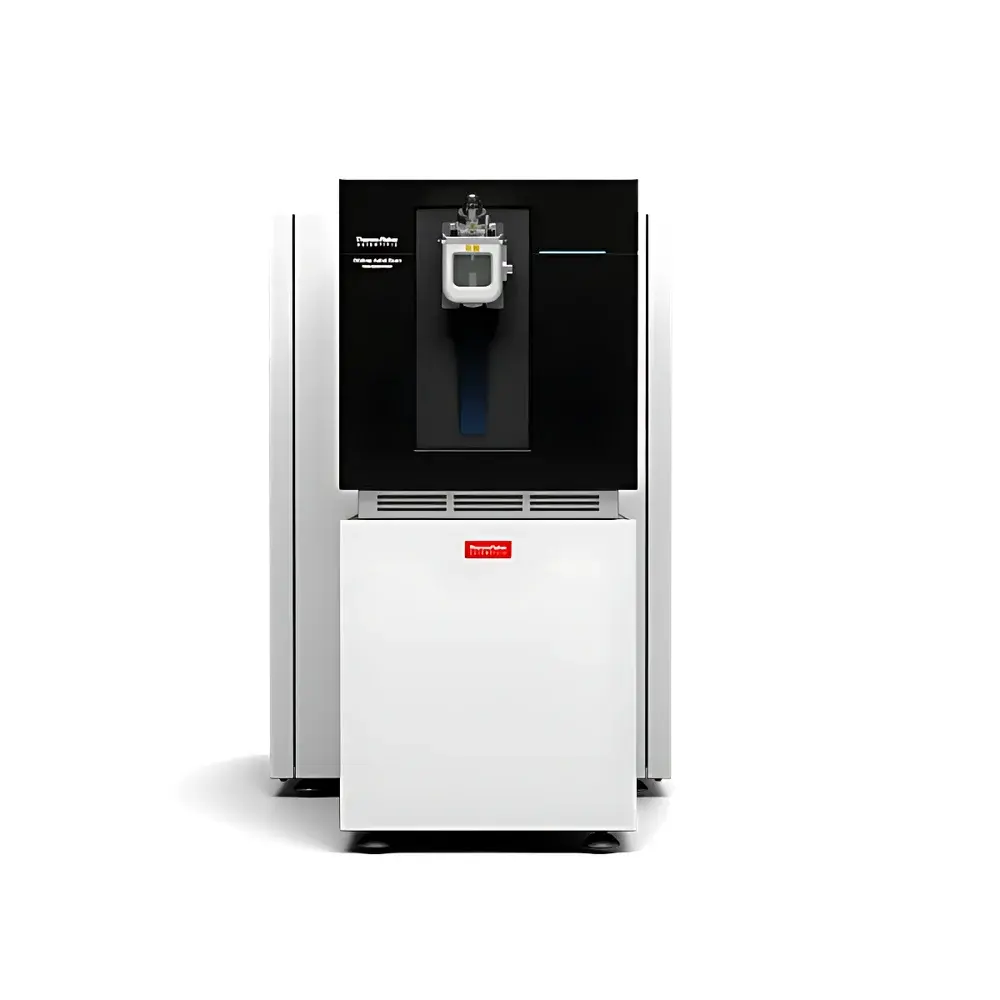
Thermo Fisher Orbitrap Astral Zoom Mass Spectrometer
| Brand | Thermo Fisher |
|---|---|
| Origin | Germany |
| Manufacturer Type | Authorized Distributor |
| Origin Category | Imported |
| Model | Orbitrap Astral Zoom Mass Spectrometer |
| Quotation | Upon Request |
| Instrument Type | Orbitrap |
| Application Scope | Specialized |
| Mass Range | m/z 40–6000 |
| Sensitivity | SIM, 50 fg on-column reserpine S/N ≥150:1 |
| MS/MS, 50 fg on-column reserpine S/N ≥100 | 1 |
| Resolution | 100,000 FWHM at m/z 138 |
| Mass Accuracy | <5 ppm RMS |
Overview
The Thermo Fisher Orbitrap Astral Zoom Mass Spectrometer represents a paradigm shift in high-resolution, high-throughput mass spectrometry for life science discovery. Engineered around an advanced Orbitrap mass analyzer with enhanced ion optics and real-time adaptive scanning, the Astral Zoom platform leverages electrostatic ion trapping and Fourier-transform detection to deliver sub-ppm mass accuracy, ultra-high resolution (100,000 FWHM), and exceptional dynamic range across broad mass ranges (m/z 40–6000). Its architecture integrates seamlessly with nano-flow UHPLC systems—particularly the Vanquish Neo—enabling robust, reproducible acquisition of complex biological samples under stringent quantitative and qualitative demands. Designed for next-generation proteomics, metabolomics, and spatial omics workflows, the system operates within GLP-compliant laboratories and supports audit-ready data acquisition per FDA 21 CFR Part 11 requirements when deployed with Thermo Scientific Chromeleon CDS software.
Key Features
- Ultra-fast scanning capability up to 270 Hz, enabling high-duty-cycle data acquisition without sacrificing resolution or sensitivity
- Integrated pre-enrichment ion optics combining a high-transmission curved ion trap and fast ion filtering, significantly improving signal-to-noise for low-abundance species
- Enhanced Dynamic Range (eDR) mode for single-injection analysis of >10,000 proteins and >200,000 unique peptides from complex digests
- Dedicated low-input acquisition modes optimized for limited-sample applications—including single-cell proteomics (≥5,800 proteins/cell from HEK293F) and LFQ-DIA workflows (≥6,500 proteins from 250 pg HeLa digest)
- TMTpro-enabled multiplexing support for up to 18-plex labeling, facilitating daily throughput of >2,000 single cells in quantitative proteomics studies
- Optimized collision energy ramping for improved cross-linking MS/MS fragmentation, supporting structural biology applications including protein–protein interaction mapping
Sample Compatibility & Compliance
The Orbitrap Astral Zoom is validated for use with standard nanospray sources (e.g., EASY-Spray, Nanospray Flex), compatible with reversed-phase, HILIC, and SCX chromatographic separations. It meets ISO/IEC 17025 calibration traceability standards through factory-certified mass calibration and resolution verification protocols. All acquisition methods are configurable to align with ASTM E2682 (guidelines for LC-MS method validation), USP analytical instrument qualification, and ICH Q2(R2) requirements for bioanalytical method validation. System logs maintain full electronic records of instrument parameters, calibration events, and user actions to satisfy GxP audit trails.
Software & Data Management
Controlled via Thermo Scientific Compound Discoverer 3.3 and Proteome Discoverer 2.5, the Astral Zoom supports automated spectral library searching, label-free quantitation (LFQ), DIA/SWATH-style data-independent acquisition, and TMTpro-based multiplexed quantification. Raw data files (.raw) are natively compatible with open-source platforms including MaxQuant, FragPipe, and Skyline. Chromatographic integration, peak alignment, and statistical reporting adhere to MIAME and MIAPE metadata standards. Data integrity is enforced through role-based access control, digital signature authentication, and immutable audit logs compliant with 21 CFR Part 11 Annex 11 guidelines.
Applications
- Proteomics: High-throughput single-cell proteomics, targeted pathway analysis, immunopeptidomics, and cross-linking MS for structural proteomics
- Metabolomics & Lipidomics: Single-cell metabolite profiling, SQUAD (Stable Isotope-Assisted Quantitative Analysis of Dynamics), and comprehensive lipid class annotation
- Clinical & Translational Research: Large-cohort biomarker discovery, host–microbiome interaction studies, tumor heterogeneity mapping, and longitudinal pharmacodynamic monitoring
- Spatial Omics: Integration with imaging MS platforms for co-localized protein and metabolite mapping in tissue sections at cellular resolution
FAQ
What is the maximum recommended sample throughput per day using the Astral Zoom with Vanquish Neo UHPLC?
Up to 300 samples per day can be analyzed using a 4.8-minute gradient method with EASY-Spray PepMap columns and optimized duty cycle scheduling.
Does the Astral Zoom support both data-dependent (DDA) and data-independent (DIA) acquisition modes?
Yes—both DDA and DIA (including SWATH-like and HR-DIA configurations) are fully supported with method-specific optimization for depth and reproducibility.
Is the system qualified for regulated environments such as clinical diagnostics labs?
When configured with validated methods, electronic signatures, and audit-trail-enabled software (e.g., Chromeleon CDS), the system complies with CLIA, CAP, and ISO 15189 requirements for diagnostic assay support.
Can the Astral Zoom perform intact protein analysis?
While primarily optimized for bottom-up and middle-down proteomics, the system supports native MS workflows up to ~60 kDa with appropriate source tuning and buffer compatibility.
How is mass calibration maintained across long-term operation?
Internal lock-mass correction using polysiloxane or external calibrants is applied continuously; routine calibration verification follows ISO/IEC 17025 procedures every 24 hours or per batch sequence.




