
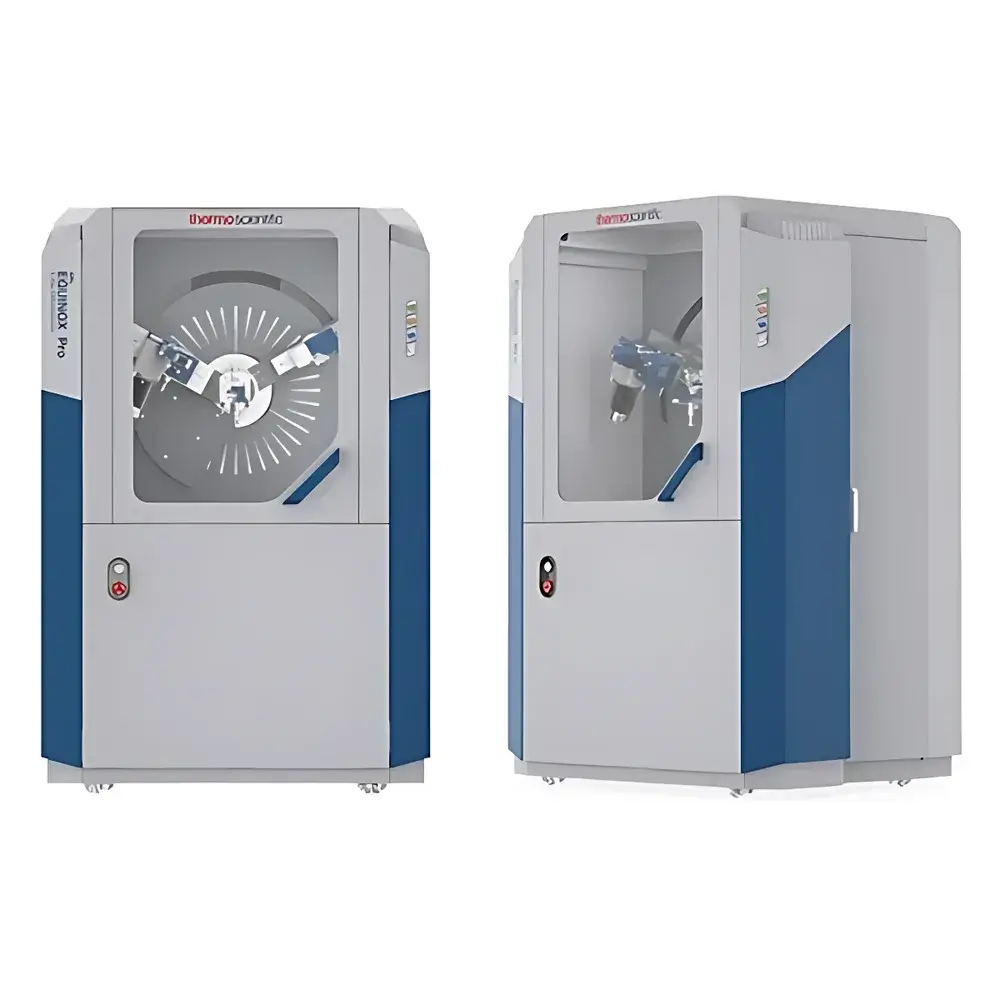
Thermo Scientific ARL EQUINOX Pro Vertical X-ray Diffractometer (XRD)
| Brand | Thermo Fisher |
|---|---|
| Origin | Shanghai, China |
| Manufacturer Type | Authorized Distributor |
| Origin Category | Domestic (China-manufactured) |
| Model | ARL EQUINOX Pro Vertical X-ray Diffractometer (XRD) |
| Pricing | Upon Request |
Overview
The Thermo Scientific ARL EQUINOX Pro Vertical X-ray Diffractometer is a high-precision, benchtop-compatible powder XRD system engineered for rigorous crystalline phase identification, quantitative phase analysis (QPA), lattice parameter refinement, and microstructural characterization (e.g., crystallite size and microstrain). Based on the classical θ/θ Bragg–Brentano geometry, the instrument employs Cu Kα radiation (λ = 1.5418 Å) and delivers angular accuracy better than ±0.01° 2θ with long-term mechanical stability. Its vertical goniometer architecture minimizes gravitational sag in sample stages and detector arms—critical for maintaining optical alignment during extended scans or automated batch runs. Designed under the “system-level optimization” philosophy, the ARL EQUINOX Pro integrates synchronized hardware control, real-time position feedback, and modular beam-path engineering to ensure analytical reproducibility across laboratories operating under ISO/IEC 17025, ASTM E1421, and ICH Q5E compliance frameworks.
Key Features
- θ/θ Bragg–Brentano Goniometer: Dual-axis independent motion with direct-drive stepper motors eliminates backlash and gear-induced hysteresis; angular resolution ≤ 0.001° 2θ with closed-loop positional verification.
- Pulse-Triggered Positional Counting (PTPC): Synchronizes detector gating with actual goniometer position via hardware-level pulse signals—reducing peak shift artifacts and improving intensity fidelity at low-count-rate regimes (e.g., trace-phase detection).
- “Magic Card” Optomechanical Architecture: Modular, snap-fit optical components—including fixed-height X-ray tube mount, dynamically compensated slit assembly, and magnetically coupled detector carriage—enable rapid reconfiguration between reflection, transmission, and grazing-incidence geometries without recalibration.
- Dynamic Mechanical Error Compensation: Real-time correction of thermal drift and mechanical flexure using embedded temperature sensors and kinematic modeling algorithms; maintains alignment stability over >8-hour continuous operation.
- Integrated Radiation Safety: Interlocked shutter mechanism, dose-rate monitoring, and CE-compliant shielding meet IEC 61010-1 and local regulatory requirements for Class II X-ray generating equipment.
Sample Compatibility & Compliance
The ARL EQUINOX Pro accommodates standard 25 mm and 32 mm diameter powder holders, capillary tubes (0.3–1.0 mm OD), thin-film substrates (up to 100 × 100 mm), and irregular solids via optional XYZ motorized stage. Sample height tolerance is ±0.3 mm without manual adjustment due to auto-focus Z-sensing. All configurations support GLP/GMP workflows: audit trails, user access levels, electronic signatures, and 21 CFR Part 11–compliant data archiving are fully implemented in Thermo’s SmartLab Studio II software suite. Instrument qualification documentation (DQ/IQ/OQ/PQ templates) and calibration certificates traceable to NIST SRM 640e silicon reference are available upon request.
Software & Data Management
Controlled exclusively via Thermo Scientific SmartLab Studio II (v4.5+), the system supports full automation—from sample loading (with optional autosampler integration) to Rietveld refinement (using TOPAS or integrated GSAS-II interface). Raw data are stored in industry-standard .raw/.chi formats with embedded metadata (operator ID, timestamp, measurement parameters, calibration history). Batch processing includes automatic background subtraction, peak search (based on second-derivative thresholding), and ICDD PDF-4+ database matching with confidence scoring. Export options include CIF, CSV, XML, and PDF reports compliant with internal QA review protocols.
Applications
- Pharmaceutical solid-state characterization: polymorph screening, hydrate/anhydrate differentiation, amorphous content quantification (via spiking or Rietveld methods)
- Advanced ceramics and battery materials: cathode/anode phase evolution during cycling, Li-ion diffusion pathway analysis via lattice parameter tracking
- Geological and metallurgical QC: mineralogical composition mapping in ores, slag, and sintered alloys
- Nanomaterials R&D: Scherrer-based crystallite size distribution, Williamson–Hall microstrain deconvolution
- Forensic and regulatory testing: counterfeit drug detection, raw material identity verification per USP <921>
FAQ
Is the ARL EQUINOX Pro certified for use in regulated pharmaceutical environments?
Yes—the system supports 21 CFR Part 11 compliance when deployed with SmartLab Studio II v4.5+, including role-based access control, electronic signatures, and immutable audit logs.
Can it perform in situ or operando measurements?
With optional environmental stages (heating/cooling, humidity, gas flow), the vertical geometry enables straightforward integration of reaction cells and electrochemical cells for time-resolved diffraction studies.
What maintenance is required for the PTPC detector system?
The sealed proportional counter requires no routine gas refills or vacuum pump service; annual energy calibration and geometric alignment verification are recommended.
Does the “Magic Card” design support custom optical configurations?
Yes—modular slits, monochromators, and secondary optics can be interchanged without recalibrating the primary beam axis or detector zero point.
Is technical support available outside North America?
Thermo Fisher provides global field service coverage, including Shanghai-based application engineers specializing in XRD method development and regulatory validation support.




