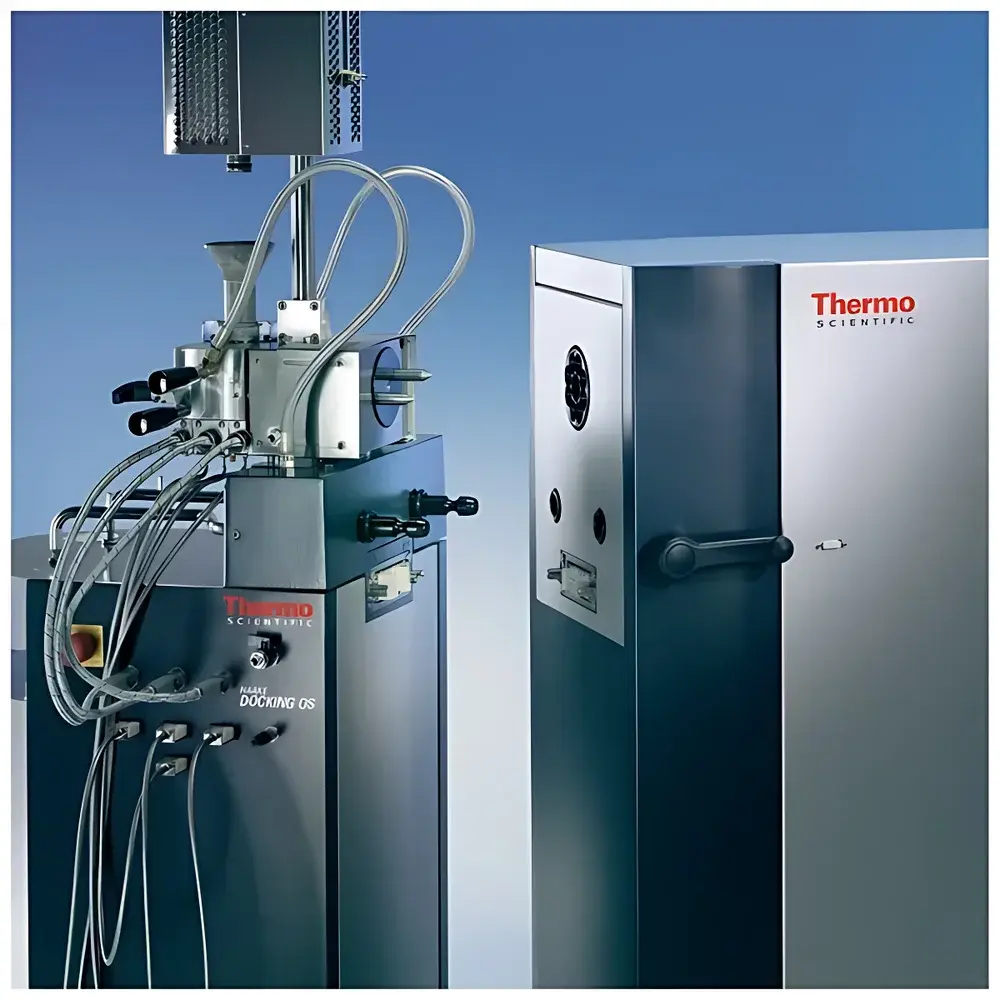
Thermo Fisher HAAKE PolyLab OS Modular Torque Rheometer
| Brand | Thermo Fisher |
|---|---|
| Origin | USA |
| Model | 567-0021 |
| Configuration | Import |
| Distribution Type | Authorized Distributor |
| Pricing | Available Upon Request |
Overview
The Thermo Fisher HAAKE PolyLab OS Modular Torque Rheometer is an engineering-grade process simulation platform designed for polymer R&D laboratories requiring quantitative, scale-relevant rheological and thermo-mechanical process data. Unlike conventional rotational rheometers, the PolyLab OS operates on the principle of torque rheometry—measuring real-time torque, temperature, pressure, and motor speed during dynamic melt processing in interchangeable mixing and extrusion modules. This enables direct correlation between lab-scale measurements and industrial-scale extrusion or compounding operations. The system’s core architecture integrates a high-precision servo-driven torque measurement unit with modular processing hardware—including internal mixers (e.g., HAAKE MiniLab II-type rotors), co-rotating twin-screw extruders (parallel and conical configurations), and single-screw extruders—each equipped with calibrated thermocouples, pressure transducers, and volumetric feeders. Its design adheres to fundamental principles of polymer processing physics: shear rate-dependent viscosity profiling, thermal history mapping, residence time distribution analysis, and dispersion kinetics quantification.
Key Features
- Modular open-architecture platform supporting interchangeable processing units: internal mixer, single-screw extruder, and co-rotating twin-screw extruder (parallel and conical geometries)
- Integrated high-resolution torque sensor (±0.02 N·m typical repeatability) and precision speed control (0.1–300 rpm range, closed-loop feedback)
- Real-time acquisition of process variables: torque, melt temperature (±0.5 °C), barrel pressure (up to 400 bar), screw speed, feed rate, and energy consumption
- Compact process simulation capability: full-scale extrusion or compounding profiles reproducible using as little as 50 g of material
- Remote operation and monitoring via Ethernet-connected controller with secure web-based interface
- Pre-calibrated field-replaceable modules enabling rapid maintenance and minimal downtime
- Compliance-ready architecture supporting audit trails, electronic signatures, and instrument qualification documentation per GMP/GLP requirements
Sample Compatibility & Compliance
The PolyLab OS accommodates thermoplastics (e.g., PE, PP, PET, PC, PA), thermoplastic elastomers (TPEs), filled composites (glass fiber, mineral, nanocellulose), flame-retardant formulations, reactive extrusion systems (e.g., grafting, crosslinking), and biopolymers (PLA, PHA). All processing modules meet ISO 11443 and ASTM D2538 standards for torque rheometry. Pressure and temperature sensors are traceably calibrated to NIST standards. Data acquisition firmware supports 21 CFR Part 11 compliance when deployed with validated software environments, including electronic record integrity, user access controls, and change audit logs. System validation packages—including IQ/OQ protocols—are available for pharmaceutical excipient development and medical-grade polymer processing applications.
Software & Data Management
Control and analysis are performed using HAAKE RheoWin software (v4.0+), a Windows-based platform engineered for polymer process analytics. It provides synchronized multi-channel acquisition (torque, temperature, pressure, RPM), automated test sequencing, and real-time visualization of viscosity vs. shear rate, temperature evolution, and power consumption curves. Export formats include CSV, XML, and HDF5 for integration with MATLAB, Python (Pandas/NumPy), or LIMS platforms. Batch reporting templates support ASTM D3835-compliant melt flow index extrapolation and ISO 11443-compliant apparent viscosity calculation. Raw data files retain full metadata (instrument ID, calibration date, operator, environmental conditions) required for regulatory submissions.
Applications
- Formulation screening: quantifying plasticizer efficiency, filler dispersion quality, and flame retardant compatibility
- Process window definition: mapping thermal degradation onset, optimal shear/temperature balance, and melt fracture thresholds
- Scale-up modeling: correlating lab-scale L/D ratios (e.g., 10:1, 25:1, 40:1) with production extruders using dimensionless similarity parameters (Weissenberg, Reynolds, Peclet numbers)
- Quality control: batch-to-batch consistency assessment via torque signature analysis and melt temperature hysteresis profiling
- Material qualification: validating regrind content limits, moisture sensitivity, and thermal stability under shear
- Hybrid characterization: coupling extrusion output with inline rheometry (e.g., capillary die + slit die) or optical methods (Raman, NIR) for real-time composition monitoring
FAQ
What sample mass is required for a representative extrusion run?
Typical experiments use 50–200 g of material, depending on module configuration and target residence time; this enables statistically robust replication without excessive material consumption.
Can the system simulate reactive extrusion processes?
Yes—the twin-screw extruder modules support controlled residence time distribution, multi-zone temperature programming, and optional vacuum venting for devolatilization or grafting reactions.
Is the torque sensor factory-calibrated and traceable?
All torque transducers are NIST-traceably calibrated prior to shipment, with calibration certificates included; recalibration intervals are defined per ISO/IEC 17025 guidelines.
Does the system support automated method transfer to production lines?
The PolyLab OS generates dimensionless process indices (e.g., specific mechanical energy, SME; specific throughput, Q/N) directly translatable to industrial extruder control systems via established scale-up correlations.
How is data integrity ensured for regulated environments?
When configured with validated RheoWin software and networked authentication, the system maintains full 21 CFR Part 11 compliance—including electronic signatures, audit trails, and role-based access control.