
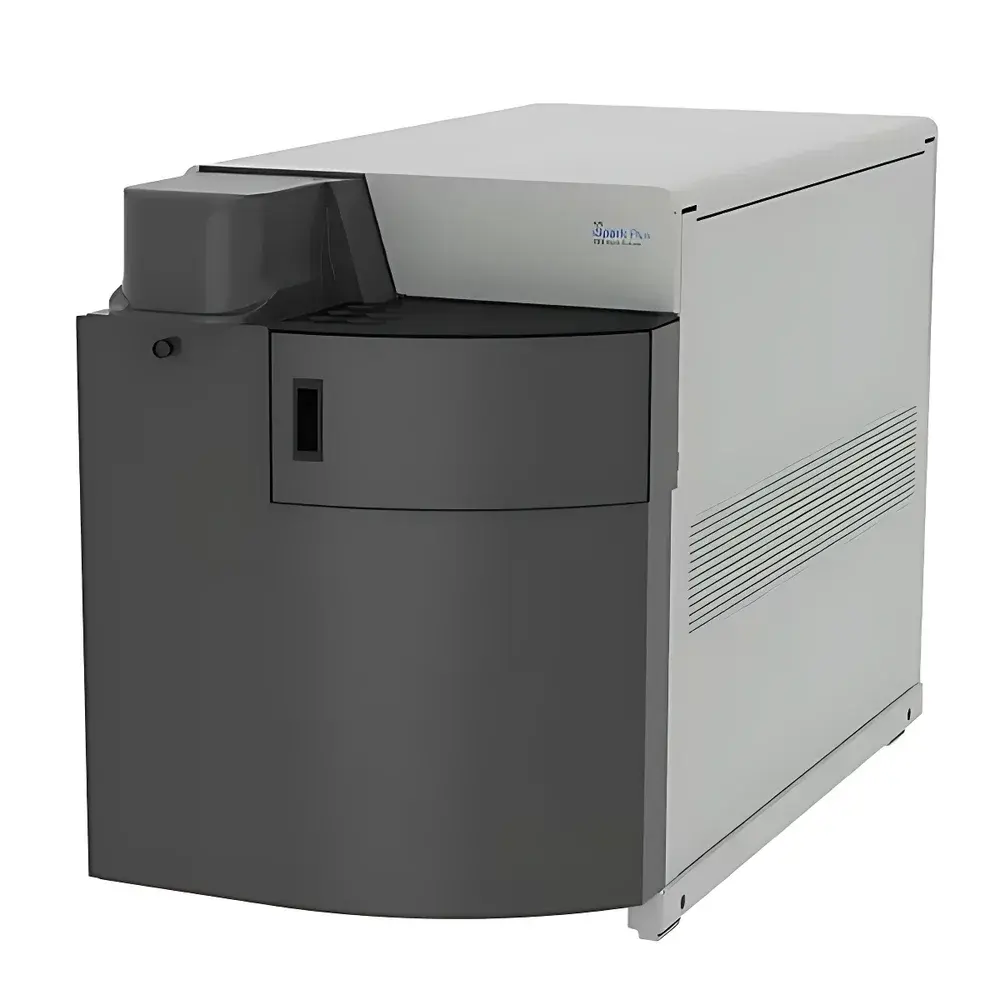
Thermo Scientific ARL iSpark Plus Series Optical Emission Spectrometer (OES)
| Brand | Thermo Fisher |
|---|---|
| Origin | Shanghai, China |
| Manufacturer Type | Authorized Distributor |
| Regional Classification | Domestic (China-manufactured) |
| Model | ARL iSpark Plus Series OES |
| Pricing | Available upon Request |
Overview
The Thermo Scientific™ ARL iSpark™ Plus Series is a high-performance, spark-source optical emission spectrometer (OES) engineered for precise, rapid, and robust elemental analysis of solid metallic samples. Based on the fundamental principle of atomic emission spectroscopy—where controlled electrical discharges (sparks) vaporize and excite surface atoms in a conductive sample, causing them to emit characteristic wavelengths—the ARL iSpark Plus detects and quantifies elemental composition across the UV–VIS spectral range (typically 130–800 nm) using a high-resolution Paschen-Runge optical system with photomultiplier tube (PMT) detectors. Designed specifically for demanding industrial environments—including primary metal production, foundries, automotive component manufacturing, aerospace forging facilities, contract testing laboratories, and scrap metal recycling operations—the instrument delivers metrologically traceable results compliant with international standards such as ASTM E415, ISO 11577, ISO 6892-2, and EN 10052. Its architecture integrates thermal stability management, vacuum-purged optics, and active drift compensation to ensure long-term measurement fidelity without frequent recalibration.
Key Features
- High-stability PMT-based optical system with sealed, temperature-controlled spectrograph housing for minimal thermal drift
- Revolutionary intelliSource™ dual CCS (Current-Controlled Spark Source) enabling adaptive energy delivery per matrix—optimized for ferrous, non-ferrous, and superalloy applications
- Innovative spark stand design with integrated electrode cooling, low-memory-effect tungsten electrodes, and automated argon flush control
- Single-spark acquisition mode with diffusion spark intensity normalization algorithm—enhancing signal-to-noise ratio and improving precision for trace elements (e.g., C, P, S, N, B)
- Advanced digital spark generator delivering 15% faster analysis cycle times versus prior-generation ARL iSpark platforms
- Intelligent argon management system with dynamic flow optimization and “argon save” mode—reducing consumption by up to 40% during standby and inter-sample intervals
- Extended maintenance intervals (30% longer than predecessor models) due to optimized consumable lifetime and self-diagnostic firmware
Sample Compatibility & Compliance
The ARL iSpark Plus accommodates flat, cylindrical, and irregularly shaped conductive metal samples (diameter ≥ 10 mm; thickness ≥ 4 mm), including cast iron, carbon and alloy steels, stainless steels, aluminum alloys, copper alloys, titanium, nickel-based superalloys, and zinc die-cast materials. Sample preparation follows standardized grinding protocols per ISO 14284 and ASTM E1184. The system supports full compliance with GLP/GMP documentation requirements via optional audit trail logging, electronic signatures, and 21 CFR Part 11–compliant software modules. Calibration is performed using certified reference materials (CRMs) traceable to NIST, BAM, or IRMM standards, with factory-installed calibrations validated against customer-specific production control samples.
Software & Data Management
Controlled by Thermo Scientific™ ARL QUANTOM™ software, the platform provides intuitive method setup, real-time spectral visualization, multivariate calibration modeling (PLS, MLR), and automated outlier detection. Data export conforms to ASTM E1382-compliant formats (CSV, XML, SPC), and integration with LIMS or MES systems is achieved via OPC UA or ODBC connectivity. All analytical sessions are timestamped, user-logged, and stored with full metadata—including spark parameters, argon pressure history, detector gain settings, and background correction coefficients—to support internal quality audits and regulatory inspections.
Applications
- Routine QC/QA in steel mills and aluminum smelters for compositional verification against specification limits (e.g., AISI, EN, JIS grades)
- Research-grade analysis of novel alloy development, including micro-alloying element quantification (Nb, V, Ti, Mo) at sub-10 ppm levels
- In-line inclusion rating for fully deoxidized (killed) steels using calibrated spark intensity correlation with ASTM E45 Type A–D morphology data
- Scrap sorting and grade identification in metal recycling—enabling rapid decision-making for feedstock blending
- Failure analysis labs performing forensic metallurgical investigations requiring high-reproducibility multi-element mapping
FAQ
What types of metals can be analyzed with the ARL iSpark Plus?
It supports all major conductive metallic matrices, including ferrous alloys (carbon steels, stainless steels, cast irons), non-ferrous metals (Al, Cu, Mg, Zn, Ti, Ni), and refractory alloys.
Is vacuum pumping required for operation?
No—its optical chamber is purged with argon gas, eliminating the need for mechanical vacuum pumps and associated maintenance.
How frequently must the instrument be recalibrated?
Typical recalibration intervals range from 8–12 hours of continuous operation under stable environmental conditions, extendable with drift correction routines using control samples.
Can the system interface with existing plant automation infrastructure?
Yes—via standard Ethernet/IP, Modbus TCP, or OPC UA protocols, supporting seamless integration into Industry 4.0 manufacturing execution systems.
Does it comply with FDA or pharmaceutical-grade analytical requirements?
While primarily designed for metallurgical QA, optional 21 CFR Part 11 modules enable use in regulated environments where elemental impurity testing (e.g., ICH Q2(R2)) is required for metal components in medical devices.
Related Products





