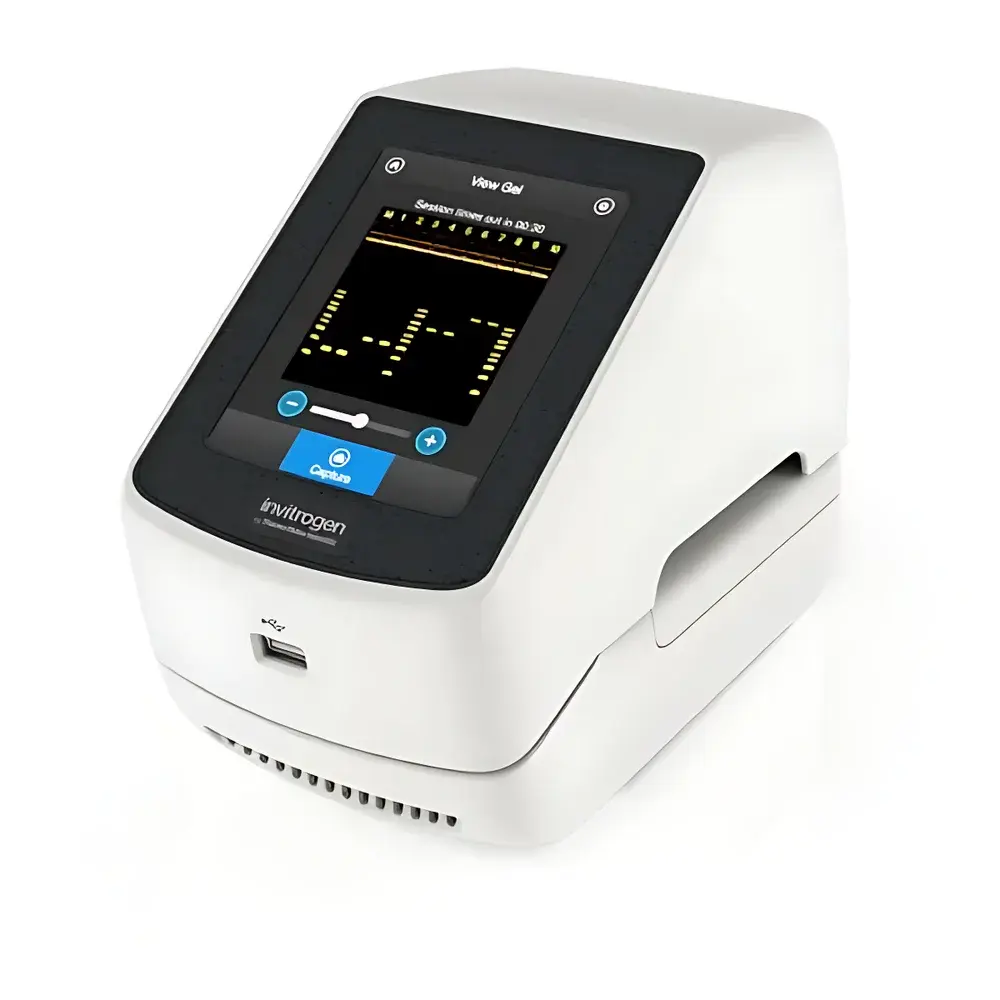
Thermo Scientific E-Gel™ Power Snap Gel Electrophoresis and Imaging System
| Brand | Thermo Scientific |
|---|---|
| Origin | USA |
| Manufacturer Type | Original Equipment Manufacturer (OEM) |
| Import Status | Imported |
| Model | G8300 |
| Pricing | Upon Request |
Overview
The Thermo Scientific E-Gel™ Power Snap Gel Electrophoresis and Imaging System is an integrated, benchtop platform engineered for rapid, safe, and reproducible nucleic acid separation and real-time visualization. Unlike conventional slab-gel electrophoresis systems requiring manual gel pouring, staining, and UV transillumination, the Power Snap system leverages proprietary dry, pre-cast E-Gel™ agarose gels—pre-formulated with embedded DNA intercalating dyes—to eliminate liquid handling, post-electrophoresis staining, and hazardous UV exposure. The system operates on the principle of constant-voltage electrophoresis in a sealed, self-contained cassette format, enabling controlled migration of DNA fragments under optimized buffer and field conditions. Its compact architecture integrates a programmable power supply, blue-light transilluminator (470 nm peak emission), and a dedicated imaging module into a single footprint—designed specifically for high-throughput molecular biology workflows in academic, clinical, and industrial laboratories where space, speed, and biosafety are critical constraints.
Key Features
- Integrated benchtop design combining electrophoresis power supply, blue-light transilluminator (470 nm), and built-in imaging camera—no external computer, software installation, or auxiliary power required.
- Pre-programmed electrophoresis protocols for all compatible E-Gel™ agarose gel formats (e.g., E-Gel EX, SYBR Safe, Go!, CloneWell II, SizeSelect II), ensuring consistent run conditions and minimizing user variability.
- Real-time electrophoretic monitoring via live blue-light visualization—enabling precise endpoint determination without over-migration or band diffusion.
- Dedicated E-Gel Power Snap camera with touchscreen interface, onboard image storage (months of typical usage), and USB export capability for immediate documentation and downstream analysis.
- Optimized for SYBR Safe and SYBR Gold II dyes; compatible with ethidium bromide–stained gels (though imaging requires external UV documentation systems).
- Blue-light excitation (470 nm) significantly reduces DNA photo-damage compared to 254 nm UV, preserving sample integrity for downstream cloning, ligation, or sequencing applications.
Sample Compatibility & Compliance
The E-Gel Power Snap system supports low-throughput E-Gel™ agarose gel cassettes (1–20 wells) across multiple concentration gradients (0.8% to 2.0% w/v) and dye formulations. It is validated for routine analysis of PCR products, restriction digests, plasmid preparations, and size-fractionated DNA fragments ranging from 50 bp to >10 kb. All E-Gel™ gels are manufactured under ISO 13485-certified quality systems and comply with Good Laboratory Practice (GLP) documentation requirements when paired with audit-trail-enabled data management practices. While the system itself does not require FDA 21 CFR Part 11 compliance, its digital imaging output supports traceable record-keeping when exported to LIMS or ELN platforms meeting regulatory data integrity standards.
Software & Data Management
The E-Gel Power Snap camera runs proprietary firmware with an intuitive graphical user interface accessible via resistive touchscreen. Image capture, contrast/brightness adjustment, annotation, and cropping are performed directly on-device. Captured TIFF and JPEG images are stored internally on non-volatile flash memory (≥8 GB capacity) and can be transferred via USB 2.0 to external drives or networked workstations. No proprietary desktop software installation is required for basic operation; however, exported images are fully compatible with third-party analysis tools including ImageJ/Fiji, TotalLab Quant, and Bio-Rad Quantity One for densitometry, molecular weight estimation, and band quantification. Metadata (date/time stamp, gel type, run duration, camera settings) is embedded in EXIF headers for full experimental traceability.
Applications
- Routine verification of PCR amplification success and amplicon size.
- Quality control of restriction enzyme digests prior to ligation or cloning.
- Plasmid miniprep QC and supercoiled vs. linear/nicked form differentiation.
- Fast genotyping assays using allele-specific or CAPS markers.
- Teaching laboratory environments—reducing hands-on time and eliminating UV safety training requirements.
- High-efficiency cloning workflows using E-Gel CloneWell II gels, where blue-light illumination minimizes DNA strand breakage and improves transformation efficiency by up to 3× relative to EtBr/UV-based recovery.
FAQ
Can the E-Gel Power Snap system image ethidium bromide–stained gels?
No—the integrated camera is calibrated for blue-light excitation (470 nm) and SYBR-class dyes. Ethidium bromide–stained gels require UV transillumination (254 nm or 302 nm) and must be imaged using external UV documentation systems.
What is the maximum run time supported by pre-programmed protocols?
Standard protocols range from 5 to 25 minutes depending on gel type and fragment size; custom timing is not user-adjustable to maintain reproducibility and prevent gel overheating.
Is the system compatible with E-Gel™ iBase or older E-Gel™ PowerBase units?
No—E-Gel Power Snap is a standalone, self-contained system. It does not interface with legacy base units or require external controllers.
How is data integrity ensured during image export?
All exported files retain embedded timestamps, instrument ID, and acquisition parameters. When saved to encrypted USB drives or enterprise file servers, they meet ALCOA+ (Attributable, Legible, Contemporaneous, Original, Accurate, Complete, Consistent, Enduring, Available) principles for regulated environments.
Does the system support multi-gel stacking or parallel runs?
No—it is designed for single-gel operation per cycle. Throughput is optimized via rapid 10-minute run times and immediate imaging—not concurrent processing.