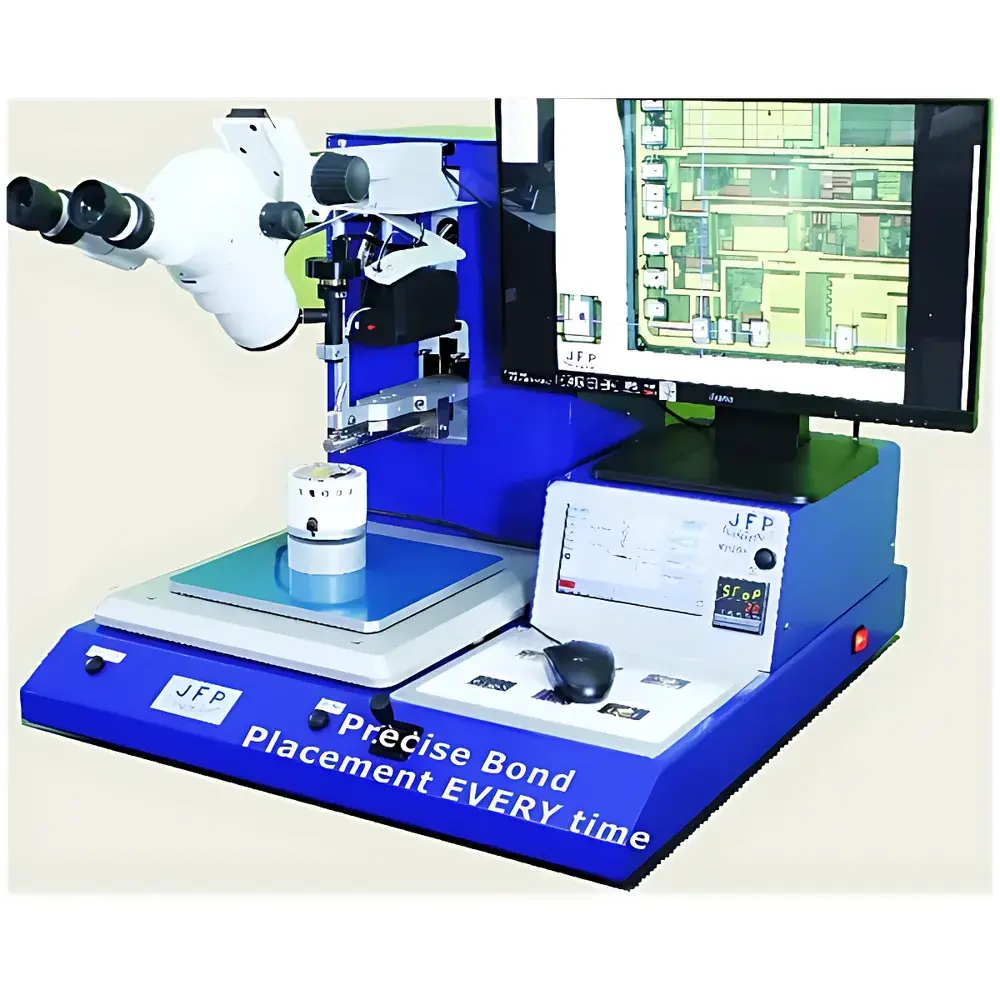
JFP WB200e Manual and Semi-Automatic Ball Bonding Machine
| Brand | JFP |
|---|---|
| Origin | France |
| Manufacturer Type | Authorized Distributor |
| Origin Category | Imported |
| Model | WB200e |
| Pricing | Upon Request |
Overview
The JFP WB200e is a precision-engineered manual and semi-automatic ball bonding machine designed for low-volume, high-mix semiconductor packaging environments—including R&D labs, failure analysis centers, and pilot-line production. It employs thermosonic wire bonding technology with gold (Au) or copper (Cu) wire, utilizing controlled ultrasonic energy, heat, and precise mechanical force to form reliable ball bonds on die pads and substrate metallization. The system is optimized for fine-pitch applications down to 60 µm pitch and supports wire diameters from 15 µm to 50 µm. Its vibration-isolated mechanical architecture ensures bond placement repeatability ≤ ±1.5 µm (3σ) under stable environmental conditions, making it suitable for qualification-grade bonding where process traceability and mechanical stability are critical.
Key Features
- Vibration-damped base and column structure—minimizes transmission of floor-borne and acoustic noise to the bonding head, preserving bond integrity during ultrasonic scrubbing.
- Programmable X–Y positioning stage with high-resolution optical encoders (0.1 µm resolution) and motorized actuation for repeatable die-to-substrate alignment.
- Motorized Z-axis with fine-tuned stroke control (0–12 mm travel), enabling consistent loop height adjustment and accommodating substrates with variable warpage or thickness up to 3.2 mm.
- Dual-mode bonding operation: fully manual Z-axis control for operator-guided learning and troubleshooting, plus semi-automatic cycle execution with user-defined parameter sets (bond force, ultrasonic power, time, temperature).
- Integrated vertical optical microscope with calibrated crosshair reticle and real-time CCD imaging—provides direct visual feedback for bond site verification, ball formation inspection, and post-bond quality assessment.
- Modular tooling interface compliant with industry-standard capillary holders and wedge chucks, supporting rapid changeover between 15–50 µm wire configurations.
Sample Compatibility & Compliance
The WB200e accommodates standard semiconductor packages including QFN, SOIC, BGA substrates, ceramic leadframes, and silicon interposers. It supports bonding onto Au, Al, Cu, and Pd-coated surfaces with appropriate surface preparation protocols. The system meets mechanical safety requirements per IEC 61000-6-2 (immunity) and IEC 61000-6-4 (emissions). While not certified for full GMP manufacturing lines, its operational log and parameter locking features support GLP-compliant documentation practices. Traceable calibration records for the Z-axis encoder and ultrasonic transducer output can be maintained per internal lab SOPs aligned with ISO/IEC 17025 principles.
Software & Data Management
The WB200e operates via an embedded industrial controller with intuitive touchscreen HMI. All bonding parameters—including bond force (mN), ultrasonic power (%), duration (ms), touchdown delay (ms), and stage coordinates—are stored in non-volatile memory with timestamped logging. Exportable CSV reports include bond ID, position, parameters, and operator ID—enabling integration into LIMS or MES platforms. Audit trail functionality records all parameter modifications and user login events, satisfying basic FDA 21 CFR Part 11 readiness for electronic records when paired with institutional access controls and electronic signatures.
Applications
- Prototype development of MEMS, RF, and optoelectronic devices requiring low-stress, low-heat bonding.
- Die-level rework and repair of failed bonds in advanced packaging test vehicles.
- Qualification of new wire alloys, capillaries, or substrate metallizations prior to transfer to high-throughput production tools.
- Educational training in microelectronics packaging fundamentals—ideal for university cleanroom labs due to its open-loop programmability and visual diagnostics.
- Reliability testing sample preparation, including thermal cycling and HAST preconditioning bond samples.
FAQ
What wire types and diameters is the WB200e compatible with?
The system supports 15–50 µm diameter gold (Au), copper (Cu), and palladium-coated copper (PdCu) wires using standard industry capillaries.
Does the WB200e support automated vision-based alignment?
No—it features a fixed vertical optical path with manual focus and crosshair overlay; pattern recognition or auto-alignment is not implemented.
Can bonding parameters be exported for external analysis?
Yes—CSV-formatted logs containing position data, force profiles, and timing parameters are exportable via USB port.
Is service and calibration support available outside Europe?
JFP-certified field service engineers operate in North America and Asia-Pacific regions; annual calibration services follow manufacturer-recommended intervals and documented procedures.
What is the maximum recommended bond pad size for reliable ball formation?
For optimal ball shear strength and crater control, minimum pad dimensions should be ≥ 3× wire diameter (e.g., ≥ 90 µm for 30 µm wire); smaller pads require empirical validation.