
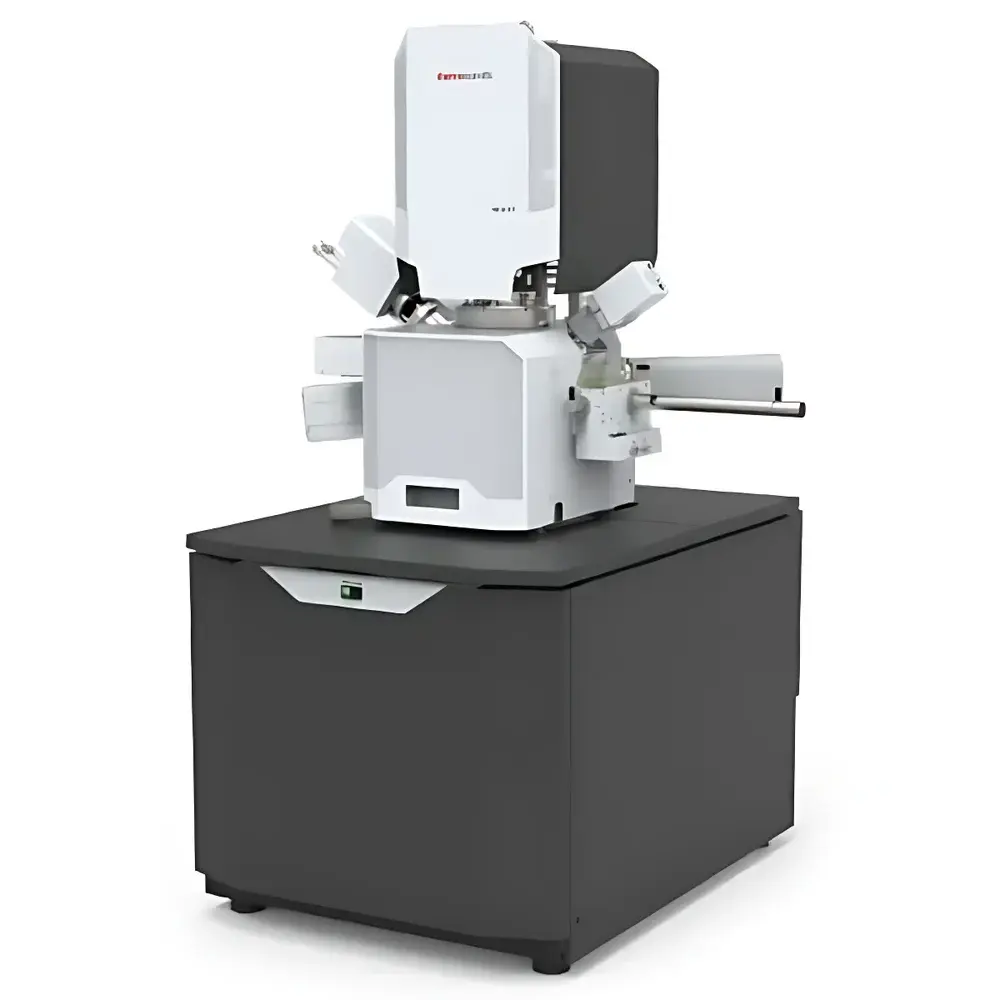
Thermo Fisher Apreo ChemiSEM Integrated Energy-Dispersive X-ray Spectroscopy Field-Emission Scanning Electron Microscope
| Brand | Thermo Fisher |
|---|---|
| Origin | Shanghai, China |
| Manufacturer Type | Authorized Distributor |
| Origin Category | Domestic (China-manufactured under Thermo Fisher global design & quality standards) |
| Model | Apreo ChemiSEM |
| Pricing | Available upon request |
Overview
The Thermo Fisher Apreo ChemiSEM is a high-performance field-emission scanning electron microscope (FE-SEM) engineered for routine and advanced materials characterization in academic research laboratories, semiconductor process development facilities, and industrial quality control environments. At its core, the system integrates a thermally assisted Schottky field-emission electron source with a patented Chroma-Lens™ column design—enabling simultaneous high-resolution imaging and quantitative energy-dispersive X-ray spectroscopy (EDS) analysis without signal compromise. Unlike conventional SEM-EDS configurations requiring sequential imaging and spectral acquisition, the Apreo ChemiSEM employs real-time, hardware-synchronized beam scanning and detector triggering to deliver spatially registered elemental maps at sub-10 nm probe sizes. Its dual-beam architecture supports both low-kV surface-sensitive imaging (<1 keV) and high-penetration compositional analysis (up to 30 keV), making it uniquely suited for heterogeneous samples ranging from nanoscale catalysts and battery electrode cross-sections to metallurgical alloys and polymer composites.
Key Features
- Chroma-Lens™ optical column with aberration-corrected condenser and objective lens systems, delivering <1.0 nm resolution at 15 kV and <1.4 nm at 1 kV (in-lens SE mode)
- Integrated Ultim Max 170 EDS detector with 170 mm² active area, large solid angle collection geometry, and silicon drift detector (SDD) technology enabling count rates >100,000 cps with <125 eV Mn-Kα energy resolution
- SmartScan™ automated acquisition suite: one-click alignment, auto-focus, auto-stigmation, and beam optimization across variable kV, WD, and magnification ranges
- ChemiSTEM™ real-time elemental mapping engine: pixel-by-pixel spectrum acquisition synchronized with stage motion, supporting live EDS map generation during acquisition
- Dual-mode detection: in-lens secondary electron (SE) and backscattered electron (BSE) detectors with adjustable contrast polarity and gain compensation
- Vacuum architecture with differential pumping stages and turbomolecular pumps ensuring <5×10⁻⁷ mbar chamber pressure during EDS acquisition—critical for light-element sensitivity (B, C, N, O)
Sample Compatibility & Compliance
The Apreo ChemiSEM accommodates standard 3.5″ (89 mm) diameter SEM stubs and custom holders up to 100 mm × 100 mm × 50 mm (W × D × H). It supports conductive, semi-conductive, and insulating specimens via optional low-vacuum mode (up to 100 Pa water vapor) or integrated charge compensation using low-energy electron flood gun. The system complies with IEC 61000-6-3 (EMC emissions), IEC 61000-6-2 (EMC immunity), and ISO 14644-1 Class 5 cleanroom-compatible operation. All EDS quantification workflows adhere to ASTM E1508 and ISO 16700 standards for wavelength- and energy-dispersive microanalysis. Full audit trail logging—including operator ID, instrument parameters, calibration history, and raw spectrum metadata—is maintained per FDA 21 CFR Part 11 and GLP/GMP requirements when used with Thermo Scientific Velox software.
Software & Data Management
Controlled exclusively through Thermo Scientific Velox 3.0 software, the Apreo ChemiSEM provides a unified interface for acquisition, processing, and reporting. Velox implements hierarchical project-based data storage compliant with DICOM-SEM extensions and supports direct export to HDF5, TIFF, and .emsa formats for third-party analysis (e.g., HyperSpy, DTSA-II). Quantitative EDS analysis includes ZAF and φ(ρz) matrix corrections, standardless and standard-based quantification, and phase identification via integrated Thermo Scientific Pathfinder library (containing >1,200 reference spectra). All processing steps are scriptable via Python API; batch operations (e.g., region-of-interest extraction, spectrum normalization, map stitching) are fully automatable and logged with timestamped provenance records.
Applications
- Materials science: grain boundary segregation analysis in Ni-based superalloys, oxide layer thickness measurement on Al anodized films, and interfacial chemistry mapping in perovskite solar cell stacks
- Electronics: failure analysis of solder joint voiding, Cu diffusion profiling in BEOL structures, and contamination identification on 300 mm wafers
- Geosciences: mineral phase discrimination in polished thin sections using BSE intensity + EDS ratio imaging
- Life sciences: correlative SEM-EDS of calcified tissue biopsies, including Ca/P molar ratio quantification and trace metal localization (e.g., Fe in ferritin aggregates)
- Quality assurance: rapid pass/fail screening of coating uniformity (e.g., Zn-Ni plating on automotive fasteners) via automated line-scan EDS profiles
FAQ
Is the Apreo ChemiSEM manufactured in Shanghai identical in specification to units produced in Europe or the US?
Yes. All Apreo ChemiSEM systems—regardless of final assembly location—are built to identical Thermo Fisher global engineering specifications, undergo identical factory acceptance testing (FAT), and ship with the same firmware, software licenses, and calibration certificates.
Can the system perform EDS analysis on uncoated biological samples?
Yes, under low-vacuum mode (10–100 Pa water vapor) with charge compensation enabled; however, for optimal light-element sensitivity and spatial resolution, sputter-coating with ≤2 nm carbon or chromium is recommended.
Does Velox software support multi-user role-based access control?
Yes. Velox 3.0 includes configurable user roles (Operator, Supervisor, Administrator) with granular permissions for method editing, report signing, and audit log review—fully compliant with 21 CFR Part 11 electronic signature requirements.
What maintenance intervals are recommended to ensure long-term EDS spectral stability?
Quarterly detector calibration verification using Co/Ni/Cu standards and annual full-column alignment by certified Thermo Fisher Field Service Engineers are advised. Preventive maintenance kits and remote diagnostics are available via Thermo Fisher Connect portal.




