
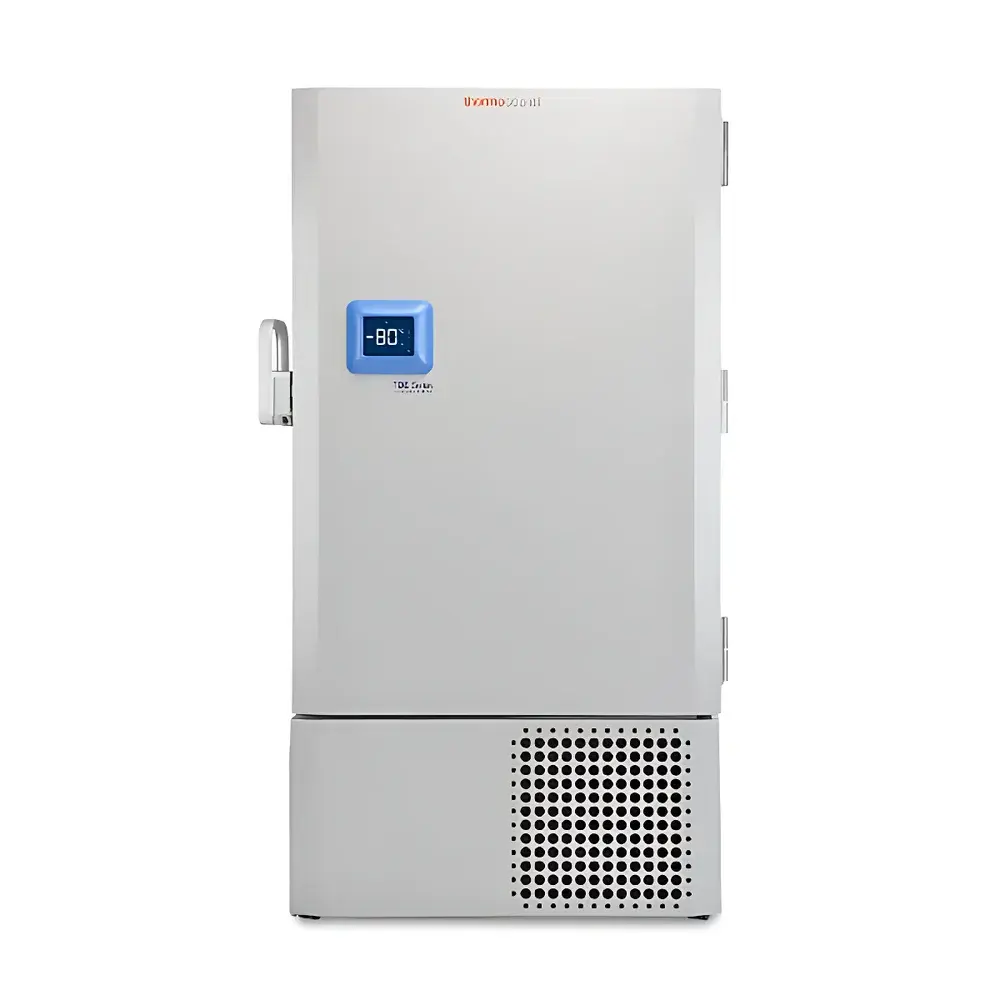
Thermo Scientific STP Series Ultra-Low Temperature Freezers
| Brand | Thermo Fisher Scientific |
|---|---|
| Origin | USA |
| Model | STP Series |
| Temperature Ranges | –40°C (upright), –80°C (upright and chest) |
| Refrigerants | R170 (ethane) and R290 (propane) |
| Power Consumption | As low as 4.4 kWh/day |
| Noise Level | ≤50 dB(A) |
| Insulation | Environmentally optimized polyurethane foam |
| Compliance | SNAP-approved, EU F-Gas Regulation compliant |
| Control System | HIC touchscreen interface |
| Standby Hold Time (unloaded, power off) | Extended duration per IEC 60068-2-1/2 testing protocols |
| Footprint Reduction | Up to 25% smaller floor area vs. prior-generation upright models |
| Ergonomic Design | Single-hand door operation, optimized handle geometry |
Overview
The Thermo Scientific™ STP Series Ultra-Low Temperature Freezers represent a next-generation platform engineered for long-term biological sample integrity, energy efficiency, and laboratory operational resilience. Built on a validated vapor-compression refrigeration architecture utilizing dual-stage cascade systems with natural hydrocarbon refrigerants (R170 and R290), these freezers maintain stable, uniform thermal environments across all storage zones—critical for preserving nucleic acids, primary cells, viral vectors, cryopreserved tissues, and GMP-grade biologics. Designed specifically for mission-critical applications in academic research laboratories, biobanks, contract development and manufacturing organizations (CDMOs), and cell and gene therapy (CGT) facilities, the STP Series meets stringent requirements for temperature stability (±2°C uniformity across chamber volume per ISO 13739:2012), rapid recovery (<15 minutes to reattain –80°C after 30-second door opening at 25°C ambient), and continuous monitoring readiness for GLP/GMP compliance.
Key Features
- Hydrocarbon-based refrigeration system compliant with U.S. EPA SNAP Program and EU F-Gas Regulation (Regulation (EU) No 517/2014), eliminating high-global-warming-potential (GWP) synthetic refrigerants.
- Advanced vacuum-insulated panel (VIP)-enhanced polyurethane foam cavity walls, delivering superior thermal resistance and extended hold time during unplanned power interruptions—validated per IEC 60068-2-1 (cold) and IEC 60068-2-2 (dry heat) test conditions.
- HIC (Human Interface Controller) touchscreen interface with multilingual support, real-time temperature logging, configurable alarm thresholds, and password-protected parameter access—designed for 21 CFR Part 11–ready audit trails when integrated with Thermo Fisher’s SampleManager LIMS or third-party validated data acquisition systems.
- Ergonomic upright and chest configurations featuring low-effort, single-hand door actuation mechanisms, recessed handles, and optimized internal shelving layouts to minimize operator fatigue and reduce cold air loss during routine sample access.
- Acoustic optimization achieving ≤50 dB(A) sound pressure level at 1 m distance—enabling installation in shared laboratory corridors or near sensitive instrumentation without acoustic interference.
- Reduced physical footprint: upright models occupy up to 25% less floor space than previous-generation equivalents, supporting high-density lab planning under LEED v4.1 BD+C and UK BREEAM laboratory certification frameworks.
Sample Compatibility & Compliance
The STP Series accommodates standard cryogenic storage formats including 2 mL cryovials (Nunc™, Corning®, Matrix™), 50 mL conical tubes, cryoboxes (10×10, 20×20 configurations), and programmable freezing racks for controlled-rate cell banking. All models are certified to ASTM F2697-22 (Standard Specification for Ultra-Low Temperature Freezers) and conform to IEC 61000-6-3 (EMC emission limits) and IEC 61000-6-2 (immunity requirements). For regulated environments, optional validation packages—including IQ/OQ documentation, temperature mapping reports (per ISO 14644-3), and alarm event log export—are available through Thermo Fisher’s Global Validation Services group. The units support integration into FDA-regulated workflows requiring electronic record retention, alarm acknowledgment logs, and user-access controls aligned with 21 CFR Part 11 Subpart B.
Software & Data Management
Embedded firmware supports local data storage of temperature history (1-second sampling interval, 30-day rolling buffer), door-open events, compressor cycle logs, and alarm status. Data export is enabled via USB-C port (CSV format) or optional Ethernet/Wi-Fi module for secure TLS 1.2–encrypted transmission to centralized monitoring platforms such as Thermo Fisher’s Unity™ Lab Management System or industry-standard BMS (Building Management Systems). Alarm escalation protocols include visual indicators, audible alerts (user-suppressible), relay outputs for external annunciators, and SMTP/SNMP notifications. All configuration changes and user logins are timestamped and recorded with unique operator IDs—ensuring full traceability required under ISO/IEC 17025 and CAP accreditation standards.
Applications
- Long-term archival storage of clinical biospecimens in biorepositories accredited to ISBER Best Practices and NCI Biorepository Guidelines.
- Cryopreservation of induced pluripotent stem cells (iPSCs), CAR-T cell products, and allogeneic tissue grafts under cGMP Annex 1 (2022) environmental control expectations.
- Stabilization of thermolabile reagents including CRISPR-Cas ribonucleoprotein complexes, modified mRNA, and lyophilized monoclonal antibodies during QC release testing.
- Supporting cold chain continuity in translational research cores where samples transition from preclinical models to IND-enabling toxicology studies.
- Backup cold storage for liquid nitrogen-based systems during scheduled maintenance or emergency dewar replenishment cycles.
FAQ
What refrigerants are used in the STP Series, and why were they selected?
The STP Series employs R170 (ethane) and R290 (propane)—naturally occurring hydrocarbons with zero ozone depletion potential (ODP) and global warming potentials (GWP) of 3.3 and 3.3, respectively. Their selection aligns with EPA SNAP Program approvals and EU F-Gas phase-down mandates while maintaining thermodynamic efficiency across –40°C to –80°C operating ranges.
Is remote monitoring and alarm notification supported out of the box?
Standard models include local HIC interface logging and relay outputs; Ethernet/Wi-Fi connectivity and cloud-based alerting require optional communication modules and configuration through Thermo Fisher’s Unity Lab Management software or compatible SCADA platforms.
Can the STP Series be validated for use in GxP environments?
Yes—comprehensive IQ/OQ documentation kits, temperature mapping protocols, and 21 CFR Part 11–compliant electronic signature options are available through Thermo Fisher’s Validation Services team upon request.
How does the STP Series achieve improved energy efficiency compared to prior models?
Through optimized compressor staging logic, reduced thermal bridging via VIP-enhanced insulation, lower fan power consumption, and adaptive defrost algorithms that minimize unnecessary heating cycles—collectively enabling as low as 4.4 kWh/day energy draw under IEC 62552-2 test conditions.
What is the minimum ambient temperature range for safe installation?
The STP Series is rated for reliable operation in ambient temperatures from +10°C to +32°C, with relative humidity ≤80% non-condensing—suitable for most climate-controlled laboratory spaces without supplemental HVAC augmentation.



