
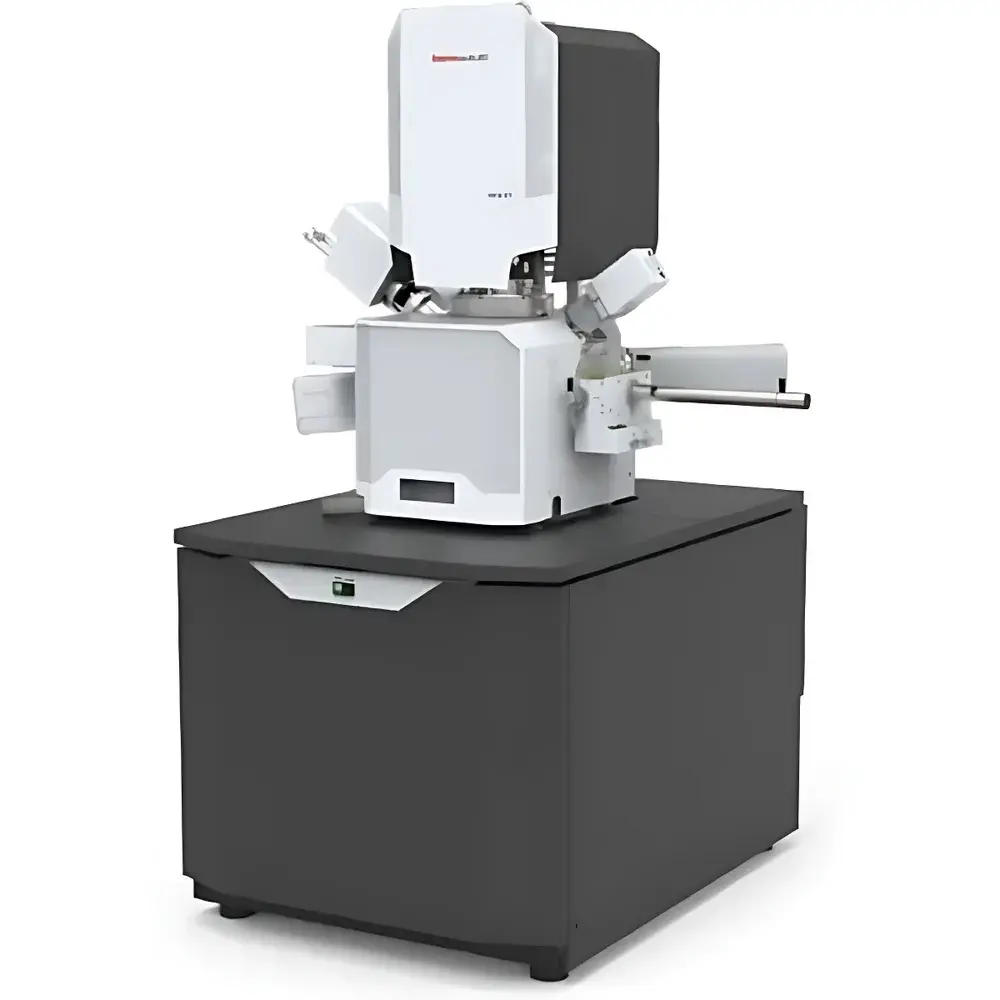
Thermo Scientific Apreo ChemiSEM Integrated Field-Emission Scanning Electron Microscope with EDS
| Brand | Thermo Fisher |
|---|---|
| Origin | Shanghai, China |
| Manufacturer Type | Authorized Distributor |
| Regional Classification | Domestically Assembled (China) |
| Model | Apreo ChemiSEM |
| Pricing | Available Upon Request |
Overview
The Thermo Scientific Apreo ChemiSEM is an integrated field-emission scanning electron microscope (FE-SEM) engineered for high-resolution imaging and simultaneous in situ elemental characterization. Built upon a high-brightness Schottky field-emission gun (FEG), the system delivers sub-nanometer resolution at low accelerating voltages (down to 1 kV), enabling high surface sensitivity and minimal charging on beam-sensitive or non-conductive samples. Its core innovation—ChemiSEM technology—embeds energy-dispersive X-ray spectroscopy (EDS) directly into the SEM control architecture, eliminating workflow discontinuities between imaging and microanalysis. Unlike conventional SEM-EDS workflows requiring manual stage repositioning, parameter switching, and separate software launches, ChemiSEM synchronizes beam scanning, detector acquisition, and spectral processing in real time. This architecture supports quantitative elemental mapping with pixel-resolved ZAF correction and live stoichiometric feedback—critical for materials science applications where phase identification, interfacial chemistry, and trace element distribution must be correlated spatially and quantitatively at the nanoscale.
Key Features
- Integrated ChemiSEM platform: Unified hardware and software architecture for concurrent high-resolution imaging and EDS analysis without mode switching or sample repositioning
- Smart Frame Integration (SFI): Adaptive frame averaging algorithm that dynamically optimizes dwell time and scan speed to maximize signal-to-noise ratio while preserving structural fidelity
- Automated focus & stigmation: AI-assisted routines leveraging contrast gradient analysis and beam convergence modeling to achieve optimal focus within seconds—even on rough or tilted surfaces
- High-efficiency EDS detection: Large-area silicon drift detector (SDD) with 100,000 cps throughput, coupled with pulse-processing electronics optimized for low-overlap peak deconvolution
- Beam deceleration optics: Enables landing energies as low as 100 eV for ultra-shallow interaction volume analysis, critical for thin-film, 2D material, and biological coating studies
- Modular expandability: Native support for optional EBSD, cathodoluminescence (CL), and STEM-in-SEM detectors via standardized vacuum interface and synchronized trigger protocols
Sample Compatibility & Compliance
The Apreo ChemiSEM accommodates standard 32 mm pin-mount stubs and 100 mm wafers (with optional stage), supporting bulk metals, ceramics, polymers, geological specimens, and coated biological tissues. Optional low-vacuum and environmental SEM (ESEM) modes extend usability to partially hydrated or outgassing samples. All EDS quantification routines comply with ISO 14785:2022 (microanalysis — quantification procedures for EDS) and ASTM E1508–22 (standard guide for quantitative elemental analysis by EDS). The system’s audit trail functionality—including user action logging, parameter versioning, and raw spectrum archiving—meets GLP and FDA 21 CFR Part 11 requirements when deployed in regulated QA/QC environments.
Software & Data Management
Acquisition and analysis are managed through Thermo Scientific Velox software—a modular, scriptable platform built on a Qt-based framework with native HDF5 data container support. Velox provides real-time EDS map generation with automatic background subtraction, peak identification (using NIST X-ray database), and matrix correction (ZAF or φ(ρz)). All processed maps, spectra, and metadata are stored in vendor-neutral .h5 files, ensuring long-term accessibility and third-party interoperability (e.g., with HyperSpy or DTSA-II). Software licensing includes remote diagnostics, firmware update notifications, and access to Thermo Fisher’s centralized knowledge base—including application notes on alloy segregation mapping, inclusion analysis per ASTM E45, and nanoparticle dispersion quantification.
Applications
- Metallurgy & failure analysis: Correlating grain boundary chemistry (e.g., Cr depletion in stainless steels) with crystallographic orientation via synchronized EDS/EBSD
- Advanced battery research: In situ lithium distribution mapping across cathode particle cross-sections under variable bias conditions
- Geoscience: Quantitative clay mineral identification and porosity-linked elemental partitioning in shale cores
- Electronics packaging: Intermetallic compound (IMC) thickness measurement and Sn/Pb/Cu stoichiometry verification at solder joint interfaces
- Nanomaterials development: Size-dependent composition profiling of core-shell nanoparticles using line-scan EDS with sub-5 nm step resolution
FAQ
Is the Apreo ChemiSEM fully manufactured in China?
No—the Apreo ChemiSEM platform is designed and engineered by Thermo Fisher Scientific in the Netherlands and the U.S.; the Shanghai facility performs final assembly, calibration, and quality verification under Thermo Fisher’s global manufacturing standards.
Does ChemiSEM support automated phase identification?
Yes—when combined with optional EBSD, Velox software enables automated phase mapping using integrated crystallographic and compositional databases (e.g., ICDD PDF-4+), with confidence index filtering and misorientation thresholding.
Can EDS spectra be exported for third-party quantification?
Yes—all raw spectra (.eds), processed maps (.h5), and acquisition parameters are exportable in open formats compatible with commercial (Oxford AZtec, EDAX TEAM) and open-source (PyXRF, HyperSpy) analysis tools.
What vacuum level is required for high-resolution EDS mapping?
Optimal EDS performance requires high vacuum (<1 × 10⁻⁵ Pa); however, the system maintains usable spectral resolution down to 1 × 10⁻³ Pa for rapid survey mapping of moderately outgassing samples.
Is remote operation supported for multi-user labs?
Yes—Velox supports secure remote desktop access via TLS-encrypted VNC, with role-based permissions (operator, analyst, administrator) and session logging aligned with ISO/IEC 27001 information security guidelines.




