
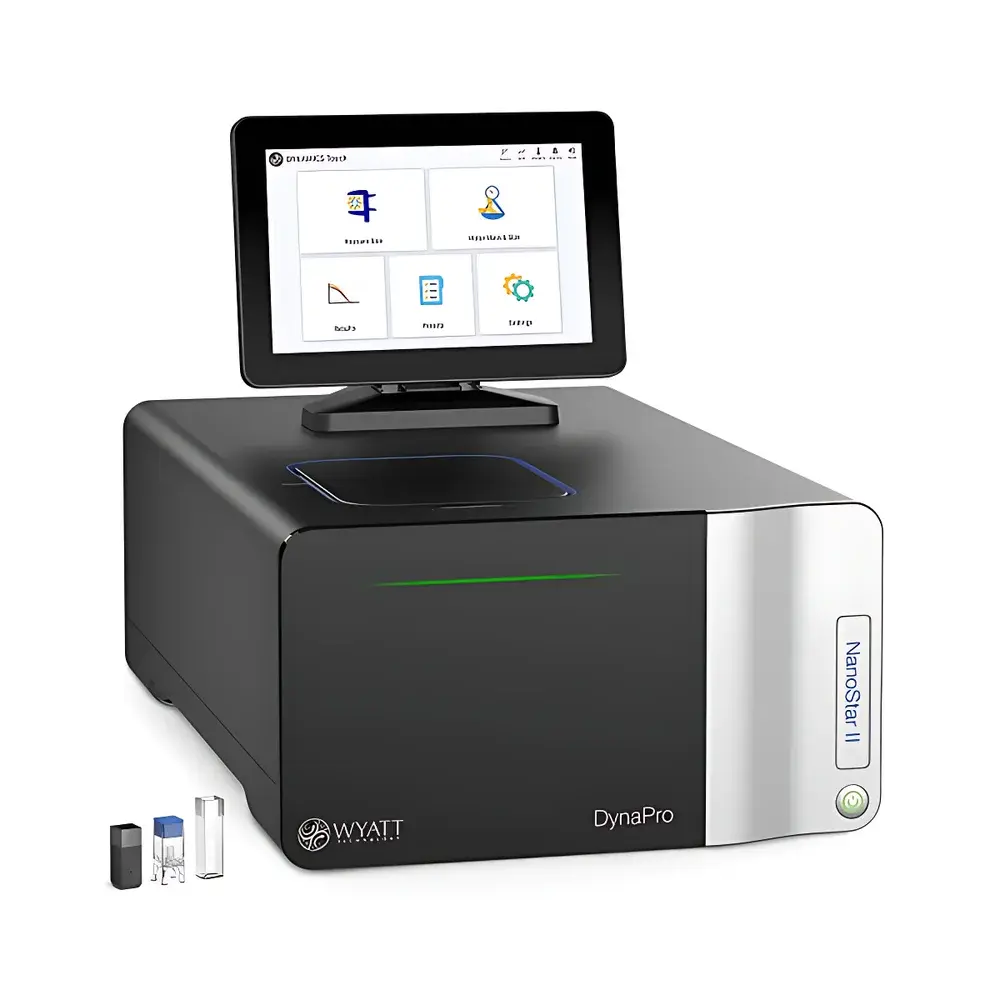
Wyatt NanoStar II Dynamic Light Scattering and Turbidimeter
| Brand | Wyatt |
|---|---|
| Origin | USA |
| Manufacturer | Wyatt Technology Corporation |
| Type | Benchtop Laboratory Instrument |
| Measurement Range | 1–80 NTU |
| Operating Temperature Range | −15 °C to +150 °C |
| Sample Volume | As low as 2 µL |
| Integrated Software | DYNAMICS Touch™ and DynaPro® NanoStar® |
Overview
The Wyatt NanoStar II is a benchtop optical measurement instrument engineered for simultaneous, high-precision dynamic light scattering (DLS), static light scattering (SLS), and turbidimetric analysis in a single, integrated platform. Unlike conventional turbidimeters or standalone DLS systems, the NanoStar II employs a cuvette-based optical architecture optimized for rigorous temperature-controlled measurements across a broad thermal range (−15 °C to +150 °C). Its core measurement principle relies on analyzing intensity fluctuations of scattered laser light (DLS) to determine hydrodynamic radius (Rh) and polydispersity index (PDI), while angularly resolved SLS data enable absolute molecular weight (Mw) determination via Debye or Zimm analysis. Concurrent turbidity quantification—reported in nephelometric turbidity units (NTU) over a calibrated 1–80 NTU range—provides orthogonal stability assessment by monitoring aggregation onset (Tonset), melting temperature (Tm), aggregation temperature (Tagg), second virial coefficient (A2), and diffusion interaction parameter (kD). This multi-parametric capability supports early-stage biopharmaceutical development, formulation screening, and quality-by-design (QbD) workflows where molecular integrity and colloidal stability must be evaluated under physiologically or process-relevant conditions.
Key Features
- Cuvette-based optical design enabling precise, reproducible DLS, SLS, and turbidity measurements in one instrument
- Integrated Peltier temperature control with ±0.1 °C stability across −15 °C to +150 °C—critical for thermal denaturation and aggregation studies
- Minimal sample requirement: compatible with volumes as low as 2 µL, reducing material consumption for precious biologics or synthetic nanoparticles
- Onboard DYNAMICS Touch™ software with intuitive touchscreen interface for real-time method setup, acquisition, and basic analysis without external PC dependency
- Full compatibility with desktop DynaPro® NanoStar® software for advanced data modeling—including cumulant analysis, CONTIN regularization, Debye/Zimm fitting, and aggregation kinetics profiling
- Robust mechanical architecture designed for laboratory environments with vibration-damped optical path and automated alignment verification
Sample Compatibility & Compliance
The NanoStar II accommodates standard 10 mm square quartz or glass cuvettes, supporting aqueous, organic, and mixed-solvent systems. It is routinely deployed in laboratories adhering to ICH Q5C, USP , ISO 7027, and ASTM D6506 standards for turbidity and particle size characterization. Data integrity is maintained through audit-trail-enabled software compliant with FDA 21 CFR Part 11 requirements when operated in validated configurations. The system supports GLP/GMP-aligned workflows via electronic signatures, user access controls, and secure raw data archiving. All calibration protocols—including NTU reference standards traceable to NIST SRM 2001—are documented per ISO/IEC 17025 guidelines.
Software & Data Management
DYNAMICS Touch™ provides immediate access to preconfigured methods for rapid turbidity screening, DLS sizing, and thermal ramp assays. Raw correlation functions, scattering intensity vs. angle, and time-resolved NTU traces are stored in vendor-neutral HDF5 format. The full-featured DynaPro® NanoStar® software enables batch processing, statistical comparison across sample sets, and export of results to CSV, PDF, or XML for LIMS integration. Advanced modules support custom model fitting (e.g., two-population DLS, non-ideal SLS), reporting templates aligned with regulatory submission formats (e.g., BLA, MAA), and automated pass/fail criteria based on user-defined thresholds for Rh, PDI, kD, or Tonset.
Applications
- Thermal stability profiling of monoclonal antibodies, fusion proteins, and viral vectors
- Excipient screening and buffer optimization for liquid formulations
- Aggregation kinetics and nucleation onset detection during accelerated stability studies
- Characterization of lipid nanoparticles (LNPs), polymeric micelles, and extracellular vesicles
- Batch-to-batch comparability assessment in QC release testing
- Supporting mechanistic understanding of protein–polymer interactions via A2 and kD determination
FAQ
Can the NanoStar II measure both turbidity and particle size from the same sample injection?
Yes. The instrument acquires DLS, SLS, and turbidity data sequentially or concurrently within a single cuvette run, eliminating inter-sample variability and minimizing handling errors.
Is the 2 µL minimum volume applicable across all measurement modes?
The 2 µL requirement applies specifically to DLS and turbidity measurements using micro-cuvettes; SLS at low angles may require ≥10 µL for optimal signal-to-noise ratio.
Does the system support GMP-compliant data handling?
When configured with DYNAMICS software in validated mode—including electronic signatures, role-based permissions, and full audit trail—the NanoStar II meets 21 CFR Part 11 and Annex 11 requirements.
How is turbidity calibration verified?
Calibration uses NIST-traceable formazin or polymer-based NTU standards; users can perform daily verification with supplied reference suspensions and document results within the software’s calibration log.
Can the NanoStar II operate unattended overnight?
Yes. Thermal ramps, multi-step protocols, and scheduled acquisitions can be queued and executed autonomously, with email alerts triggered upon completion or error detection.





