
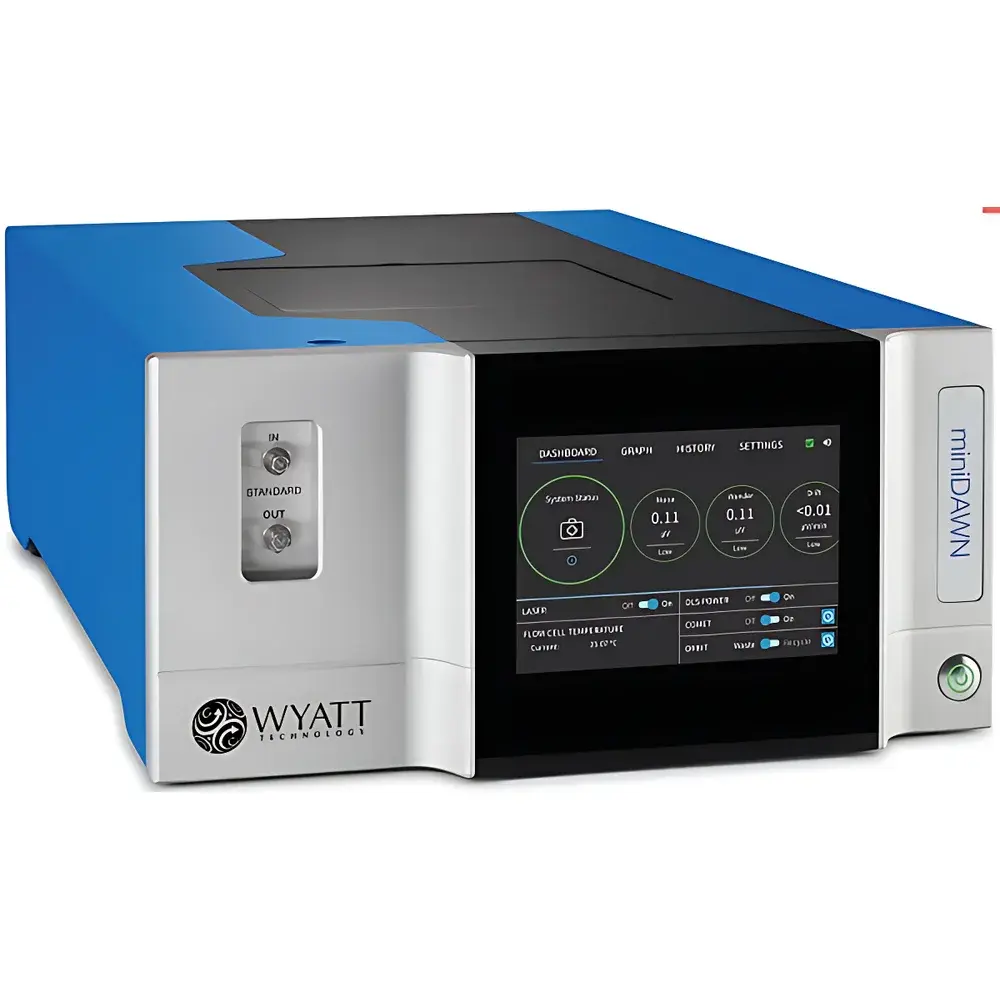
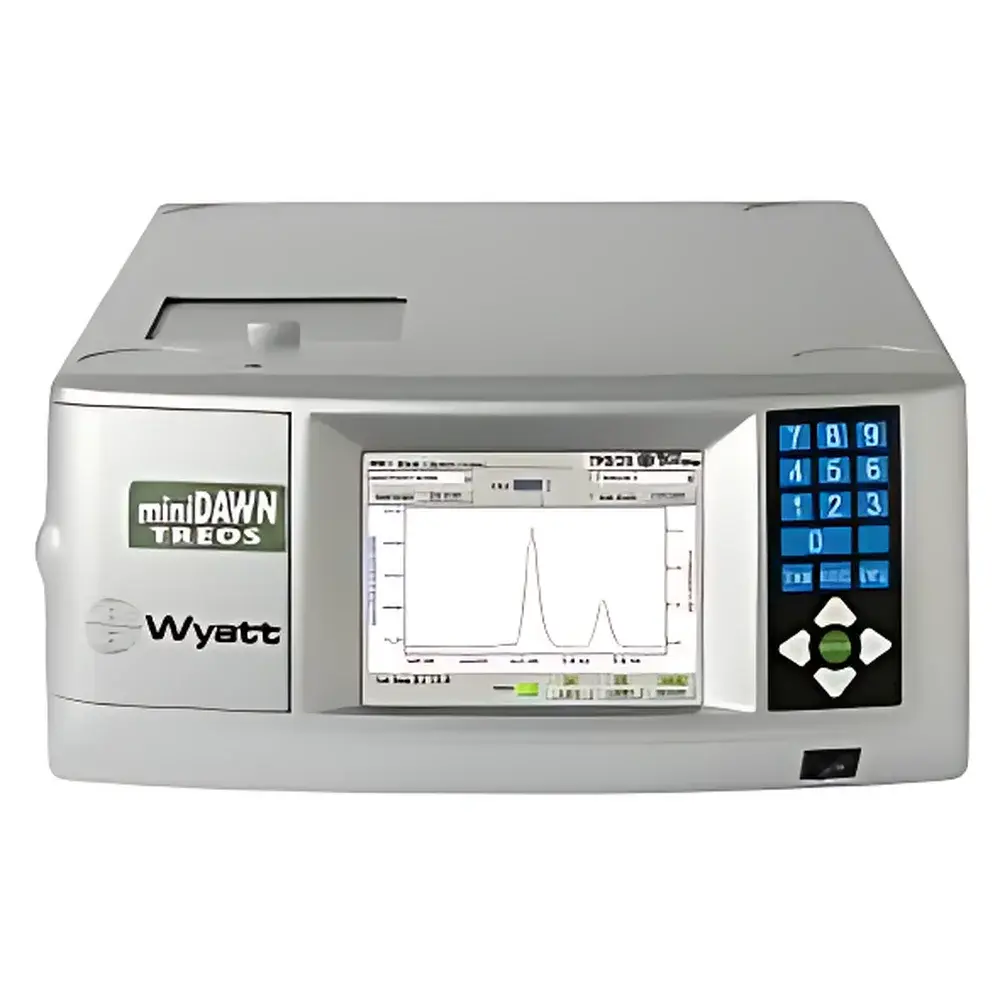
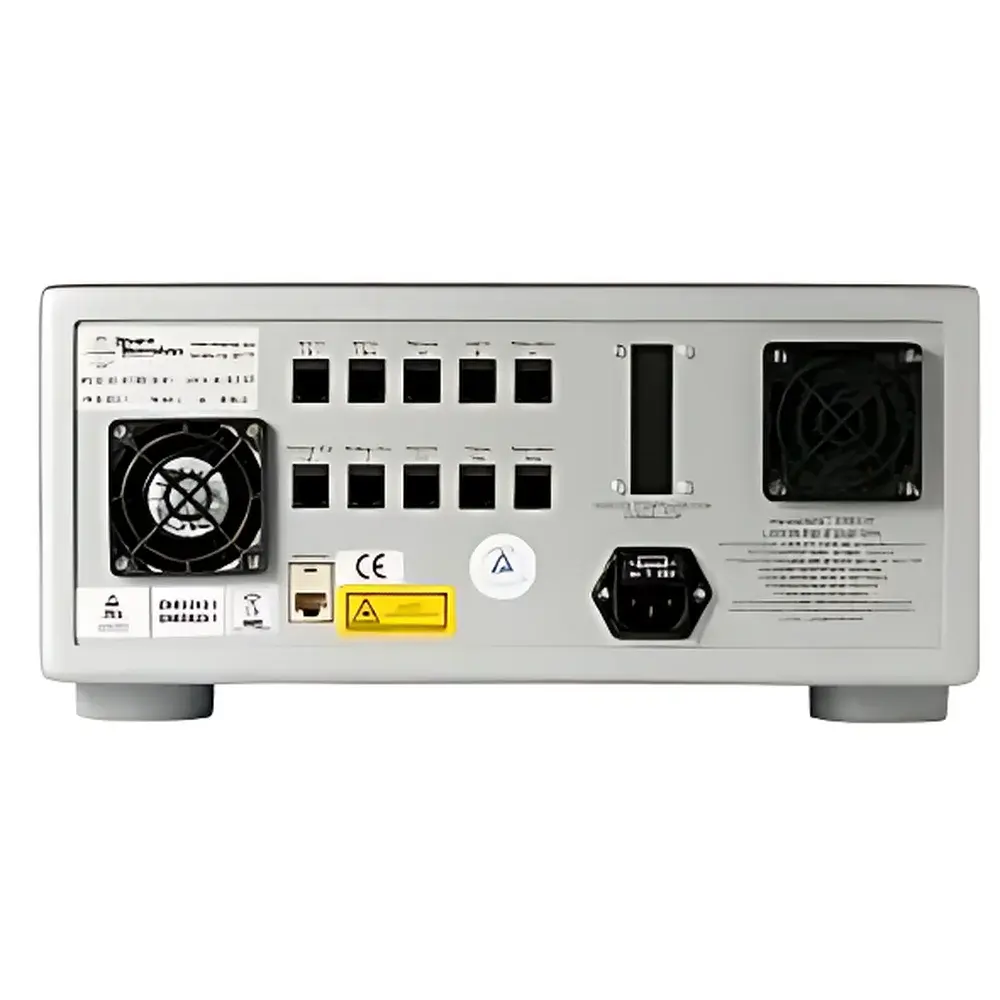
Wyatt miniDAWN Triple-Angle Light Scattering Detector for Gel Permeation Chromatography
| Brand | Wyatt |
|---|---|
| Origin | USA |
| Manufacturer | Wyatt Technology Corporation |
| Type | Imported Instrument |
| Model | miniDAWN |
| Instrument Category | Ambient-Temperature GPC/SEC Detector |
| Pump Flow Range | 0.001–10 mL/min |
| Pump Pressure Range | 0–40 MPa |
| RI Detector Drift | <3 × 10⁻⁷ RIU/h |
| RI Detector Cell Volume | 7 µL |
| UV Detector Wavelength Range | 190–600 nm |
| UV Detector Noise | <0.25 × 10⁻⁵ AU |
| Column Oven Temperature Range | Ambient to 85 °C |
| Scattering Angles | 3 (low-angle, 90°, high-angle) |
| Molecular Weight Range | 10³–10⁶ Da |
| Root-Mean-Square Radius (Rg) Range | 10–50 nm |
| Laser Source | 60 mW GaAs linearly polarized laser, 658 nm |
| Data Interface | Ethernet |
| Display | Full-color LCD |
Overview
The Wyatt miniDAWN is a precision triple-angle light scattering (MALS) detector engineered for integration with gel permeation chromatography (GPC) or size-exclusion chromatography (SEC) systems. It operates on the fundamental principle of static light scattering—measuring the angular dependence of scattered laser intensity to determine absolute molar mass (Mw), root-mean-square radius (Rg), and second virial coefficient (A2) without reliance on column calibration standards. Its three precisely aligned detection angles—low-angle (e.g., ~7°), orthogonal (90°), and high-angle (e.g., ~150°)—enable robust characterization across a broad dynamic range: from oligomeric proteins (~1 kDa) to highly branched polymers and virus-like particles exceeding 1 MDa. Dual reference-angle channels continuously monitor laser stability and optical alignment, ensuring long-term measurement integrity during extended SEC runs or kinetic studies. Designed for ambient-temperature operation, the miniDAWN is optimized for compatibility with standard HPLC/GPC platforms, including those equipped with UV, RI, and viscometric detectors.
Key Features
- Triple-angle detection architecture with real-time reference-angle monitoring for enhanced signal stability and drift compensation
- Integrated 658 nm, 60 mW linearly polarized GaAs laser with TEM00 beam profile for high signal-to-noise ratio and minimal multiple-scattering artifacts
- Simultaneous determination of weight-average molar mass (Mw), Rg, and A2 from a single SEC elution peak
- Ethernet-based digital data acquisition enabling synchronized, time-stamped communication with chromatography data systems (CDS)
- Compact, modular design with front-panel full-color LCD for immediate parameter verification and diagnostic feedback
- Optimized optical path geometry minimizing band-broadening effects and preserving chromatographic resolution
Sample Compatibility & Compliance
The miniDAWN supports aqueous and organic mobile phases compatible with common SEC columns (e.g., Agilent PLgel, Tosoh TSK-GEL, Malvern OMNISEC). It interfaces seamlessly with RI detectors (7 µL flow cell, drift <3 × 10⁻⁷ RIU/h) and UV detectors (190–600 nm, noise <0.25 × 10⁻⁵ AU), enabling multi-detector SEC analysis required by ASTM D5296, ISO 16014, and USP . When coupled with differential viscometry, it supports Mark–Houwink parameter derivation (k and α) for conformational analysis per ISO 4120. All firmware and data handling comply with FDA 21 CFR Part 11 requirements when used with compliant CDS software, supporting audit trails, electronic signatures, and secure user access control in GLP/GMP environments.
Software & Data Management
Data acquisition and analysis are performed using Wyatt’s ASTRA software—a validated platform supporting batch processing, baseline correction, band-broadening deconvolution, and Zimm, Debye, and Berry linear fits. ASTRA generates exportable reports conforming to ISO/IEC 17025 documentation standards, including uncertainty propagation for Mw and Rg. Raw scattering intensity files (.DAT) are stored in vendor-neutral ASCII format; metadata (angle configuration, laser power, temperature, flow rate) is embedded and machine-readable. Ethernet connectivity allows remote monitoring and integration into centralized laboratory informatics systems (LIMS) via OPC UA or RESTful API extensions.
Applications
- Determination of absolute molecular weight distributions of synthetic polymers, polysaccharides, and dendrimers without calibration curves
- Characterization of protein–ligand, protein–nucleic acid, and antibody–drug conjugate (ADC) stoichiometry and heterogeneity
- Quantification of branching density and conformational parameters (e.g., ρ = Rg/Rh) in polyolefins and copolymers
- Measurement of A2 for thermodynamic assessment of polymer solubility and formulation stability
- Time-resolved analysis of aggregation kinetics, degradation pathways, and shear-induced structural changes
- Support of regulatory submissions requiring orthogonal, first-principles molecular characterization per ICH Q5E and Q5C guidelines
FAQ
Can the miniDAWN be used without an SEC system?
Yes—it functions as a standalone batch-mode MALS instrument for solution characterization of purified samples, enabling measurement of Mw, Rg, and A2 in cuvette-based assays.
What is the minimum sample concentration required for reliable detection?
Typical lower limits range from 0.1–0.5 mg/mL depending on molar mass and dn/dc; for proteins >50 kDa, concentrations as low as 0.05 mg/mL may suffice with optimized signal averaging.
Does the miniDAWN support high-pressure applications?
It is designed for ambient-pressure SEC operation (up to 40 MPa pump pressure tolerance), but the detector flow cell itself operates at near-atmospheric backpressure; inline pressure regulation is recommended for UHPLC coupling.
How is alignment verified and maintained?
ASTRA includes automated alignment diagnostics; the dual reference angles provide continuous validation, and mechanical alignment is factory-set with no user-serviceable optics.
Is method transfer between instruments supported?
Yes—ASTRA’s method templates preserve all optical, flow, and fitting parameters; inter-instrument reproducibility is validated per ISO 5725-2 for precision and trueness across laboratories.
Related Products






