
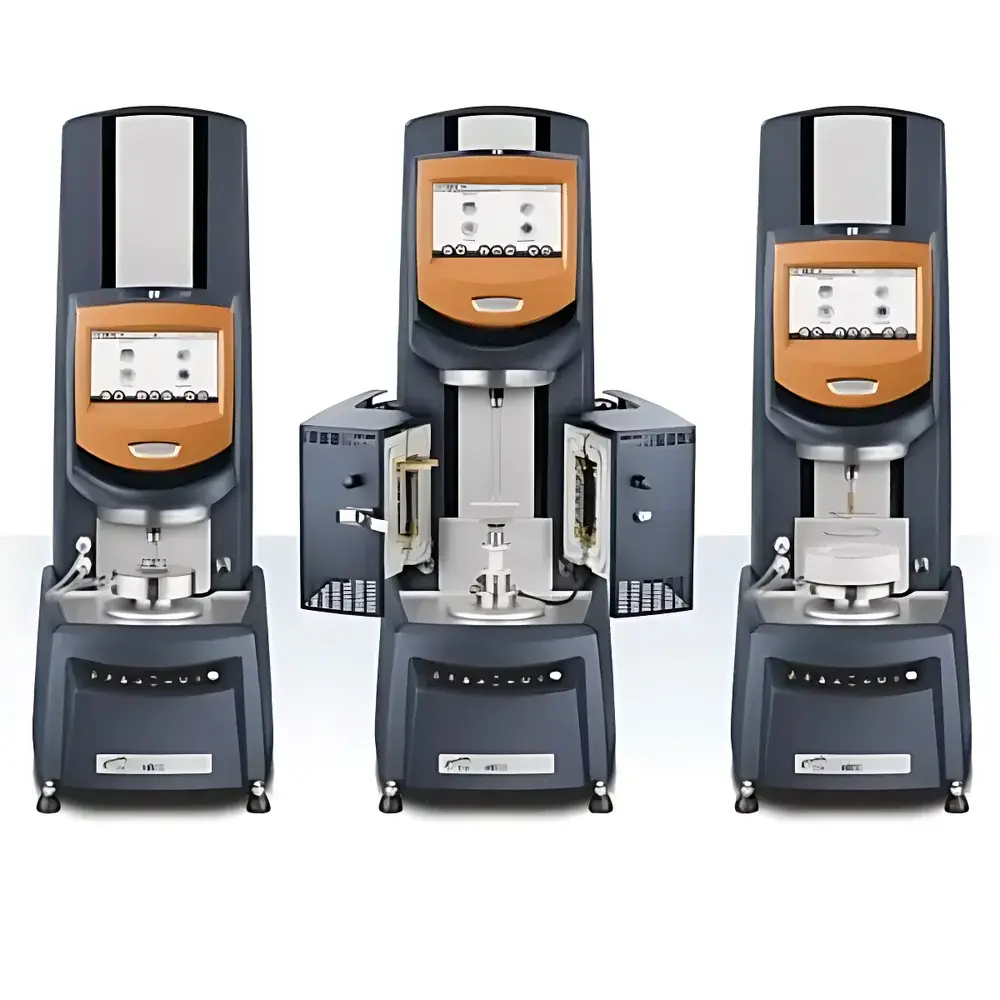
TA Instruments Discovery Hybrid Rheometer HR 10
| Brand | TA Instruments |
|---|---|
| Origin | USA |
| Manufacturer Type | Authorized Distributor |
| Product Category | Imported Instrument |
| Model | Discovery Hybrid Rheometer HR 10 |
| Instrument Type | Rotational Rheometer |
| Thrust Bearing | Magnetic Levitation Thrust Bearing |
| Temperature Range | −40 to 200 °C |
| Frequency Range | 1.0 × 10⁻⁷ to 100 Hz |
| Minimum Angular Velocity | 0 rad/s |
| Maximum Torque | 200 mN·m |
| Maximum Angular Velocity | 300 rad/s |
| Torque Resolution | 0.1 nN·m |
Overview
The TA Instruments Discovery Hybrid Rheometer HR 10 is an advanced rotational rheometer engineered for high-fidelity viscoelastic characterization of complex fluids and soft solids under precisely controlled thermal and mechanical conditions. Built upon a hybrid air-bearing motor-transducer architecture, it combines direct-drive torque control with real-time strain feedback to deliver exceptional accuracy across both steady-state and dynamic oscillatory measurements. Its core measurement principle relies on controlled shear deformation—via parallel-plate, cone-and-plate, or concentric cylinder geometries—to quantify material responses including storage modulus (G′), loss modulus (G″), complex viscosity (η*), yield stress, thixotropy, and time–temperature superposition behavior. Designed for research laboratories and industrial QC environments where reproducibility, thermal stability, and low-noise signal fidelity are critical, the HR 10 supports rigorous method development aligned with ASTM D4402, ISO 6721-10, and USP guidelines for rheological testing of pharmaceuticals, polymers, foods, and personal care formulations.
Key Features
- Hybrid Air-Bearing Architecture: Integrates a brushless DC motor with magnetic levitation thrust bearing to eliminate mechanical friction, enabling true zero-torque baseline stability and ultra-low torque resolution (0.1 nN·m) essential for weak gel and dilute polymer characterization.
- Wide Dynamic Range: Covers angular velocities from 0 rad/s (true stationary state) to 300 rad/s (≈2865 rpm), and oscillatory frequencies spanning seven decades (10⁻⁷–100 Hz), supporting both creep recovery and high-frequency small-amplitude oscillatory shear (SAOS) protocols.
- Extended Thermal Control: Compatible with Peltier-based temperature stages and liquid nitrogen cooling units, delivering precise temperature regulation from −40 °C to +200 °C with ±0.1 °C stability—critical for studying glass transitions, crystallization kinetics, and thermal degradation.
- Modular Geometry Support: Accepts standardized DIN/ISO-compliant fixtures—including 25 mm and 40 mm parallel plates, 1° and 2° cones, and Couette cells—with automated gap calibration and real-time normal force compensation.
- Real-Time Data Acquisition: 16-bit ADC sampling at up to 1 kHz ensures high-fidelity capture of transient responses such as step-strain relaxation, large amplitude oscillatory shear (LAOS), and multi-wave frequency sweeps.
Sample Compatibility & Compliance
The HR 10 accommodates a broad spectrum of sample types—from low-viscosity solvents and emulsions to highly filled suspensions, thermosetting resins, hydrogels, and molten thermoplastics. Its non-contact torque sensor design minimizes wall-slip artifacts in heterogeneous systems, while optional solvent trapping and humidity-controlled enclosures extend usability to volatile or hygroscopic materials. The instrument complies with international regulatory expectations for analytical instrumentation: data integrity features include electronic audit trails, user access levels, and secure method storage—all supporting adherence to FDA 21 CFR Part 11, EU Annex 11, and GLP/GMP documentation requirements when paired with TRIOS software in validated mode.
Software & Data Management
Controlled exclusively via TA Instruments’ TRIOS software platform (v10.x or later), the HR 10 offers intuitive workflow-driven experiment setup, automated calibration routines, and integrated data analysis modules for linear viscoelastic region (LVR) determination, Cole–Cole plot generation, Cox–Merz validation, and master curve construction using Williams–Landel–Ferry (WLF) or Arrhenius modeling. All raw and processed data are stored in vendor-neutral HDF5 format with embedded metadata (temperature, geometry, calibration constants), ensuring long-term traceability and interoperability with third-party analysis tools such as Python-based rheoPy or MATLAB-based RheoToolbox.
Applications
- Characterization of polymer melts and solutions for processing window definition and melt fracture prediction
- Rheokinetic analysis of UV-curable acrylates and epoxy formulations during in situ curing
- Yield stress mapping of drilling muds, cement pastes, and ceramic slips
- Structure–property relationships in biopolymer networks (e.g., gelatin, carrageenan, alginate)
- Quality control of injectable hydrogels and ophthalmic suspensions per USP and Ph. Eur. 2.9.35
- Time-resolved thixotropic recovery in paints, inks, and food products following shear cessation
FAQ
What distinguishes the HR 10 from conventional rotational rheometers?
The HR 10 employs a hybrid motor-transducer system with magnetic levitation thrust bearings, eliminating mechanical wear and enabling sub-nN·m torque resolution and true zero-velocity operation—capabilities not achievable with traditional gear- or belt-driven systems.
Can the HR 10 perform both controlled-stress and controlled-strain tests?
Yes. It operates in dual-control mode: stress-controlled for yield and fracture studies, and strain-controlled for linear viscoelasticity and LAOS, with seamless switching within a single experiment.
Is temperature calibration traceable to NIST standards?
All Peltier and environmental chamber options include factory-calibrated Pt100 sensors with documented NIST-traceable certificates; optional external calibration verification kits are available.
Does TRIOS software support automated compliance with 21 CFR Part 11?
Yes—when configured in “validated mode,” TRIOS provides role-based authentication, electronic signatures, immutable audit logs, and secure backup protocols required for regulated environments.
What maintenance is required for the magnetic levitation bearing?
None. The magnetic levitation thrust bearing is sealed and requires no lubrication, periodic alignment, or replacement over the instrument’s operational lifetime.



